Mathematics · Entrance exam Q&A · Unofficial

Grade 12 Mathematics (Natural) entrance exam questions and answers

Unofficial Natural stream Grade 12 Mathematics entrance exam questions from the Abrari study bank. 209 reviewed items across 2018 E.C., 2017 E.C., 2016 E.C., 2015 E.C. are in this subject. A sample with unofficial answers and explanations is on this page — practise the rest online. Not a government paper.

209 unofficial Mathematics questions in the public bank

2018 E.C. Mathematics questions

Unofficial stems, answers, and explanations from the Abrari bank. Years use the Ethiopian calendar.

Q1 · statistics (mean deviation)

Consider the data: 11, 13, 15, 17, 19, 21. Which one of the following is the mean deviation from the mean?
  1. A. 4
  2. B. 3.5
  3. C. 4.5
  4. D. 3
Worked solutionUnofficial

Unofficial keyed letter D. A full worked solution is not published for this item yet.

Unofficial — solved by Abrari, not an official EAES key.

Practice this subject

Q2 · coordinate geometry (parallel/perpendicular lines)

Consider the quadrilateral ABCD where A=(0,0)A=(0,0), B=(−1,1)B=(-1,1), C=(0,2)C=(0,2) and D=(2,2)D=(2,2). Which one of the following is true?
  1. A. CD is perpendicular to AB.
  2. B. BC is parallel to AD.
  3. C. CD is perpendicular to BE.
  4. D. AB is parallel to CD.
Worked solutionUnofficial

Unofficial keyed letter B. A full worked solution is not published for this item yet.

Unofficial — solved by Abrari, not an official EAES key.

Practice this subject

Q3 · functions (greatest integer function)

Consider the greatest integer function defined by f(x)=[x−1]f(x) = [x - 1]. Which of the following sets is the domain of ff?
  1. A. The set of rational numbers.
  2. B. The set of integers.
  3. C. The set of real numbers.
  4. D. The set of natural numbers.
Worked solutionUnofficial

Unofficial keyed letter C. A full worked solution is not published for this item yet.

Unofficial — solved by Abrari, not an official EAES key.

Practice this subject

Q4 · relations and functions

Which one of the following relations is a function?
  1. A. R={(x,y):x,y∈R and y2=x}R=\{(x,y): x,y \in \mathbb{R} \text{ and } y^2 = x\}
  2. B. R={(x,y):x,y∈R and ∣y∣=x}R=\{(x,y): x,y \in \mathbb{R} \text{ and } |y| = x\}
  3. C. R={(x,y):x,y∈R and y=x2}R=\{(x,y): x,y \in \mathbb{R} \text{ and } y = x^2\}
  4. D. R={(x,y):x,y∈R and y4=x}R=\{(x,y): x,y \in \mathbb{R} \text{ and } y^4 = x\}
Worked solutionUnofficial

Unofficial keyed letter C. A full worked solution is not published for this item yet.

Unofficial — solved by Abrari, not an official EAES key.

Practice this subject

Q6 · average rate of change

What is the average rate of change of y=f(x)y = f(x) with respect to xx on the interval [a,b][a, b]?
  1. A. f(b)+f(a)2\frac{f(b)+f(a)}{2}
  2. B. b−af(b)−f(a)\frac{b-a}{f(b)-f(a)}
  3. C. f(b)−f(a)2\frac{f(b)-f(a)}{2}
  4. D. f(b)−f(a)b−a\frac{f(b)-f(a)}{b-a}
Worked solutionUnofficial

Unofficial keyed letter D. A full worked solution is not published for this item yet.

Unofficial — solved by Abrari, not an official EAES key.

Practice this subject

Q7 · logarithmic equations

Which one of the following sets is the solution of log⁡3x+log⁡3(x−2)=1\log_3 x + \log_3 (x - 2) = 1?
  1. A. {−1,3}\{-1, 3\}
  2. B. {3}\{3\}
  3. C. {2}\{2\}
  4. D. {0,2}\{0, 2\}
Worked solutionUnofficial

Unofficial keyed letter B. A full worked solution is not published for this item yet.

Unofficial — solved by Abrari, not an official EAES key.

Practice this subject

Q9 · statistics (mode)

Consider the test results of 20 students in a given class.
13 14 14 15 19 18 13 15 16 16 13 14 14 15 19 18 13 15 16 16 17 18 15 13 14 16 14 18 16 16
Which one of the following numbers is the mode of the above data?
  1. A. 16
  2. B. 15
  3. C. 14
  4. D. 18
Worked solutionUnofficial

Unofficial keyed letter A. A full worked solution is not published for this item yet.

Unofficial — solved by Abrari, not an official EAES key.

Practice this subject

Q10 · vectors (addition)

Consider the figure given below.

[Figure: points A, B, C and D; arrow from A to B (vector AB), arrow from C to D (vector CD), and a segment joining C and A.]

Which one of the following vectors is equal to AB⃗+CD⃗+BC⃗\vec{AB} + \vec{CD} + \vec{BC}?
  1. A. CD⃗\vec{CD}
  2. B. AC⃗\vec{AC}
  3. C. AD⃗\vec{AD}
  4. D. BD⃗\vec{BD}
Worked solutionUnofficial

Unofficial keyed letter C. A full worked solution is not published for this item yet.

Unofficial — solved by Abrari, not an official EAES key.

Practice this subject

Q11 · equation of a line

Which one of the following equations represents a line that passes through the points (2,−1)(2, -1) and (−3,4)(-3, 4)?
  1. A. x+y−1=0x + y - 1 = 0
  2. B. x+y+1=0x + y + 1 = 0
  3. C. x−y−1=0x - y - 1 = 0
  4. D. x−y+1=0x - y + 1 = 0
Worked solutionUnofficial

Unofficial keyed letter A. A full worked solution is not published for this item yet.

Unofficial — solved by Abrari, not an official EAES key.

Practice this subject

Q12 · binomial theorem

What is the coefficient of x3y4x^3 y^4 in the expansion of (x−2y)7(x - 2y)^7?
  1. A. 35
  2. B. 70
  3. C. 560
  4. D. -280
Worked solutionUnofficial

Unofficial keyed letter C. A full worked solution is not published for this item yet.

Unofficial — solved by Abrari, not an official EAES key.

Practice this subject

10 of 56 unofficial 2018 E.C. questions on this page.

All 2018 E.C. stems: 2018 E.C. Mathematics (56)

2017 E.C. Mathematics questions

Unofficial stems, answers, and explanations from the Abrari bank. Years use the Ethiopian calendar.

Q6 · trigonometric graphs

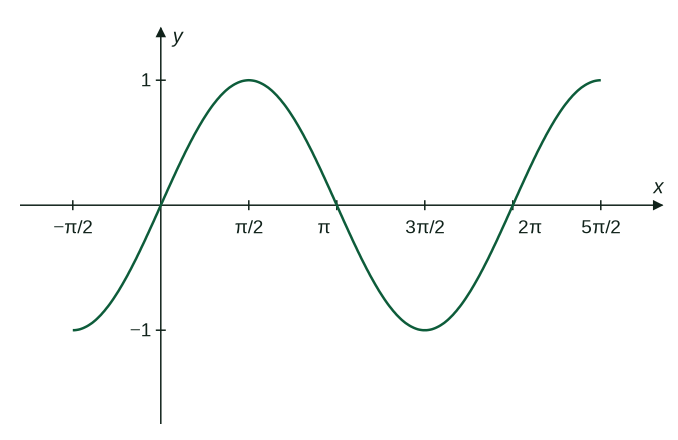
Consider the graph of a certain trigonometric function given below. Which one of the following functions represents the above graph for −π2≤x≤5π2-\frac{\pi}{2} \leq x \leq \frac{5\pi}{2}?
Figure for question 6 from the exam paper
  1. A. y=sec⁡xy = \sec x
  2. B. y=sin⁡xy = \sin x
  3. C. y=csc⁡xy = \csc x
  4. D. y=cos⁡xy = \cos x
Worked solutionUnofficial

Answer: B

Check key points on the graph:

  • At x=0x=0, y=0y=0.
  • At x=π2x=\tfrac{\pi}{2}, y=1y=1 (maximum).
  • At x=πx=\pi, y=0y=0.
  • At x=3π2x=\tfrac{3\pi}{2}, y=−1y=-1 (minimum).
  • At x=2πx=2\pi, y=0y=0.

These are exactly the values of sin⁡x\sin x: sin⁡0=0\sin 0=0, sin⁡π2=1\sin\tfrac{\pi}{2}=1, sin⁡π=0\sin\pi=0, sin⁡3π2=−1\sin\tfrac{3\pi}{2}=-1.

The curve is smooth and stays between −1-1 and 11, so it cannot be sec⁡x\sec x or csc⁡x\csc x, which have vertical asymptotes and values with ∣y∣≥1|y|\ge1.

Answer: B.

Why not A/C/D?

  • A. sec x has asymptotes at x = ±π/2, 3π/2, ... and never takes values between −1 and 1, but the graph passes through 0.
  • C. csc x is undefined at x = 0, π, 2π, yet the graph passes through 0 at exactly those points.
  • D. cos 0 = 1, but the graph passes through the origin (y = 0 at x = 0).

Unofficial — solved by Abrari, not an official EAES key.

Practice this subject

Q53 · vectors (addition)

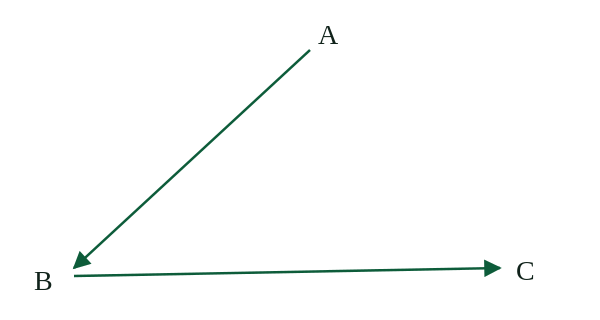
If two vectors V⃗=AB⃗\vec{V} = \vec{AB}, and U⃗=BC⃗\vec{U} = \vec{BC} are given as shown in the figure below. Then what is the vector V⃗+U⃗\vec{V} + \vec{U}?
Figure for question 53 from the exam paper
  1. A. AC⃗\vec{AC}
  2. B. BA⃗\vec{BA}
  3. C. CA⃗\vec{CA}
  4. D. CB⃗\vec{CB}
Worked solutionUnofficial

Answer: A

V⃗=AB⃗\vec V=\vec{AB} goes from A to B, and U⃗=BC⃗\vec U=\vec{BC} starts where V⃗\vec V ends. By the triangle law, when vectors are placed head to tail, their sum goes from the first tail to the last head: V⃗+U⃗=AB⃗+BC⃗=AC⃗\vec V+\vec U=\vec{AB}+\vec{BC}=\vec{AC} Answer: A.

Why not B/C/D?

  • B. BA⃗\vec{BA} is −V⃗-\vec V; it ignores U⃗\vec U and reverses V⃗\vec V.
  • C. CA⃗\vec{CA} is the right size but points the wrong way; it equals −(V⃗+U⃗)-(\vec V+\vec U).
  • D. CB⃗\vec{CB} is −U⃗-\vec U and ignores V⃗\vec V.

Unofficial — solved by Abrari, not an official EAES key.

Practice this subject

Q1 · power functions

Which one of the following function is NOT a power function?
  1. A. f(x)=x−35f(x) = x^{-\frac{3}{5}}
  2. B. f(x)=2x32f(x) = \sqrt{2} x^{\frac{3}{2}}
  3. C. f(x)=πx5f(x) = \pi x^5
  4. D. f(x)=(3)xf(x) = (\sqrt{3})^x
Worked solutionUnofficial

Unofficial keyed letter D. A full worked solution is not published for this item yet.

Unofficial — solved by Abrari, not an official EAES key.

Practice this subject

Q2 · derivatives

Let f(x)=(1−2x)12f(x) = (1 - 2x)^\frac{1}{2}. Then what is the values of f′(x)f'(x)?
  1. A. 11−2x\frac{1}{\sqrt{1 - 2x}}
  2. B. −121−2x\frac{-1}{2} \sqrt{1 - 2x}
  3. C. 121−2x\frac{1}{2} \sqrt{1 - 2x}
  4. D. −11−2x-\frac{1}{\sqrt{1 - 2x}}
Worked solutionUnofficial

Unofficial keyed letter D. A full worked solution is not published for this item yet.

Unofficial — solved by Abrari, not an official EAES key.

Practice this subject

Q3 · vectors

Which of the following statement describes the difference between scalar and vector quantities?
  1. A. Physical quantities that only have direction are scalars, while that have only magnitude are vectors.
  2. B. Physical quantities that only have magnitude are scalars, while that have both magnitude and direction are vectors.
  3. C. Physical quantities that only have magnitude are vectors, while that have both magnitude and direction are scalars.
  4. D. Physical quantities that only have direction are vectors, while that have both magnitude and direction are scalars.
Worked solutionUnofficial

Unofficial keyed letter B. A full worked solution is not published for this item yet.

Unofficial — solved by Abrari, not an official EAES key.

Practice this subject

Q4 · statistics (mean deviation)

Consider the following data: 1, 3, 7, 9, 11, 13, 18, 28. Then the coefficient of mean deviation about the median is equal to:
  1. A. 14\frac{1}{4}
  2. B. 85\frac{8}{5}
  3. C. 58\frac{5}{8}
  4. D. 12\frac{1}{2}
Worked solutionUnofficial

Unofficial keyed letter C. A full worked solution is not published for this item yet.

Unofficial — solved by Abrari, not an official EAES key.

Practice this subject

Q5 · real numbers

Which one of the following is an irrational number?
  1. A. 3.40003.4000
  2. B. 0.04\sqrt{0.04}
  3. C. 1.16222...1.16222...
  4. D. 29\sqrt{29}
Worked solutionUnofficial

Unofficial keyed letter D. A full worked solution is not published for this item yet.

Unofficial — solved by Abrari, not an official EAES key.

Practice this subject

Q7 · probability

Which one of the following statements defines favorable outcomes in a random experiment?
  1. A. The outcomes that insure the occurrence of a particular result.
  2. B. The outcomes containing all sample elements.
  3. C. The outcomes containing only one sample element.
  4. D. The outcomes that have equal chance of being chosen.
Worked solutionUnofficial

Unofficial keyed letter A. A full worked solution is not published for this item yet.

Unofficial — solved by Abrari, not an official EAES key.

Practice this subject

Q8 · logarithms

Given that log⁡4.8=0.6812\log 4.8 = 0.6812, log⁡6.93=0.8406\log 6.93 = 0.8406 and log⁡6.84=0.8351\log 6.84 = 0.8351, then what is the value of 48\sqrt{48}?
  1. A. 6.83
  2. B. 6.71
  3. C. 6.93
  4. D. 6.84
Worked solutionUnofficial

Unofficial keyed letter C. A full worked solution is not published for this item yet.

Unofficial — solved by Abrari, not an official EAES key.

Practice this subject

Q9 · polynomial operations

Let f(x)=x3+2x+1f(x) = x^3 + 2x + 1 and g(x)=x2+1g(x) = x^2 + 1 be given two polynomial functions. Then which of the following is true?
  1. A. f(x)g(x)=x2+1x−1\frac{f(x)}{g(x)} = \frac{x^2 + 1}{x - 1}
  2. B. f(x)+g(x)=x3+x2f(x) + g(x) = x^3 + x^2
  3. C. f(x)−g(x)=x3−x2+2xf(x) - g(x) = x^3 - x^2 + 2x
  4. D. f(x)g(x)=x5+x3+x2−2x−1f(x) g(x) = x^5 + x^3 + x^2 - 2x - 1
Worked solutionUnofficial

Unofficial keyed letter C. A full worked solution is not published for this item yet.

Unofficial — solved by Abrari, not an official EAES key.

Practice this subject

10 of 48 unofficial 2017 E.C. questions on this page.

All 2017 E.C. stems: 2017 E.C. Mathematics Natural (48)

2016 E.C. Mathematics questions

Unofficial stems, answers, and explanations from the Abrari bank. Years use the Ethiopian calendar.

Q7 · relations

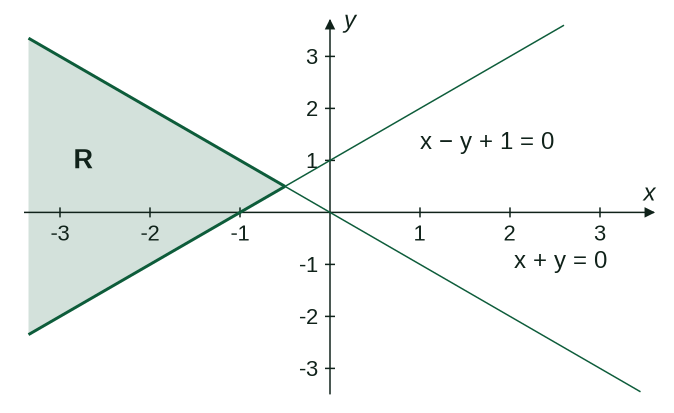
The shaded region in the following figure is the graph of a relation R. Which one of the following is the domain and range of R respectively?
Figure for question 7 from the exam paper
  1. A. (−∞,−12)(-\infty, -\frac{1}{2}) and R\mathbb{R}
  2. B. R\mathbb{R} and (−∞,−12)(-\infty, -\frac{1}{2})
  3. C. R\mathbb{R} and (−∞,−12](-\infty, -\frac{1}{2}]
  4. D. (−∞,−12](-\infty, -\frac{1}{2}] and R\mathbb{R}
Worked solutionUnofficial

Answer: D

Find where the two boundary lines meet. Substitute y=−xy=-x into x−y+1=0x-y+1=0: x+x+1=0⇒x=−12,y=12x+x+1=0 \Rightarrow x=-\tfrac12,\quad y=\tfrac12

R is the wedge to the left of this point, between y=x+1y=x+1 (below) and y=−xy=-x (above). The boundaries are solid lines, so the vertex (−12,12)(-\tfrac12,\tfrac12) belongs to R.

Domain: R contains points for every x≤−12x\le -\tfrac12 and none to the right, so the domain is (−∞,−12](-\infty,-\tfrac12].

Range: at a given xx, yy runs from x+1x+1 up to −x-x. As x→−∞x\to-\infty, x+1→−∞x+1\to-\infty and −x→+∞-x\to+\infty, so every real yy is reached. The range is R\mathbb{R}.

Answer: D.

Why not A/B/C?

  • A. It leaves out x=−12x=-\tfrac12, but the solid boundary lines (and their meeting point) belong to R.
  • B. It swaps domain and range and also uses an open interval.
  • C. It swaps domain and range: the xx-values are bounded at −12-\tfrac12, while the yy-values are all real numbers.

Unofficial — solved by Abrari, not an official EAES key.

Practice this subject

Q13 · linear-inequalities

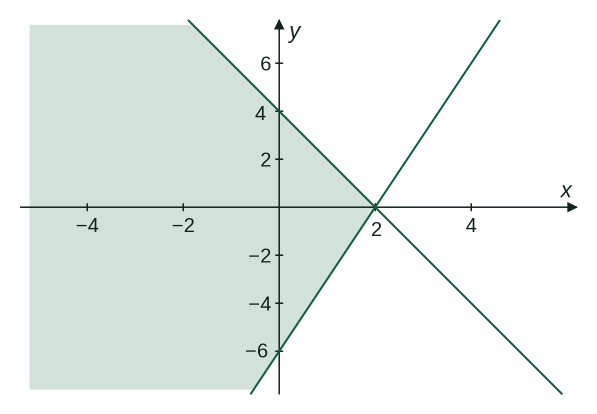
Given that a graph of a system of linear inequalities is shown below, which one of the following systems of linear inequalities is represented by the shaded region in the graph?
Figure for question 13 from the exam paper
  1. A. 2x+y≤42x + y \leq 4 and 3x−y≥63x - y \geq 6
  2. B. 2x+y≥42x + y \geq 4 and 3x−y≤63x - y \leq 6
  3. C. 2x+y≥42x + y \geq 4 and 3x−y≥63x - y \geq 6
  4. D. 2x+y≤42x + y \leq 4 and 3x−y≤63x - y \leq 6
Worked solutionUnofficial

Answer: D

The line through (0,4)(0,4) and (2,0)(2,0) has slope −2-2, so it is y=−2x+4y=-2x+4, that is 2x+y=42x+y=4. The line through (0,−6)(0,-6) and (2,0)(2,0) has slope 33, so it is y=3x−6y=3x-6, that is 3x−y=63x-y=6. The origin (0,0)(0,0) is in the shaded region, so use it as a test point. For 2x+y2x+y: 0≤40\le 4, so the region is 2x+y≤42x+y\le 4. For 3x−y3x-y: 0≤60\le 6, so the region is 3x−y≤63x-y\le 6. Answer: D.

Why not A/B/C?

  • A. 3x−y≥63x-y\ge 6 is the side to the right of the rising line, but the origin (which gives 0) is shaded.
  • B. 2x+y≥42x+y\ge 4 is the side above and right of the falling line, which does not contain the shaded origin.
  • C. Both inequalities point away from the origin, which would describe the unshaded region on the right.

Unofficial — solved by Abrari, not an official EAES key.

Practice this subject

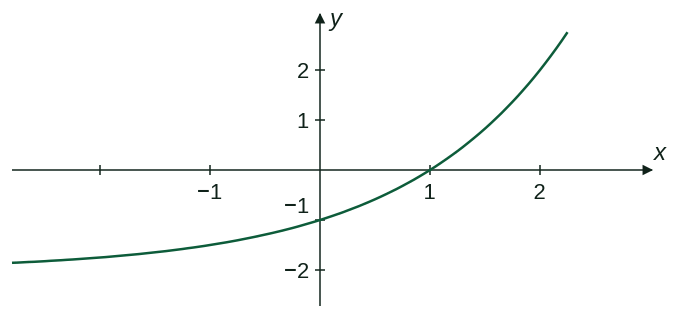
Q26 · exponential-functions

Consider the following graph of a given exponential function f(x). Which one of the following functions represents the graph shown above?
Figure for question 26 from the exam paper
  1. A. f(x)=(12)x−2f(x) = (\frac{1}{2})^x - 2
  2. B. f(x)=(12)x−2f(x) = (\frac{1}{2})^{x-2}
  3. C. f(x)=2x−2f(x) = 2^x - 2
  4. D. f(x)=2x−2f(x) = 2^{x-2}
Worked solutionUnofficial

Answer: C

The graph rises from left to right, so the base is greater than 1. That rules out the (12)(\frac12) options A and B.

Check the y-intercept. For C, 20−2=−12^0 - 2 = -1, which matches the graph. For D, 20−2=142^{0-2} = \frac14, which does not.

Check the x-intercept. For C, 21−2=02^1 - 2 = 0, so the curve crosses at x=1x = 1, as shown.

The graph also flattens toward y=−2y = -2 on the left, which is the asymptote of 2x−22^x - 2.

Answer: C.

Why not A/B/D?

  • A. (12)x−2(\frac12)^x - 2 is decreasing and its y-intercept is 1−2=−11 - 2 = -1, but the graph is increasing.
  • B. (12)x−2(\frac12)^{x-2} is decreasing, always positive, and has y-intercept 4. None of that matches.
  • D. 2x−22^{x-2} is always positive with y-intercept 14\frac14, so it never crosses the x-axis or reaches −1-1.

Unofficial — solved by Abrari, not an official EAES key.

Practice this subject

Q46 · quadratics

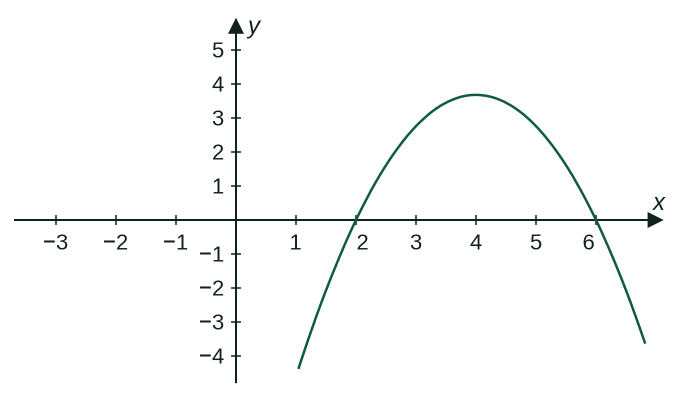
The figure shows the graph of a quadratic function f(x)=ax2+bx+cf(x) = ax^2 + bx + c. Which one of the following is the solution set of the inequality f(x)≤0f(x) \leq 0?
Figure for question 46 from the exam paper
  1. A. {x : x ≥ 2 and x ≤ 6}
  2. B. {x : x ≤ -4 or x ≥ 0}
  3. C. {x : x ≤ 2 or x ≥ 6}
  4. D. {x : x ≤ 0 and x ≥ -4}
Worked solutionUnofficial

Answer: C

The parabola opens downward and meets the x-axis at x=2x = 2 and x=6x = 6.

Between 2 and 6 the graph is above the x-axis, so f(x)>0f(x) > 0 there.

For x≤2x \le 2 or x≥6x \ge 6 the graph is on or below the x-axis, so f(x)≤0f(x) \le 0.

Solution set: {x:x≤2 or x≥6}\{x : x \le 2 \text{ or } x \ge 6\}.

Answer: C.

Why not A/B/D?

  • A. That is where f(x)≥0f(x) \ge 0 (the part above the axis), the opposite inequality.
  • B. It uses roots −4 and 0, which are not where this graph crosses the x-axis.
  • D. It uses the wrong roots (−4 and 0) and the 'between' interval.

Unofficial — solved by Abrari, not an official EAES key.

Practice this subject

Q57 · circles

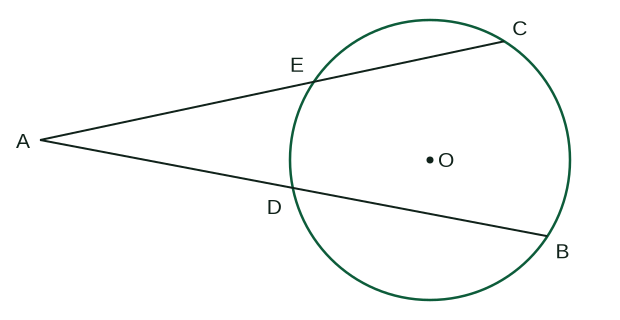
In the figure, O is the center of the circle and segments AB‾\overline{AB} and AC‾\overline{AC} intersect the circle at D and E respectively. If m(∠ACD)=30°m(\angle ACD) = 30° and m(∠BEC)=50°m(\angle BEC) = 50°, then which one of the following is equal to m(∠BAC)m(\angle BAC)?
Figure for question 57 from the exam paper
  1. A. 30°
  2. B. 80°
  3. C. 20°
  4. D. 70°
Worked solutionUnofficial

Answer: C

∠ACD=∠ECD\angle ACD = \angle ECD is an inscribed angle on arc EDED, so arc ED=2(30∘)=60∘ED = 2(30^\circ) = 60^\circ. ∠BEC\angle BEC is an inscribed angle on arc BCBC, so arc BC=2(50∘)=100∘BC = 2(50^\circ) = 100^\circ. For two secants from an outside point, the angle equals half the difference of the intercepted arcs: m(∠BAC)=12(100∘−60∘)=20∘m(\angle BAC) = \tfrac{1}{2}(100^\circ - 60^\circ) = 20^\circ (Check: in triangle ABEABE, the exterior angle ∠BEC=∠A+∠ABE\angle BEC = \angle A + \angle ABE, and ∠ABE=∠DCE=30∘\angle ABE = \angle DCE = 30^\circ, so ∠A=50∘−30∘=20∘\angle A = 50^\circ - 30^\circ = 20^\circ.)

Answer: C.

Why not A/B/D?

  • A. 30° is just ∠ACD itself, not the angle at A.
  • B. 80° adds the two given angles (50° + 30°) instead of subtracting.
  • D. 70° does not follow from the arcs; the arcs differ by 40°, and half of that is 20°, so 70° is a miscalculation (for example 180° − 50° − 60°).

Unofficial — solved by Abrari, not an official EAES key.

Practice this subject

Q1 · statistics

Which one of the following is true about the Range and Interquartile Range of a given data?
  1. A. Both are measures of the variability of each item in the data.
  2. B. Both are measures of variation of the data.
  3. C. Both are affected by extreme values in the data.
  4. D. Both are considering only the middle 50% of the data.
Worked solutionUnofficial

Unofficial keyed letter B. A full worked solution is not published for this item yet.

Unofficial — solved by Abrari, not an official EAES key.

Practice this subject

Q2 · binomial-theorem

Which one of the following numbers is the coefficient of x6y4x^{6}y^{4} in the expansion of (x+y)10(x + y)^{10}?
  1. A. 240
  2. B. 1260
  3. C. 210
  4. D. 4860
Worked solutionUnofficial

Unofficial keyed letter C. A full worked solution is not published for this item yet.

Unofficial — solved by Abrari, not an official EAES key.

Practice this subject

Q3 · solid-geometry

The altitude of a frustum of a regular square pyramid is 9 cm. What is the volume of the frustum if the side length of the upper base is 6 cm and the side length of the lower base is 10 cm?
  1. A. 196 cm3^3
  2. B. 324 cm3^3
  3. C. 588 cm3^3
  4. D. 108 cm3^3
Worked solutionUnofficial

Unofficial keyed letter C. A full worked solution is not published for this item yet.

Unofficial — solved by Abrari, not an official EAES key.

Practice this subject

Q5 · circles

A sector of a circle of diameter 8 cm is formed by a central angle of 45°. What is the area of the sector?
  1. A. (2π+8)(2\pi+8) cm²
  2. B. 2π2\pi cm²
  3. C. π\pi cm²
  4. D. 8π8\pi cm²
Worked solutionUnofficial

Unofficial keyed letter B. A full worked solution is not published for this item yet.

Unofficial — solved by Abrari, not an official EAES key.

Practice this subject

Q8 · polynomials

Which one of the following statements is the polynomial division theorem?
  1. A. If ff is a non-constant polynomial and cc is a real number, then x−cx - c is a factor of f(x)f(x) if and only if f(c)=0f(c) = 0.
  2. B. If f(x)f(x) and d(x)d(x) are polynomials such that d(x)≠0d(x) \neq 0 and deg⁡(d(x))≤deg⁡(f(x))\deg(d(x)) \leq \deg(f(x)), then there exist unique polynomials q(x)q(x) and r(x)r(x) such that f(x)=d(x)q(x)+r(x)f(x) = d(x)q(x)+r(x), where r(x)=0r(x) = 0 or deg⁡(r(x))<deg⁡(d(x))\deg(r(x)) < \deg(d(x)).
  3. C. If ff is a non-constant polynomial and cc is a real number, then the remainder when f(x)f(x) divided by x−cx - c is f(c)f(c).
  4. D. Rational root theorem statement.
Worked solutionUnofficial

Unofficial keyed letter B. A full worked solution is not published for this item yet.

Unofficial — solved by Abrari, not an official EAES key.

Practice this subject

10 of 54 unofficial 2016 E.C. questions on this page.

All 2016 E.C. stems: 2016 E.C. Mathematics Natural (54)

2015 E.C. Mathematics questions

Unofficial stems, answers, and explanations from the Abrari bank. Years use the Ethiopian calendar.

Q3 · Statistics (histogram)

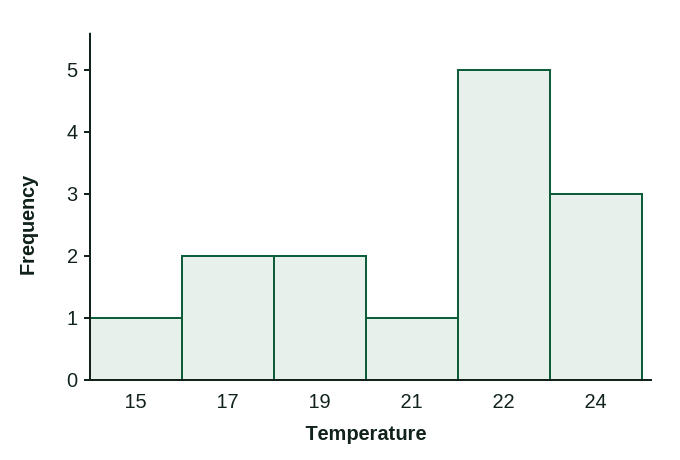
The histogram below shows the recorded temperature (in °C) of a certain town in Ethiopia for the first 15 days of March 2023. Then which one of the following statement is true about the data represented by the histogram?
Figure for question 3 from the exam paper
  1. A. The temperature was 24°C for two days.
  2. B. The mode of the data is 22°C.
  3. C. The highest frequency is 3-.
  4. D. For 45% of the days, the temperature was more than 19°C.
Worked solutionUnofficial

Answer: B

Read each bar: 15 → 1, 17 → 2, 19 → 2, 21 → 1, 22 → 5, 24 → 3.

The mode is the value with the highest frequency. The tallest bar is 22°C with frequency 5, so the mode is 22°C.

Check the others. 24°C has frequency 3, not 2. The highest frequency is 5, not 3.

Days above 19°C: 1+5+3=91 + 5 + 3 = 9, which is 915=60%\frac{9}{15} = 60\% (or 914≈64%\frac{9}{14} \approx 64\% using the bar total), not 45%.

Answer: B.

Why not A/C/D?

  • A. The 24°C bar has height 3, so that temperature was recorded on 3 days, not 2.
  • C. The tallest bar has height 5 (at 22°C), so the highest frequency is 5, not 3.
  • D. The days above 19°C are 1+5+3=91+5+3 = 9, which is about 60% of the days, not 45%.

Unofficial — solved by Abrari, not an official EAES key.

Practice this subject

Q15 · Volume of solids

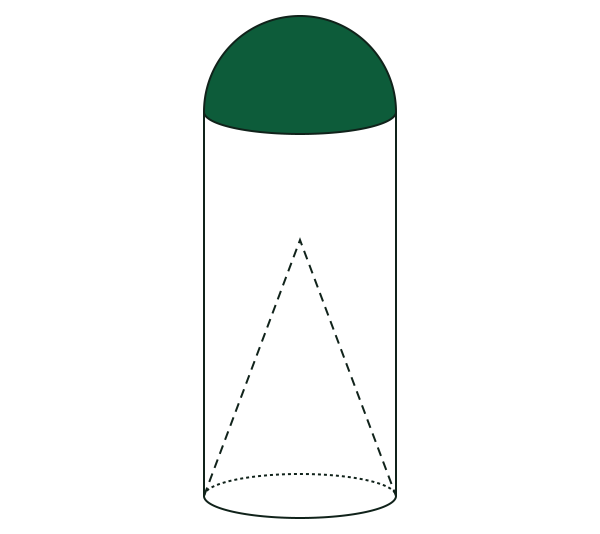
The object shown in the figure below is made of wood. Its top cover is a solid hemisphere and its bottom is a cylindrical part of base diameter 6cm and height of 12cm. From the bottom of the cylindrical part of height 8cm is cut off. Thus, what is the volume of the solid in cubic centimeter?
Figure for question 15 from the exam paper
  1. A. 102π
  2. B. 72π
  3. C. 96π
  4. D. 126π
Worked solutionUnofficial

Answer: A

Radius r=3r = 3 cm. Hemisphere: V1=23πr3=23π(27)=18πV_1 = \tfrac{2}{3}\pi r^3 = \tfrac{2}{3}\pi(27) = 18\pi. Cylinder: V2=πr2h=π(9)(12)=108πV_2 = \pi r^2 h = \pi(9)(12) = 108\pi. The dashed cone (base = bottom of the cylinder, height 8 cm) is cut out: V3=13πr2h=13π(9)(8)=24πV_3 = \tfrac{1}{3}\pi r^2 h = \tfrac{1}{3}\pi(9)(8) = 24\pi. V=18π+108π−24π=102π cm3V = 18\pi + 108\pi - 24\pi = 102\pi\ \text{cm}^3

Answer: A.

Why not B/C/D?

  • B. 72π is just a cylinder of height 8 cm (π·9·8) and ignores both the hemisphere and the actual shape.
  • C. 96π does not match the figure; it would come from errors such as leaving out the hemisphere and subtracting a 4 cm cone (108π − 12π).
  • D. 126π = 18π + 108π adds the hemisphere and full cylinder but forgets to remove the cone that was cut out.

Unofficial — solved by Abrari, not an official EAES key.

Practice this subject

Q36 · Limits

What is the value of lim⁡x→1x2−1x2+1\lim_{x \to 1} \frac{x^{2} - 1}{x^{2} + 1}?
  1. A. 3
  2. B. 1
  3. C. 2
  4. D. 0
Worked solutionUnofficial

Answer: D

The rational function x2−1x2+1\frac{x^{2}-1}{x^{2}+1} is defined at x=1x=1 because the denominator is 12+1=2≠01^{2}+1=2\neq 0. The limit is ordinary substitution.

lim⁡x→1x2−1x2+1=12−112+1=02=0.\lim_{x\to 1}\frac{x^{2}-1}{x^{2}+1}=\frac{1^{2}-1}{1^{2}+1}=\frac{0}{2}=0.

Letter D is 00.

Why not A/B/C?

  • A. 33 comes from adding the numerator and the denominator at x=1x=1 (or adding 1+21+2) instead of dividing 00 by 22.
  • B. 11 would be x2−1x2−1\frac{x^{2}-1}{x^{2}-1} or a mistaken 2/22/2. The denominator is x2+1x^{2}+1, so the value is 0/2=00/2=0.
  • C. 22 is the value of the denominator at x=1x=1, not the value of the fraction.

Unofficial — solved by Abrari, not an official EAES key.

Practice this subject

Q4 · Similar triangles

A 20m high building casts a shadow of 4m, at the same time a 35m tree casts a shadow of x m. What is the value of x?
  1. A. 8m
  2. B. 11m
  3. C. 7m
  4. D. 15m
Worked solutionUnofficial

Unofficial keyed letter C. A full worked solution is not published for this item yet.

Unofficial — solved by Abrari, not an official EAES key.

Practice this subject

Q5 · Pythagorean / displacement

A car started moving 9km to the East then moved 4 km to the North and then 12km towards West to reach its destination. How far the car it travelled from its starting point?
  1. A. 25km
  2. B. 12km
  3. C. 4km
  4. D. 5km
Worked solutionUnofficial

Unofficial keyed letter D. A full worked solution is not published for this item yet.

Unofficial — solved by Abrari, not an official EAES key.

Practice this subject

Q6 · Remainder theorem

When the polynomial P(x)=3x6+5x4−7x3+2kx2+3P(x) = 3x^{6} + 5x^{4} - 7x^{3} + 2kx^{2} + 3 is divided by (x + 1), the remainder is 4. What is the value of k?
  1. A. -5
  2. B. -7
  3. C. 3
  4. D. 6
Worked solutionUnofficial

Unofficial keyed letter B. A full worked solution is not published for this item yet.

Unofficial — solved by Abrari, not an official EAES key.

Practice this subject

Q8 · Quadratic functions

Which of the following statement is true about f(x)=x2−6x+10f(x) = x^{2} - 6x + 10?
  1. A. f(x)≥2f(x) \geq 2 for all x in the domain of f.
  2. B. The line x=1x = 1 is the axis of symmetry of the graph of f.
  3. C. The graph of f opens downward.
  4. D. The vertex of the graph of f is (3, 1).
Worked solutionUnofficial

Unofficial keyed letter D. A full worked solution is not published for this item yet.

Unofficial — solved by Abrari, not an official EAES key.

Practice this subject

Q9 · Area of regular polygon

What is the area of a regular hexagon inscribed in a circle of radius 6cm?
  1. A. 483 cm248\sqrt{3} \,\text{cm}^{2}
  2. B. 543 cm254\sqrt{3} \,\text{cm}^{2}
  3. C. 48 cm2
  4. D. 363 cm236\sqrt{3} \,\text{cm}^{2}
Worked solutionUnofficial

Unofficial keyed letter B. A full worked solution is not published for this item yet.

Unofficial — solved by Abrari, not an official EAES key.

Practice this subject

Q10 · Number theory

Which of the following defines a prime number?
  1. A. It is a number that has more than two positive factors.
  2. B. It is a number whose only factor is 1.
  3. C. It is a number that has only two positive factors.
  4. D. It is a number whose only factor is itself.
Worked solutionUnofficial

Unofficial keyed letter C. A full worked solution is not published for this item yet.

Unofficial — solved by Abrari, not an official EAES key.

Practice this subject

Q16 · Domain of functions

The domain of the function f(x)=2x23f(x) = 2x^{\frac{2}{3}} is
  1. A. R∖{0}\mathbb{R}\setminus\{0\}
  2. B. [0,∞)
  3. C. R\mathbb{R}
  4. D. (0, 2)
Worked solutionUnofficial

Unofficial keyed letter C. A full worked solution is not published for this item yet.

Unofficial — solved by Abrari, not an official EAES key.

Practice this subject

10 of 51 unofficial 2015 E.C. questions on this page.

All 2015 E.C. stems: 2015 E.C. Mathematics Natural (51)

Practise the rest of Mathematics online · Mathematics (Natural) model exam · All Mathematics papers

Grade 12 national exam · Model exam questions · 2016 E.C. all subjects · 2017 E.C. all subjects · 2018 E.C. all subjects · All past papers · Practice online

Frequently asked questions

Are these official Grade 12 Mathematics exam questions?
No. They are unofficial practice reconstructed from the Abrari study bank. Abrari is not affiliated with MoE, EAES, or NEAEA and does not publish official keys.
Are the answers official?
No. Letters and worked solutions are unofficial Abrari keys. Do not treat them as an official marking scheme.
Why is only a sample on this page?
This page shows a sample grouped by year. Open a year paper or start Mathematics practice to work the rest of the bank, timed, with the same unofficial explanations.
Do you sell leaked or paid exam papers?
No. Abrari does not host leaked exams, paid bank copies, or official answer keys.