Physics · Entrance exam Q&A · Unofficial

Grade 12 Physics entrance exam questions and answers

Unofficial Grade 12 Physics entrance exam questions from the Abrari study bank. 206 reviewed items across 2018 E.C., 2017 E.C., 2016 E.C., 2015 E.C. are in this subject. A sample with unofficial answers and explanations is on this page — practise the rest online. Not a government paper.

206 unofficial Physics questions in the public bank

2018 E.C. Physics questions

Unofficial stems, answers, and explanations from the Abrari bank. Years use the Ethiopian calendar.

Q1 · electrostatics / charging by induction

During a charging process by induction, a positively charged rod is brought close to a neutral metal sphere mounted on an insulated stand without touching it. Then, the metal sphere:
  1. A. becomes positively charged, whenever it is grounded.
  2. B. loses some electrons, whenever it is grounded.
  3. C. gains some electrons, whenever it is grounded.
  4. D. gains some protons whenever it is grounded.
Worked solutionUnofficial

Unofficial keyed letter C. A full worked solution is not published for this item yet.

Unofficial — solved by Abrari, not an official EAES key.
Practice this subject

Q2 · electrostatics / electroscope

A positively charged rod is brought near to a neutral electroscope A and a negatively charged rod is brought near to a neutral electroscope B. What will happen to the gold foils of the electroscopes? The gold foils of:
  1. A. both electroscopes attract each other.
  2. B. both electroscopes repel each other.
  3. C. electroscope A repels and that of B attracts each other.
  4. D. electroscope A attract and that of B repels each other.
Worked solutionUnofficial

Unofficial keyed letter B. A full worked solution is not published for this item yet.

Unofficial — solved by Abrari, not an official EAES key.
Practice this subject

Q3 · kinematics equations

A particle moving with a speed of v0v_0 to the right starts accelerating uniformly with acceleration aa. The total distance covered by the particle during the time interval tt is ss. Assuming the right direction is positive, which one of the following equations enables us to calculate the time tt in terms of v0v_0, aa and ss?
  1. A. t=−v0+v02+2asat = \dfrac{-v_0 + \sqrt{v_0^2 + 2as}}{a}
  2. B. t=−v0+v02+2as2at = \dfrac{-v_0 + \sqrt{v_0^2 + 2as}}{2a}
  3. C. t=v0+v02+2asat = \dfrac{v_0 + \sqrt{v_0^2 + 2as}}{a}
  4. D. t=v0−v02+2as2at = \dfrac{v_0 - \sqrt{v_0^2 + 2as}}{2a}
Worked solutionUnofficial

Unofficial keyed letter A. A full worked solution is not published for this item yet.

Unofficial — solved by Abrari, not an official EAES key.
Practice this subject

Q4 · kinematics / position-time graph

The figure shown below represents the position-time graph of uniformly accelerated ball in a straight line. The instantaneous velocity of the ball at point x is equal to:

[Figure: position (m) vs time (s) graph. A curve rises from position S1S_1 at time t1t_1 to S3S_3 at t3t_3; point x on the curve corresponds to position S2S_2 at time t2t_2.]
  1. A. the average velocity during the time interval between t1t_1 and t3t_3.
  2. B. the ratio of the position at x (s2s_2) to the time t2t_2.
  3. C. the total distance travelled to the total time, t3−t1t_3 - t_1.
  4. D. the slope of the tangent line at point x.
Worked solutionUnofficial

Unofficial keyed letter D. A full worked solution is not published for this item yet.

Unofficial — solved by Abrari, not an official EAES key.
Practice this subject

Q5 · elasticity / strain

A weight of 1000 N suspended from an aluminum wire of length 2.5 m causes a 4.0×10−34.0 \times 10^{-3} tensile strain on the wire. What is the change in length of the aluminum wire?
  1. A. 10 cm
  2. B. 0.01 cm
  3. C. 0.1 cm
  4. D. 1 cm
Worked solutionUnofficial

Unofficial keyed letter D. A full worked solution is not published for this item yet.

Unofficial — solved by Abrari, not an official EAES key.
Practice this subject

Q6 · electromagnetic induction / Lenz's law

For a coil placed in a variable magnetic field, Lenz's law states that the direction of the induced current in the coil is in such a way as to:
  1. A. oppose the flux change through the coil.
  2. B. make the flux through the coil zero.
  3. C. increase the flux through the coil.
  4. D. decrease the flux through the coil.
Worked solutionUnofficial

Unofficial keyed letter A. A full worked solution is not published for this item yet.

Unofficial — solved by Abrari, not an official EAES key.
Practice this subject

Q7 · electronics / transistor doping

Considering the concentration of dopants in different section of a transistors, which one of the following describes a correct order from lowest to highest?
  1. A. Collector, Base, Emitter
  2. B. Base, Collector, Emitter
  3. C. Emitter, Base, Collector
  4. D. Base, Emitter, Collector
Worked solutionUnofficial

Unofficial keyed letter B. A full worked solution is not published for this item yet.

Unofficial — solved by Abrari, not an official EAES key.
Practice this subject

Q8 · electronics / transistor configurations

Which of the following circuit diagrams correctly represents a transistor configurations that is used to get both current and voltage gain?

[Figure: four transistor circuits. Diagram A: NPN transistor, base B as input, collector C at the top (output), emitter E at the bottom connected to the common line. Diagram B: collector C on the left, emitter E on the right, base B at the bottom connected to the common line. Diagram C: base B on the left as input, emitter E at the top, collector C at the bottom connected to the common line. Diagram D: emitter E on the left, collector C on the right, base B at the bottom connected to the common line.]
  1. A. Diagram A
  2. B. Diagram B
  3. C. Diagram C
  4. D. Diagram D
Worked solutionUnofficial

Unofficial keyed letter A. A full worked solution is not published for this item yet.

Unofficial — solved by Abrari, not an official EAES key.
Practice this subject

Q9 · magnetic field of a straight wire

If the magnitude of magnetic field produced at a distance of 2 cm from a long straight current carrying wire is 1.2 T, then what is the magnitude of magnetic field at a distance of 3 cm from the wire?
  1. A. 0.6 T
  2. B. 1.2 T
  3. C. 0.8 T
  4. D. 1.8 T
Worked solutionUnofficial

Unofficial keyed letter C. A full worked solution is not published for this item yet.

Unofficial — solved by Abrari, not an official EAES key.
Practice this subject

Q10 · transformers

Suppose a 50 Hz outlet voltage of 10,000 V needs to be reduced to 220 V using a stepdown transformer. How many turns does the primary coil on the transformer have if the secondary coil has 110 turns?
  1. A. 550
  2. B. 5000
  3. C. 110
  4. D. 1000
Worked solutionUnofficial

Unofficial keyed letter B. A full worked solution is not published for this item yet.

Unofficial — solved by Abrari, not an official EAES key.
Practice this subject

10 of 55 unofficial 2018 E.C. questions on this page.

All 2018 E.C. stems: 2018 E.C. Physics (55)

2017 E.C. Physics questions

Unofficial stems, answers, and explanations from the Abrari bank. Years use the Ethiopian calendar.

Q10 · diode / rectification

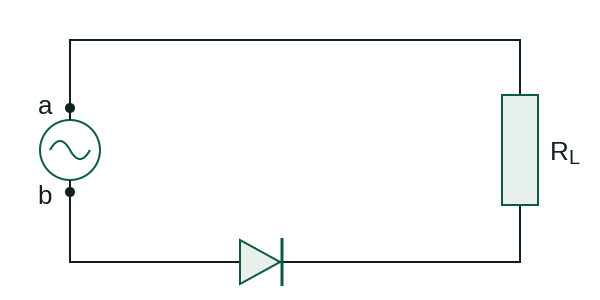
Consider a circuit containing a diode and load resistor (RL) connected to an AC voltage source. If initially, polarity of 'a' is positive while 'b' is negative,
Figure for question 10 from the exam paper
  1. A. During the second half-cycle, the diode is forward biased and current flows in the load resistor.
  2. B. During the first half-cycle, the diode is reverse biased and voltage is developed across the load resistor.
  3. C. During the first half-cycle, the diode is forward biased and voltage is developed across the load resistor.
  4. D. During the second half-cycle, the diode is reverse biased and no current flows in the load resistor.
Worked solutionUnofficial

Answer: A

A diode conducts only when current enters at the triangle (anode) and leaves at the bar (cathode). In the figure that means left to right along the bottom wire. First half-cycle (a +, b −): current would leave a, go across the top, down through RLR_L, and then leftward along the bottom wire. Leftward is bar-to-triangle, so the diode is reverse biased. No current flows, and no voltage is developed across RLR_L. Second half-cycle (b +, a −): current leaves b and goes rightward through the diode (triangle to bar), so the diode is forward biased. It then flows up through RLR_L and back to a, so current flows in the load. This is half-wave rectification: RLR_L conducts only during the second half-cycle. Answer: A.

Why not B/C/D?

  • B. The diode is indeed reverse biased in the first half-cycle, but then no current flows, so no voltage is developed across RLR_L.
  • C. With a positive, current would have to pass through the diode from bar to triangle, so the diode is reverse biased, not forward biased.
  • D. In the second half-cycle b is positive and drives current through the diode from triangle to bar, so it is forward biased and current does flow.

Unofficial — solved by Abrari, not an official EAES key.

Practice this subject

Q11 · inclined plane / mechanical advantage

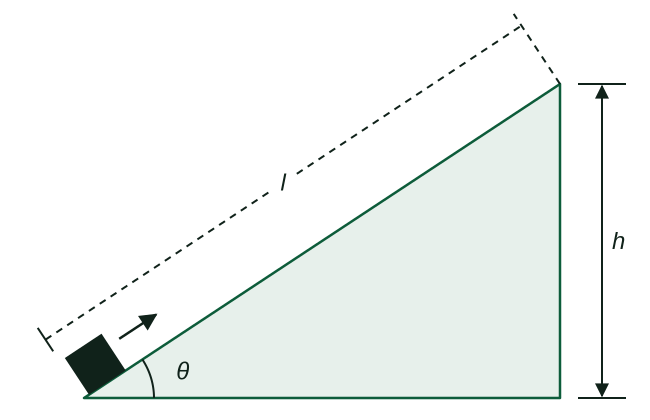
A force is used to push a box of mass, m along the slope of an inclined plane with constant velocity. If the coefficient of friction between the box and the inclined plane be μ, the actual mechanical advantage (AMA) of the inclined plane is
Figure for question 11 from the exam paper
  1. A. 1/(cos⁡θ+μsin⁡θ)1/(\cos \theta + \mu \sin \theta)
  2. B. 1/(sin⁡θ+μcos⁡θ)1/(\sin \theta + \mu \cos \theta)
  3. C. (cos⁡θ+μsin⁡θ)(\cos \theta + \mu \sin \theta)
  4. D. (sin⁡θ+μcos⁡θ)(\sin \theta + \mu \cos \theta)
Worked solutionUnofficial

Answer: B

At constant velocity, the push along the slope balances the component of gravity down the slope plus kinetic friction.

F=mgsin⁡θ+μmgcos⁡θ=mg(sin⁡θ+μcos⁡θ)F = mg\sin\theta + \mu mg\cos\theta = mg(\sin\theta + \mu\cos\theta)

The load being lifted is the weight mgmg.

AMA=loadeffort=mgmg(sin⁡θ+μcos⁡θ)=1sin⁡θ+μcos⁡θ\text{AMA} = \frac{\text{load}}{\text{effort}} = \frac{mg}{mg(\sin\theta + \mu\cos\theta)} = \frac{1}{\sin\theta + \mu\cos\theta}

Answer: B.

Why not A/C/D?

  • A. This mixes up sine and cosine. The gravity component along the slope is mgsin⁡θmg\sin\theta, and the friction is μmgcos⁡θ\mu mg\cos\theta.
  • C. This mixes up sine and cosine and also gives effort/load instead of load/effort.
  • D. This is effort divided by load (F/mgF/mg), the reciprocal of the AMA.

Unofficial — solved by Abrari, not an official EAES key.

Practice this subject

Q55 · kinematics / v-t graph

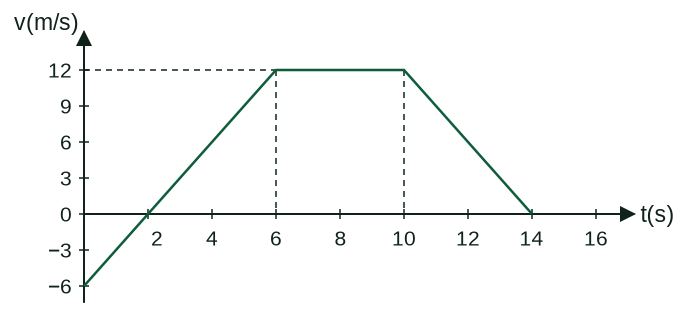
The velocity-time graph of an object moving in a straight line is shown. What is the magnitude of the total displacement covered by the object in the time interval of seconds?
Figure for question 55 from the exam paper
  1. A. 102 m
  2. B. 90 m
  3. C. 54 m
  4. D. 42 m
Worked solutionUnofficial

Answer: B

Displacement is the signed area under the v–t graph from 0 to 14 s.

0–2 s (below the axis): 12(2)(−6)=−6\tfrac{1}{2}(2)(-6) = -6 m.

2–6 s: 12(4)(12)=24\tfrac{1}{2}(4)(12) = 24 m. 6–10 s: 4×12=484 \times 12 = 48 m. 10–14 s: 12(4)(12)=24\tfrac{1}{2}(4)(12) = 24 m.

s=−6+24+48+24=90 ms = -6 + 24 + 48 + 24 = 90\ \text{m}

Answer: B.

Why not A/C/D?

  • A. 102 m adds the 6 m below the axis as positive; that is the total distance, not the displacement.
  • C. 54 m is the distance with the constant-velocity part (48 m) left out.
  • D. 42 m is the displacement with the constant-velocity part (48 m) left out.

Unofficial — solved by Abrari, not an official EAES key.

Practice this subject

Q56 · circular motion / conical pendulum

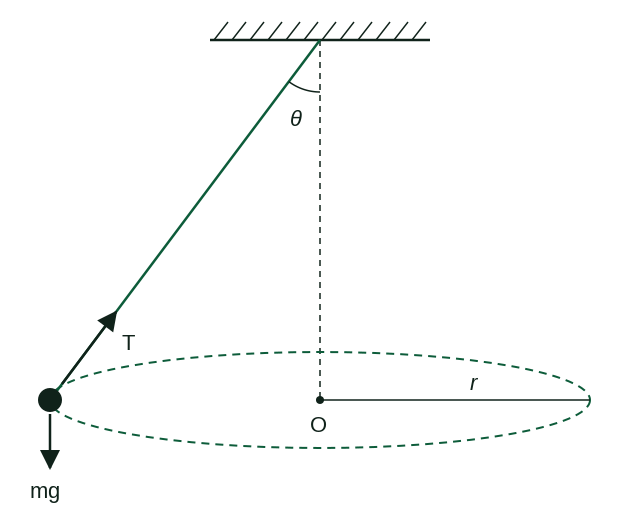
Suppose a particle of mass m is tied to a string and then whirled around in a horizontal circle of radius r about the center O. If the string makes an angle θ\theta to the vertical while rotating, the component of the force responsible for the circular motion of the mass providing the centripetal force is
Figure for question 56 from the exam paper
  1. A. Tsin⁡θT \sin \theta
  2. B. Tcos⁡θT \cos \theta
  3. C. mgsin⁡θmg \sin \theta
  4. D. mgcos⁡θmg \cos \theta
Worked solutionUnofficial

Answer: A

Only two forces act on the mass: the tension TT along the string and the weight mgmg downward.

The centripetal force must point horizontally toward the centre OO.

The weight is vertical, so it has no horizontal part. Split TT using the angle θ\theta from the vertical:

vertical component Tcos⁡θT\cos\theta (balances mgmg); horizontal component Tsin⁡θT\sin\theta (points toward OO).

So Tsin⁡θ=mv2rT\sin\theta = \dfrac{mv^2}{r} provides the centripetal force.

Answer: A.

Why not B/C/D?

  • B. Tcos⁡θT\cos\theta is the vertical component of tension, which balances the weight; it does not point toward O.
  • C. The weight mgmg is purely vertical, so it has no component toward the centre of a horizontal circle.
  • D. mgcos⁡θmg\cos\theta is not a horizontal force; the weight has no horizontal component here.

Unofficial — solved by Abrari, not an official EAES key.

Practice this subject

Q57 · moment of inertia

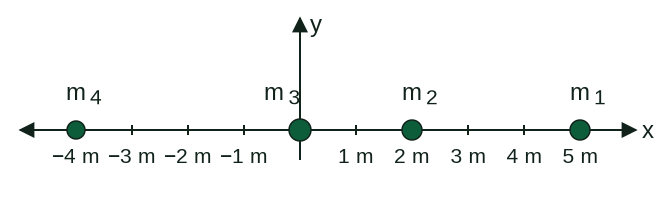
Four point masses m₁ = 4 kg, m₂ = 1 kg, m₅ = 3 kg, and m₄ = 5 kg are attached to a massless rod which lays on the x-axis. How much is the moment of inertia of the system about the y-axis?
Figure for question 57 from the exam paper
  1. A. 187 kg m²
  2. B. 184 kg m²
  3. C. 190 kg m²
  4. D. 84 kg m²
Worked solutionUnofficial

Answer: B

For point masses about the y-axis, I=∑mr2I = \sum m r^2, where rr is each mass's distance from the y-axis (its ∣x∣|x|).

  • m1m_1: 4(5)2=1004(5)^2 = 100
  • m2m_2: 1(2)2=41(2)^2 = 4
  • m3m_3: 3(0)2=03(0)^2 = 0 (it lies on the axis)
  • m4m_4: 5(4)2=805(4)^2 = 80 I=100+4+0+80=184 kg m2I = 100 + 4 + 0 + 80 = 184\ \text{kg m}^2

Answer: B.

Why not A/C/D?

  • A. 187 adds m3's 3 kg as if it were at 1 m; m3 sits on the y-axis and contributes nothing.
  • C. 190 does not match Σmr²; it comes from mis-adding or mis-placing a mass.
  • D. 84 leaves out m1's contribution of 100 kg m² (or uses only m2 and m4).

Unofficial — solved by Abrari, not an official EAES key.

Practice this subject

Q59 · Newton's second law / forces

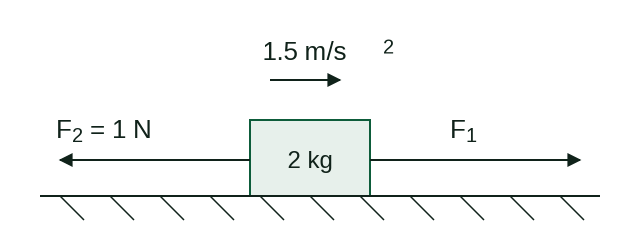
A 2 kg object accelerates with 1.5 m/s² to the right on a horizontal frictionless surface under the action of two horizontal forces, F₁ and F₂. What should be the magnitude of F₁?
Figure for question 59 from the exam paper
  1. A. 4 N
  2. B. 3 N
  3. C. 1 N
  4. D. 2 N
Worked solutionUnofficial

Answer: A

The surface is frictionless, so only F₁ (right) and F₂ (left) act horizontally. Take right as positive. Newton's second law gives F1−F2=maF_1-F_2=ma F1−1=2×1.5=3F_1-1=2\times1.5=3 So F1=4F_1=4 N. Answer: A.

Why not B/C/D?

  • B. 3 N is the net force mama; it forgets that F₁ must also cancel the 1 N F₂.
  • C. 1 N is the value of F₂, not F₁.
  • D. 2 N comes from subtracting F₂ from the net force (3−13-1) instead of adding it.

Unofficial — solved by Abrari, not an official EAES key.

Practice this subject

Q1 · simple machines

A force that is exerted on a simple machine in order to produce input work is called
  1. A. friction.
  2. B. load.
  3. C. effort.
  4. D. normal.
Worked solutionUnofficial

Unofficial keyed letter C. A full worked solution is not published for this item yet.

Unofficial — solved by Abrari, not an official EAES key.
Practice this subject

Q2 · waves

Which one of the following statements is correct about transverse and longitudinal waves?
  1. A. The directions of wave motion and vibration of the particles are parallel for transverse waves and perpendicular for longitudinal waves.
  2. B. Waves on a string are longitudinal whereas sound waves are transverse.
  3. C. The directions of wave motion and vibration of particles are parallel for longitudinal waves but perpendicular for transverse waves.
  4. D. A longitudinal wave comprises a series of crests and troughs, whereas a transverse wave comprises a series of compressions and rarefactions.
Worked solutionUnofficial

Unofficial keyed letter C. A full worked solution is not published for this item yet.

Unofficial — solved by Abrari, not an official EAES key.
Practice this subject

Q3 · fluids / buoyancy

An object that is partially or fully submerged in a fluid experiences an upward force from the fluid. The apparent weight of the object is the weight of the
  1. A. fluid it displaces.
  2. B. object in air minus the buoyant force.
  3. C. object in air.
  4. D. fluid it displaces minus the buoyant force.
Worked solutionUnofficial

Unofficial keyed letter B. A full worked solution is not published for this item yet.

Unofficial — solved by Abrari, not an official EAES key.
Practice this subject

Q4 · simple machines / efficiency

A wheel and axle of radii 40 cm and 8 cm, respectively, is used to lift a bucket of 6 kg of water from a well by applying an effort of 20 N on the wheel. The percentage efficiency of this simple machine is
  1. A. 60%
  2. B. 66.7%
  3. C. 30%
  4. D. 80%
Worked solutionUnofficial

Unofficial keyed letter A. A full worked solution is not published for this item yet.

Unofficial — solved by Abrari, not an official EAES key.
Practice this subject

10 of 57 unofficial 2017 E.C. questions on this page.

All 2017 E.C. stems: 2017 E.C. Physics (57)

2016 E.C. Physics questions

Unofficial stems, answers, and explanations from the Abrari bank. Years use the Ethiopian calendar.

Q7 · Electrostatics / Coulomb force

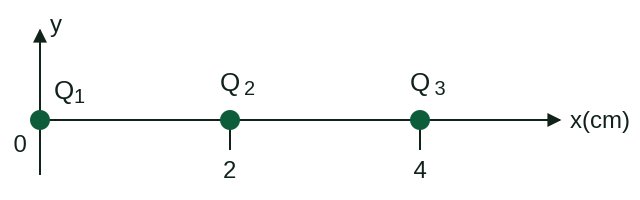
Three charges Q1 = 5 x 10⁻¹⁰ C, Q2 = 2 x 10⁻¹⁰ C and Q3 = 3 x 10⁻¹⁰ C, are placed on the x axis at points x = 0, x = 2 cm and x = 4 cm, respectively, as shown in the figure below. What is the magnitude of electrostatic force exerted on Q2 by the other two charges?
Figure for question 7 from the exam paper
  1. A. 3.6 x 10⁻⁶ N
  2. B. 9 x 10⁻⁷ N
  3. C. 9 N
  4. D. 9 x 10-15 N
Worked solutionUnofficial

Answer: B

Each distance is r=2r=2 cm =0.02=0.02 m, so r2=4×10⁻⁴r^2=4\times10^{-4} m². Force of Q₁ on Q₂ (repulsive, pushes Q₂ to the right): F12=(9×10⁹)(5×10⁻¹⁰)(2×10⁻¹⁰)4×10−4=2.25×10⁻⁶ NF_{12}=\frac{(9\times10^9)(5\times10^{-10})(2\times10^{-10})}{4\times10^{-4}}=2.25\times10^{-6}\ \text{N} Force of Q₃ on Q₂ (repulsive, pushes Q₂ to the left): F32=(9×10⁹)(3×10⁻¹⁰)(2×10⁻¹⁰)4×10−4=1.35×10⁻⁶ NF_{32}=\frac{(9\times10^9)(3\times10^{-10})(2\times10^{-10})}{4\times10^{-4}}=1.35\times10^{-6}\ \text{N} The two forces point in opposite directions, so Fnet=2.25×10⁻⁶−1.35×10−6=9×10⁻⁷F_{net}=2.25\times10^{-6}-1.35\times10^{-6}=9\times10^{-7} N, toward +x. Answer: B.

Why not A/C/D?

  • A. 3.6×10−63.6\times10^{-6} N adds the two forces, ignoring that they push Q₂ in opposite directions.
  • C. 9 N comes from leaving out the powers of ten on the charges (or the distance).
  • D. 9×10−159\times10^{-15} N comes from using r = 2 instead of 0.02 m (cm not converted to metres).

Unofficial — solved by Abrari, not an official EAES key.

Practice this subject

Q14 · Rotational motion / angular velocity

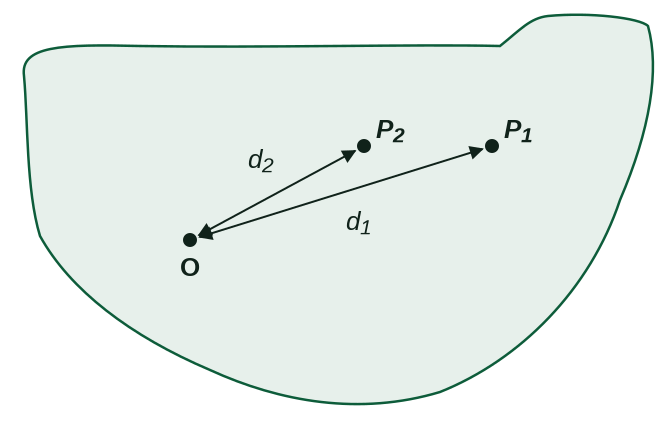
Two points P1 and P2 on a rigid body are located at different distances, d1 and d2 respectively, from the pivot point O as shown in the figure below. If a body is set to rotate about the pivot point O,
Figure for question 14 from the exam paper
  1. A. P2 completes a cycle before point P1.
  2. B. P1 and P2 have equal linear speed.
  3. C. P1 and P2 have equal angular velocity.
  4. D. P2 has greater linear speed than P1.
Worked solutionUnofficial

Answer: C

Every point on a rigid body turns through the same angle in the same time, so all points have the same angular velocity ω\omega. That means C is correct.

Linear speed is v=ωdv = \omega d. Since d1>d2d_1 > d_2, P1 moves faster than P2: v1>v2v_1 > v_2.

Both points finish a full turn together, because their period T=2π/ωT = 2\pi/\omega is the same.

Answer: C.

Why not A/B/D?

  • A. Both points have the same angular velocity, so they have the same period and finish each cycle together.
  • B. With v=ωdv = \omega d and d1≠d2d_1 \ne d_2, the linear speeds are different.
  • D. This is backwards. P1 is farther from O (d1>d2d_1 > d_2), so P1 has the greater linear speed.

Unofficial — solved by Abrari, not an official EAES key.

Practice this subject

Q30 · Fluid pressure / barometer

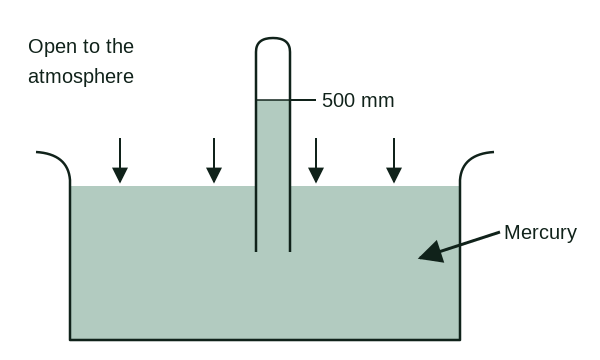
In order to measure atmospheric pressure in a given location, a student used a dish with mercury, a test tube of 4 mm radius closed at one end and a meter stick. The student inserted the open end of the tube in mercury inside the dish and left the dish open to the atmosphere as shown in the figure below. If the mercury was observed to be pushed up to raise in the tube by 500 mm, what is the atmospheric pressure in that location? (ρmercury = 13600 kg/m3)
Figure for question 30 from the exam paper
  1. A. 101 kPa
  2. B. 340 kPa
  3. C. 68 kPa
  4. D. 27 kPa
Worked solutionUnofficial

Answer: C

The atmosphere holds up the mercury column, so Patm=ρghP_{atm} = \rho g h.

h=500 mm=0.5 mh = 500\text{ mm} = 0.5\text{ m}, ρ=13600 kg/m3\rho = 13600\ \text{kg/m}^3, g=10 m/s2g = 10\ \text{m/s}^2.

P=13600×10×0.5=68 000 Pa=68 kPaP = 13600 \times 10 \times 0.5 = 68\,000\ \text{Pa} = 68\ \text{kPa}

The tube radius (4 mm) does not matter: the pressure of a column depends only on its height.

Answer: C.

Why not A/B/D?

  • A. 101 kPa is standard sea-level pressure (760 mm Hg), not the pressure for a 500 mm column.
  • B. 340 kPa is five times too large; it would need a 2.5 m column, not 0.5 m.
  • D. 27 kPa would need a column of only 0.2 m; it does not follow from ρgh with h = 0.5 m.

Unofficial — solved by Abrari, not an official EAES key.

Practice this subject

Q38 · Circuits / Kirchhoff current law

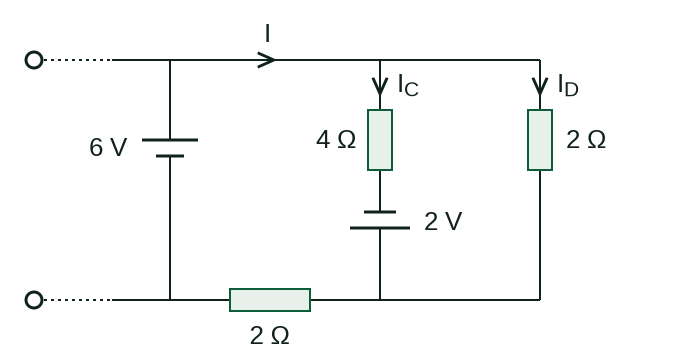
Measurements of the currents IC and ID is made for a part of a circuit given in the diagram. If I = 2 A is recorded, then which of the following is correct about the values of current IC and ID?
Figure for question 38 from the exam paper
  1. A. IC = 1.5 A and ID = 0.5 A
  2. B. IC = 2.5 A and ID = -0.5 A
  3. C. IC = 3 A and ID = -1 A
  4. D. IC = 1 A and ID = 1 A
Worked solutionUnofficial

Answer: D

Junction rule at the top: IC+ID=I=2I_C + I_D = I = 2 A.

The two branches connect the same two nodes, so they have the same potential difference VV between the top and bottom wires.

D branch: V=2IDV = 2I_D.

C branch: going down, the 4 Ω resistor drops 4IC4I_C, then the 2 V cell is crossed from − to +, which raises the potential by 2 V. So V=4IC−2V = 4I_C - 2.

Set them equal: 2ID=4IC−22I_D = 4I_C - 2. Substitute ID=2−ICI_D = 2 - I_C: 4−2IC=4IC−24 - 2I_C = 4I_C - 2, so IC=1I_C = 1 A and ID=1I_D = 1 A.

Answer: D.

Why not A/B/C?

  • A. 1.5 A and 0.5 A satisfy the junction rule, but the branch voltages would be 4(1.5)−2=44(1.5)-2 = 4 V and 2(0.5)=12(0.5) = 1 V, which are not equal.
  • B. 2.5 A and −0.5 A give branch voltages of 8 V and −1 V, which are not equal.
  • C. 3 A and −1 A give branch voltages of 10 V and −2 V, which are not equal.

Unofficial — solved by Abrari, not an official EAES key.

Practice this subject

Q49 · Center of mass

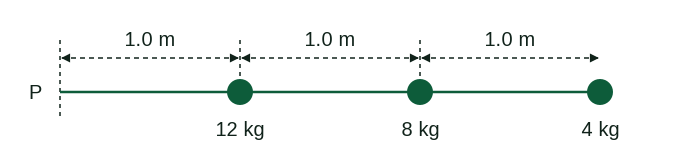
The system comprising three point masses is arranged as shown in the figure below. What is the distance of the center of mass of a system, from point P?
Figure for question 49 from the exam paper
  1. A. 1.67 m
  2. B. 0.67 m
  3. C. 2.33 m
  4. D. 1.00 m
Worked solutionUnofficial

Answer: A

Take P as the origin. The positions are x1=1.0x_1=1.0 m (12 kg), x2=2.0x_2=2.0 m (8 kg) and x3=3.0x_3=3.0 m (4 kg).

xcm=m1x1+m2x2+m3x3m1+m2+m3=12(1)+8(2)+4(3)12+8+4=4024≈1.67 mx_{cm}=\frac{m_1x_1+m_2x_2+m_3x_3}{m_1+m_2+m_3}=\frac{12(1)+8(2)+4(3)}{12+8+4}=\frac{40}{24}\approx1.67\ \text{m}

The centre of mass lies nearer the heavy 12 kg mass, as expected.

Answer: A.

Why not B/C/D?

  • B. 0.67 m measures from the 12 kg mass instead of from P (1.67 − 1.0).
  • C. 2.33 m measures from the 4 kg end instead of from P (3.0 − 0.67), or reverses the order of the masses.
  • D. 1.00 m is just the position of the 12 kg mass; it ignores the 8 kg and 4 kg masses.

Unofficial — solved by Abrari, not an official EAES key.

Practice this subject

Q1 · Units / torque

In the following choices, given that the symbols N, m, J, kg, stand for Newton, meter, Joule, and kilogram, respectively, then which one is the correct SI unit of torque?
  1. A. N
  2. B. kg m²
  3. C. N m = J
  4. D. N m ≠ J
Worked solutionUnofficial

Unofficial keyed letter C. A full worked solution is not published for this item yet.

Unofficial — solved by Abrari, not an official EAES key.
Practice this subject

Q2 · Waves (longitudinal)

Which one of the following waves is an example of longitudinal waves in material medium?
  1. A. Water wave at depth
  2. B. P-waves in earthquake
  3. C. Wave in a string
  4. D. S-waves in earthquake
Worked solutionUnofficial

Unofficial keyed letter B. A full worked solution is not published for this item yet.

Unofficial — solved by Abrari, not an official EAES key.
Practice this subject

Q4 · Gravitation / orbital & escape velocity

Which one of the following statements is correct about the difference between orbital and escape velocities of a satellite orbiting the Earth?
  1. A. Orbital velocity depends on the radius of the Earth, whereas escape velocity depends on the radius of the satellite's orbit.
  2. B. Escape velocity depends on the radius of the Earth, whereas orbital velocity depends on the radius of the satellite's orbit.
  3. C. Orbital velocity is inversely proportional to the radius of the Earth, whereas escape velocity is directly proportional to the radius of the Earth.
  4. D. Orbital velocity depends on the mass of the earth, whereas escape velocity depends on the mass of the satellite.
Worked solutionUnofficial

Unofficial keyed letter B. A full worked solution is not published for this item yet.

Unofficial — solved by Abrari, not an official EAES key.
Practice this subject

Q5 · AC/DC generators

Which one of the following statements is correct about actions of A.C. and D.C. generators?
  1. A. The voltage output of D.C. generators varies periodically whereas the voltage output of A.C generator is constant.
  2. B. The current outputs of both generator A.C. and D.C. generator have constant values.
  3. C. The voltage induced by A.C. generator reverses its direction periodically whereas by the D.C. generators has a constant value.
  4. D. The current outputs of both A.C. and D.C. generators reverse their directions periodically.
Worked solutionUnofficial

Unofficial keyed letter C. A full worked solution is not published for this item yet.

Unofficial — solved by Abrari, not an official EAES key.
Practice this subject

Q6 · Rotational dynamics / work

An electric motor exerts a constant 10 N⋅m torque on a grindstone, which has a moment of inertia of 5.0 kg⋅m2 about its axis. The system starts from rest and turns. What is the work done by the motor in 4.0 s?
  1. A. 160 J
  2. B. 40 J
  3. C. 2 J
  4. D. 320 J
Worked solutionUnofficial

Unofficial keyed letter A. A full worked solution is not published for this item yet.

Unofficial — solved by Abrari, not an official EAES key.
Practice this subject

10 of 46 unofficial 2016 E.C. questions on this page.

All 2016 E.C. stems: 2016 E.C. Physics (46)

2015 E.C. Physics questions

Unofficial stems, answers, and explanations from the Abrari bank. Years use the Ethiopian calendar.

Q5 · Capacitor network

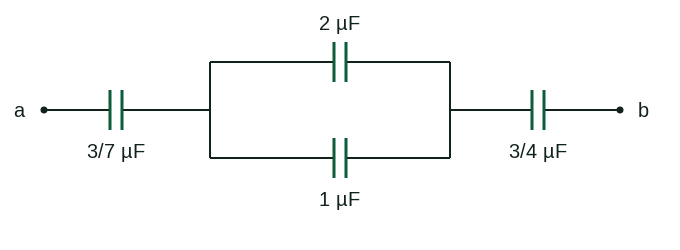
Four capacitors are connected in a capacitor network as shown in the figure below. The equivalent capacitance between terminals a and b in μF is
Figure for question 5 from the exam paper
  1. A. 34\frac{3}{4}
  2. B. 12
  3. C. 4
  4. D. 14\frac{1}{4}
Worked solutionUnofficial

Answer: D

Capacitors in parallel add: Cp=2+1=3 μFC_p = 2 + 1 = 3\ \mu\text{F}.

Now 37 μ\tfrac{3}{7}\ \muF, 3 μ3\ \muF and 34 μ\tfrac{3}{4}\ \muF are in series:

1C=73+13+43=123=4\frac{1}{C} = \frac{7}{3} + \frac{1}{3} + \frac{4}{3} = \frac{12}{3} = 4

C=14 μFC = \frac{1}{4}\ \mu\text{F}

Answer: D.

Why not A/B/C?

  • A. 34\tfrac{3}{4} µF is just the last capacitor's value. A series combination must be smaller than every capacitor in it, including 37\tfrac{3}{7} µF.
  • B. 12 µF is 1C\tfrac{1}{C} in thirds (123\tfrac{12}{3}) read as the capacitance, or comes from adding series capacitors as if they were in parallel.
  • C. 4 µF is the value of 1C\tfrac{1}{C}; you forgot to take the reciprocal at the end.

Unofficial — solved by Abrari, not an official EAES key.

Practice this subject

Q9 · Center of mass

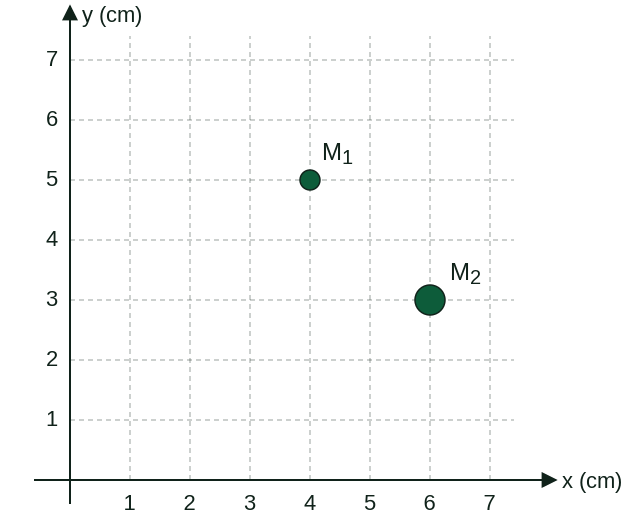
Consider a system of two point masses M1 and M2 with M1 = 0.5 M2. The two masses are located on the x-y plane as shown in the figure below. Which one of the following alternatives indicates the position of center of mass of the system?
Figure for question 9 from the exam paper
  1. A. (5,4)cm\left(5,4\right) cm
  2. B. (57,73)cm\left(\frac{5}{7},\frac{7}{3}\right) cm
  3. C. (163,113)cm\left(\frac{16}{3},\frac{11}{3}\right) cm
  4. D. (113,163)cm\left(\frac{11}{3},\frac{16}{3}\right) cm
Worked solutionUnofficial

Answer: C

Let M1=mM_1 = m, so M2=2mM_2 = 2m. Positions: M1(4,5)M_1(4, 5) cm, M2(6,3)M_2(6, 3) cm. xcm=m(4)+2m(6)m+2m=163 cmx_{cm} = \frac{m(4) + 2m(6)}{m + 2m} = \frac{16}{3}\ \text{cm} ycm=m(5)+2m(3)3m=113 cmy_{cm} = \frac{m(5) + 2m(3)}{3m} = \frac{11}{3}\ \text{cm} The centre of mass is at (163,113)\left(\tfrac{16}{3}, \tfrac{11}{3}\right) cm, closer to the heavier mass M2M_2, as expected.

Answer: C.

Why not A/B/D?

  • A. (5, 4) is the simple midpoint, which treats the two masses as equal.
  • B. (5/7, 7/3) does not come from a correct weighted average; it is not even between the two masses.
  • D. (11/3, 16/3) swaps the x and y coordinates of the correct answer.

Unofficial — solved by Abrari, not an official EAES key.

Practice this subject

Q15 · Moment of force

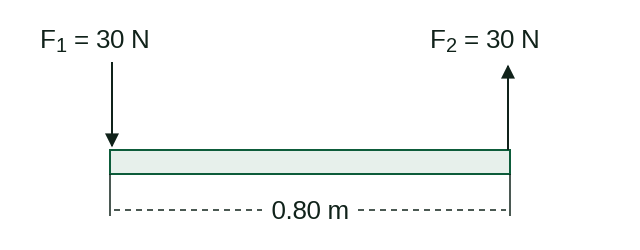
Two coplanar forces acts on a uniform beam as shown in the figure below. The moment of force on the beam is
Figure for question 15 from the exam paper
  1. A. 48.0 Nm.
  2. B. 12.0 Nm.
  3. C. 30.0 Nm.
  4. D. 24.0 Nm.
Worked solutionUnofficial

Answer: D

The two forces are equal in size, opposite in direction and act along different lines, so they form a couple. The net force is zero, but there is a turning effect.

The moment of a couple is one force times the perpendicular distance between the two lines of action: M=F d=30 N×0.80 m=24 N⋅mM = F\,d = 30\ \text{N}\times 0.80\ \text{m} = 24\ \text{N·m}

The same result comes from taking moments about either end. For example, about the left end only F2F_2 has a lever arm: 30×0.80=2430\times0.80=24 N·m.

Answer: D.

Why not A/B/C?

  • A. 48 N·m comes from adding the forces to 60 N and then multiplying by 0.80 m, but in a couple each force is counted only once over the full separation.
  • B. 12 N·m uses half the beam (0.40 m) with one force only; it leaves out the second force's equal contribution about the centre.
  • C. 30 N·m is just the force value with no lever arm; a moment needs force times distance.

Unofficial — solved by Abrari, not an official EAES key.

Practice this subject

Q16 · Continuity equation

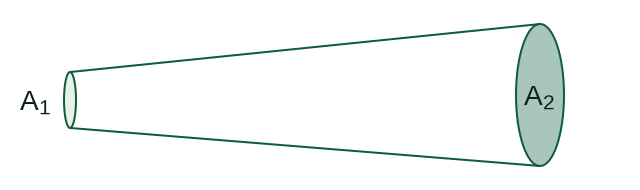
Water flows at the rate of 500.0 cm³/s at small cross-section 5 cm². The larger cross-section is 25 cm². What is the ratio of the speed of the water at A₁ to A₂.
Figure for question 16 from the exam paper
  1. A. 5
  2. B. 100
  3. C. 0.2
  4. D. 20
Worked solutionUnofficial

Answer: A

For an incompressible fluid the volume flow rate is the same everywhere (continuity equation): A1v1=A2v2A_1v_1=A_2v_2 So v1v2=A2A1=25 cm25 cm2=5\dfrac{v_1}{v_2}=\dfrac{A_2}{A_1}=\dfrac{25\ \text{cm}^2}{5\ \text{cm}^2}=5. Check: v1=5005=100v_1=\dfrac{500}{5}=100 cm/s and v2=50025=20v_2=\dfrac{500}{25}=20 cm/s, and 100/20=5100/20=5. Answer: A.

Why not B/C/D?

  • B. 100 is the speed at A₁ in cm/s, not the ratio of the speeds.
  • C. 0.2 is the inverse ratio v2/v1v_2/v_1 (or A1/A2A_1/A_2).
  • D. 20 is the speed at A₂ in cm/s, not the ratio.

Unofficial — solved by Abrari, not an official EAES key.

Practice this subject

Q18 · Simple harmonic motion

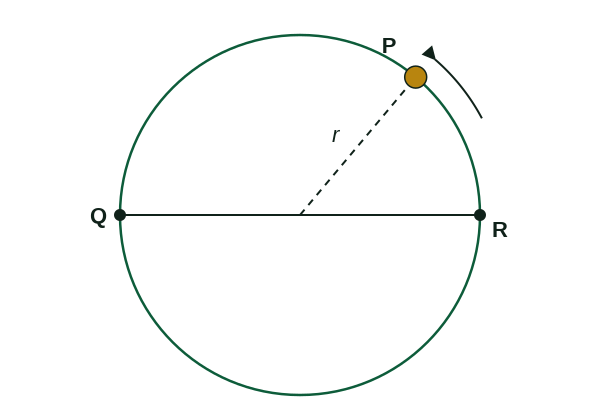
Consider a particle performing a circular motion around a circle of radius r with an angular velocity ω\omega and the particle's projection on the horizontal diameter of the circle (between points Q and R) as shown in the figure below? Which one of the following statements is correct about the motion of the particle and its projection on QR‾\overline{QR}
Figure for question 18 from the exam paper
  1. A. The projection of the particle on QR‾\overline{QR} swings between points Q and R with constant speed.
  2. B. The circular motion of the particle can be taken as a simple harmonic motion.
  3. C. The projection of the particle on QR‾\overline{QR} demonstrates simple harmonic motion.
  4. D. The projection of the particle on QR‾\overline{QR} demonstrates motion with constant acceleration.
Worked solutionUnofficial

Answer: C

Measure the angle from the centre. The projection of P on QR is at x=rcos⁡(ωt)x = r\cos(\omega t).

Differentiate twice to get the acceleration: a=−ω2rcos⁡(ωt)=−ω2xa = -\omega^2 r\cos(\omega t) = -\omega^2 x.

The acceleration is proportional to the displacement and points toward the centre, which is exactly the condition for simple harmonic motion.

The projection moves fastest at the centre (v=ωrv = \omega r) and stops at Q and R, so its speed is not constant. Its acceleration also changes with xx, so it is not constant either.

The circular motion itself is not SHM. It is uniform circular motion in two dimensions, and only its projection is SHM.

Answer: C.

Why not A/B/D?

  • A. The projection's speed changes: it is zero at Q and R and largest (ωr\omega r) at the centre.
  • B. SHM is a back-and-forth motion along a line. The circular motion is only the reference motion, and its projection is what performs SHM.
  • D. The acceleration −ω2x-\omega^2 x changes with position (zero at the centre, largest at Q and R), so it is not constant.

Unofficial — solved by Abrari, not an official EAES key.

Practice this subject

Q29 · Velocity-time graph

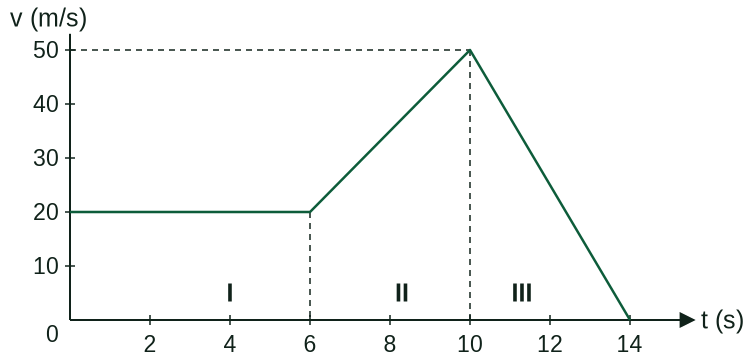
The graph given below shows the velocity of a man travelling on a motorcycle as a function of time. Which one of the following statements is correct about the velocity-time graph?
Figure for question 29 from the exam paper
  1. A. The displacement during the time interval from t = 6 s to t = 14 s is equal to the area of region II minus the area of region III.
  2. B. The displacement during the time intervals t = 0 to t = 6 s is equal to the area under the velocity-time graph in the given interval.
  3. C. The acceleration during the time interval from t = 6 s to t = 10 s is equal to the gradient of the curve in the given interval and it is negative.
  4. D. The acceleration in the first 6 s is equal to the gradient of the curve in the given interval and it is positive.
Worked solutionUnofficial

Answer: B

The area under a velocity–time graph equals the displacement.

From 0 to 6 s the area is 20×6=12020 \times 6 = 120 m, which is the displacement. So B is correct.

From 6 to 14 s the velocity is positive, so areas II and III add: they are not subtracted.

From 6 to 10 s the slope is (50−20)/4=7.5 m/s2(50-20)/4 = 7.5\ \text{m/s}^2, which is positive.

In the first 6 s the line is flat, so the acceleration is zero, not positive.

Answer: B.

Why not A/C/D?

  • A. Region III is above the time axis (v > 0), so its area adds to the displacement; it is not subtracted.
  • C. The gradient from 6 s to 10 s is +7.5 m/s², positive, not negative.
  • D. The graph is horizontal for the first 6 s, so the gradient (acceleration) is zero, not positive.

Unofficial — solved by Abrari, not an official EAES key.

Practice this subject

Q36 · DC circuit analysis

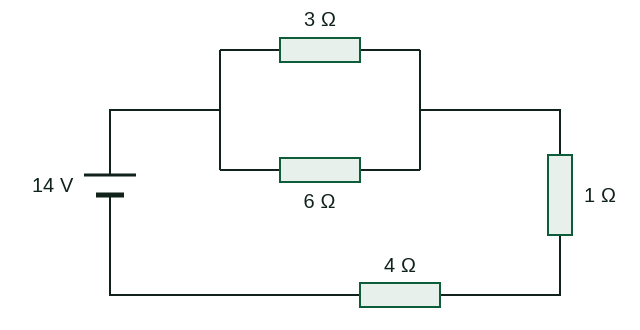
Four resistors are connected to a voltage source as shown in the circuit diagram shown below. What are the current through the 3 Ω resistor and the voltage drop across the 4 Ω resistor, respectively?
Figure for question 36 from the exam paper
  1. A. 23\frac{2}{3} A and 4 V
  2. B. 2 A and ¾ V
  3. C. 43\frac{4}{3} A and 8 V
  4. D. 34\frac{3}{4} A and 8 V
Worked solutionUnofficial

Answer: C

Parallel pair: Rp=3×63+6=2 ΩR_p = \dfrac{3\times 6}{3+6} = 2\ \Omega.

Total resistance: R=2+1+4=7 ΩR = 2 + 1 + 4 = 7\ \Omega, so the circuit current is I=147=2I = \dfrac{14}{7} = 2 A.

Voltage across the parallel pair: Vp=2×2=4V_p = 2 \times 2 = 4 V, so the current in the 3 Ω resistor is I3=43I_3 = \dfrac{4}{3} A.

The full 2 A flows through the 4 Ω resistor, so V4=2×4=8V_4 = 2 \times 4 = 8 V.

Answer: C.

Why not A/B/D?

  • A. 23\tfrac{2}{3} A is the current in the 6 Ω branch, not the 3 Ω branch, and 4 V is the parallel voltage, not the 4 Ω drop.
  • B. 2 A is the total current, which splits between 3 Ω and 6 Ω, so the 3 Ω branch carries less than 2 A. ¾ V has no basis.
  • D. 34\tfrac{3}{4} A inverts the correct fraction 43\tfrac{4}{3}; only the 8 V part is right.

Unofficial — solved by Abrari, not an official EAES key.

Practice this subject

Q49 · Energy in SHM (spring)

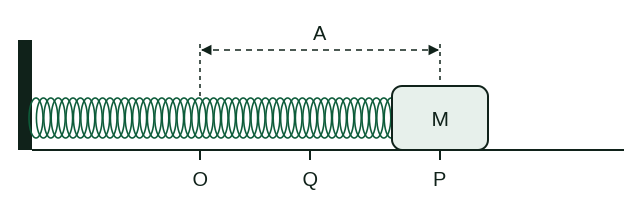
An object of mass M is attached to a spring of spring constant K, as shown in the figure below. If the mass is pulled to a point P, which is at distance A from equilibrium position O, and released, Which one of the following statements is correct about energy of the system? (assume the surface is frictionless)
Figure for question 49 from the exam paper
  1. A. At point O, the system has both kinetic and potential energy.
  2. B. At point P, the system has both kinetic energy and potential energy.
  3. C. At point P, the mass attain its maximum velocity.
  4. D. At point Q the system has both kinetic energy and potential energy.
Worked solutionUnofficial

Answer: D

Released from rest at P, the mass oscillates between −A-A and +A+A about O, with total energy E=12kA2E = \tfrac{1}{2}kA^2 conserved (no friction).

  • At P (x=Ax = A) the mass is momentarily at rest: KE=0KE = 0, all energy is spring PE.
  • At O (x=0x = 0) the spring is unstretched: PE=0PE = 0, all energy is KE and the speed is maximum.
  • At Q (0<x<A0 < x < A) the spring is partly stretched and the mass is moving: PE=12kx2>0PE = \tfrac{1}{2}kx^2 > 0 and KE=12k(A2−x2)>0KE = \tfrac{1}{2}k(A^2 - x^2) > 0. So only at Q does the system have both kinetic and potential energy.

Answer: D.

Why not A/B/C?

  • A. At O the spring is at its natural length, so the potential energy is zero; there is only kinetic energy.
  • B. At P the mass is momentarily at rest (turning point), so kinetic energy is zero.
  • C. At P the speed is zero; the maximum speed occurs at O.

Unofficial — solved by Abrari, not an official EAES key.

Practice this subject

Q1 · Electric field units

Which one of the following units is NOT a possible unit of electric field strength?
  1. A. Newton/Coulomb
  2. B. Joule/Coulomb
  3. C. Volt/meter
  4. D. Joule/(Coulomb×meter)
Worked solutionUnofficial

Unofficial keyed letter B. A full worked solution is not published for this item yet.

Unofficial — solved by Abrari, not an official EAES key.

Practice this subject

Q2 · Magnetism

Which one of the following statements does NOT describe magnetic nature of a material?
  1. A. There is no a single magnetic North or magnetic South Pole.
  2. B. Magnetic dipoles of a material aligned parallel when the magnetic material is placed in external magnetic field.
  3. C. Magnetic molecules in a magnet will align when they are heated or hammered.
  4. D. Magnetic molecules (dipoles) are oriented randomly when a material lose its magnetism.
Worked solutionUnofficial

Unofficial keyed letter C. A full worked solution is not published for this item yet.

Unofficial — solved by Abrari, not an official EAES key.

Practice this subject

10 of 48 unofficial 2015 E.C. questions on this page.

All 2015 E.C. stems: 2015 E.C. Physics (48)

Practise the rest of Physics online · Physics model exam · All Physics papers

Grade 12 national exam · Model exam questions · 2016 E.C. all subjects · 2017 E.C. all subjects · 2018 E.C. all subjects · All past papers · Practice online

Frequently asked questions

Are these official Grade 12 Physics exam questions?
No. They are unofficial practice reconstructed from the Abrari study bank. Abrari is not affiliated with MoE, EAES, or NEAEA and does not publish official keys.
Are the answers official?
No. Letters and worked solutions are unofficial Abrari keys. Do not treat them as an official marking scheme.
Why is only a sample on this page?
This page shows a sample grouped by year. Open a year paper or start Physics practice to work the rest of the bank, timed, with the same unofficial explanations.
Do you sell leaked or paid exam papers?
No. Abrari does not host leaked exams, paid bank copies, or official answer keys.