Unofficial practice for the 2015 E.C. / 2023 G.C. Social stream Mathematics Ethiopian University Entrance Exam (EUEE / matric). 56 question stems from the Abrari bank are listed below. Not an official Ministry, EAES, MoLS, or OCACC paper.
ይሞክሩ · Try 5
Try 5 Mathematics questions
1 / 5mathStatistics - mean
A student took 5 Model Exams and scored 85, 88, 90 and 92 in four subjects namely English, Geography, Economics and History exams respectively. She did not know her score in Mathematics exam but she knew that her mean score in all five exams is 90. What is her score in Mathematics?
5 የሒሳብ ጥያቄዎች
መግቢያ አያስፈልግም · No sign-in needed
Unofficial EUEE past-paper items. Not an official key.
Unofficial practice. Abrari is an independent study aid and is not affiliated with, endorsed by, or an official product of the Ethiopian Ministry of Education (MoE), EAES, MoLS, or OCACC. Answers are Abrari keys, not an official marking scheme.
Stems are visible for study. Worked solutions stay inside each item and are unofficial.
Q1 · Statistics - mean
A student took 5 Model Exams and scored 85, 88, 90 and 92 in four subjects namely English, Geography, Economics and History exams respectively. She did not know her score in Mathematics exam but she knew that her mean score in all five exams is 90. What is her score in Mathematics?
A. 95
B. 89
C. 90
D. 93
Worked solutionUnofficial
Unofficial keyed letter A. A full worked solution is not published for this item yet.
Unofficial — solved by Abrari, not an official EAES key.
For a parallelogram ABCD the length of side AB is equal to the length of the side of a square with area 64 cm². If the length of side BC of parallelogram ABCD is 3 cm and m(∠ABC) = 120°, what is the area of ABCD?
A.243 cm²
B. 64 cm²
C.43 cm²
D.123 cm²
Worked solutionUnofficial
Unofficial keyed letter D. A full worked solution is not published for this item yet.
Unofficial — solved by Abrari, not an official EAES key.
If a regular polygon circumscribes a circle and the sides of the polygon touches the circle at exactly seven points, what is the maximum number of lines of symmetry of the polygon?
A. Eight
B. Seven
C. Six
D. Five
Worked solutionUnofficial
Unofficial keyed letter B. A full worked solution is not published for this item yet.
Unofficial — solved by Abrari, not an official EAES key.
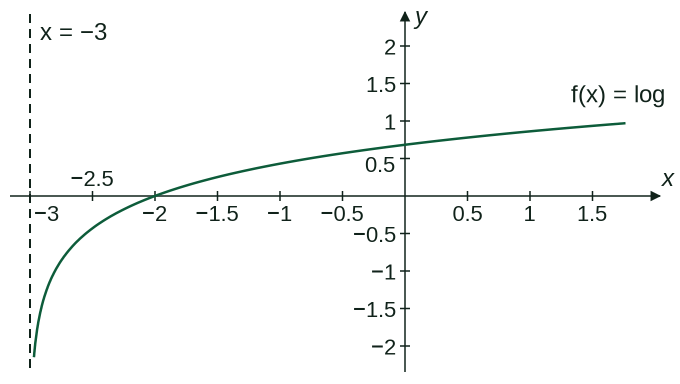
Consider the graph of f(x)=log5(x+3) which is shown below. Which one of the following is NOT true about the function f?
A. The domain of f is the set of all real numbers greater than −3.
B. The x-intercept of the graph of f is −2.
C. The y-axis is a vertical asymptote of the graph of f.
D. The function increases as the value of x increases.
Worked solutionUnofficial
Answer: C
A log is defined only for positive inputs, so we need x+3>0, which means x>−3. So A is true.
Set f(x)=0: log5(x+3)=0 gives x+3=1, so x=−2. So B is true.
The base 5 is greater than 1, so f increases. D is true.
The vertical asymptote is where x+3=0, which is the line x=−3, the dashed line in the graph. It is not the y-axis (x=0). The graph actually crosses the y-axis at log53≈0.68.
Answer: C.
Why not A/B/D?
A. True: x+3>0 gives the domain x>−3.
B. True: log5(x+3)=0 when x+3=1, which gives x=−2.
D. True: a logarithm with base greater than 1 is an increasing function.
Unofficial — solved by Abrari, not an official EAES key.
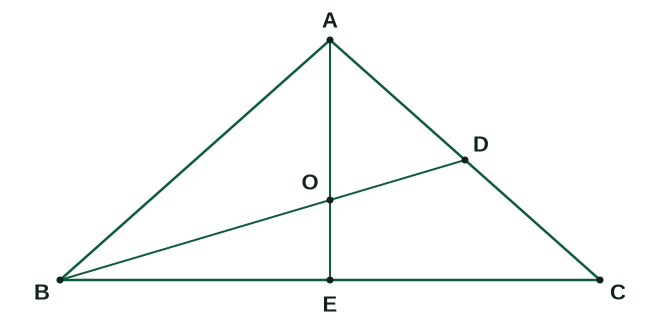
In △ABC shown below, the medians BD and AE of △ABC are concurrent at point O. If BD=15 cm, OD=5 cm and AO=BO, then which one of the following is NOT true?
A. BO = 10 cm
B. OE = 5 cm
C. AO = 5 cm
D. AE = 15 cm
Worked solutionUnofficial
Answer: C
The medians meet at the centroid, which divides each median in the ratio 2:1 from the vertex.
BD=15 and OD=5, so BO=15−5=10 cm.
Given AO=BO, so AO=10 cm.
Then OE=21AO=5 cm and AE=10+5=15 cm.
So A, B and D are true, but AO=5 cm is false.
Answer: C.
Why not A/B/D?
A. BO = BD − OD = 15 − 5 = 10 cm, so this statement is true.
B. OE is half of AO = 10 cm, so OE = 5 cm is true.
D. AE = AO + OE = 10 + 5 = 15 cm, so this statement is true.
Unofficial — solved by Abrari, not an official EAES key.
If the foci of a hyperbola are (−2,4) and (8,4) and the transverse axis is 8 cm long, which one of the following is the standard form of equation of the hyperbola?
A.16(x−3)2−9(y−4)2=1
B.9(y−4)2−16(x−3)2=1
C.25(x−3)2−16(y−4)2=1
D.16(y−4)2−25(x−3)2=1
Worked solutionUnofficial
Unofficial keyed letter A. A full worked solution is not published for this item yet.
Unofficial — solved by Abrari, not an official EAES key.
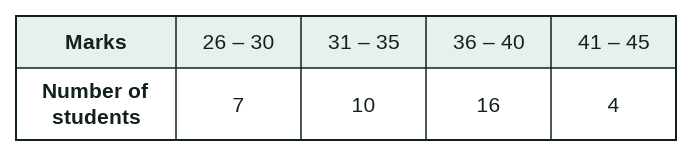
The following table shows the frequency distribution of scores of students in Mathematics Mid-Exam which was marked out of 50. Which one of the following is TRUE about distribution score?
A. The third decile of the distribution lies in the first class.
B. The fourth decile of the distribution is in the third class.
C. The fifth decile of the distribution lies in the third class.
D. The eighth decile of the distribution lies in the fourth class.
Worked solutionUnofficial
Answer: C
Total N=7+10+16+4=37. Cumulative frequencies: 7,17,33,37.
The k-th decile is at position 10kN.
D3: 103(37)=11.1 → falls in class 2 (cf 8–17).
D4: 14.8 → class 2.
D5: 18.5 → class 3 (cf 18–33).
D8: 29.6 → class 3.
Only the statement about D5 in the third class is true.
Answer: C.
Why not A/B/D?
A. D₃ is at position 11.1, which is past the first class's 7 students, so it is in the second class.
B. D₄ is at position 14.8, which is within the cumulative 17 of the second class, not the third.
D. D₈ is at position 29.6, which is within the cumulative 33 of the third class, not the fourth.
Unofficial — solved by Abrari, not an official EAES key.
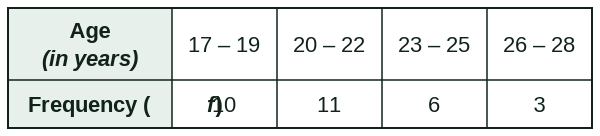
The following table shows the age distribution of Grade 12 students in one section of a certain school. Which one of the following is the mean age in years?
A. 20.2
B. 22.2
C. 23.2
D. 21.2
Worked solutionUnofficial
Answer: D
For grouped data, use the class midpoint x for each class.
Let p, q and r be propositions. If the truth value of the proposition [(p⟹q)∧r]⟹q is False. Then the converse of which proposition has truth value True?
A.p⟹¬q
B.p⟹r
C.r⟹q
D.q⟹¬p
Worked solutionUnofficial
Unofficial keyed letter C. A full worked solution is not published for this item yet.
Unofficial — solved by Abrari, not an official EAES key.
Which one of the following is the converse of the conditional statement "If life in Ethiopia was simpler, then people in Ethiopia would not go to other nations."
A. If life in Ethiopia was simpler, then people in Ethiopia would go to other nations.
B. If life in Ethiopia was not simpler, then people in Ethiopia would go to other nations.
C. If people of Ethiopia would go to other nations, then life in the Ethiopia was not simpler.
D. If people of Ethiopia would not go to other nations, then life in Ethiopia was simpler.
Worked solutionUnofficial
Unofficial keyed letter D. A full worked solution is not published for this item yet.
Unofficial — solved by Abrari, not an official EAES key.
A man deposited Birr 5000 in a bank with annual interest rate of 14% compounded semi-annually. What is the total interest earned at the end of the second year approximately?
A. Birr 6554
B. Birr 1554
C. Birr 5554
D. Birr 1654
Worked solutionUnofficial
Unofficial keyed letter B. A full worked solution is not published for this item yet.
Unofficial — solved by Abrari, not an official EAES key.
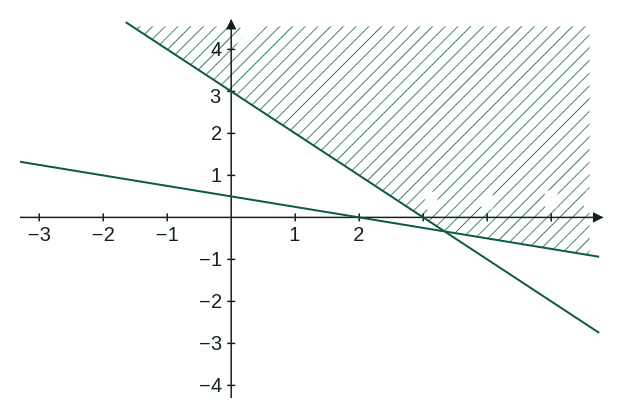
On the coordinate plane a graph is given as shown below. Which one of the following system of linear inequalities has the above shaded region as its solution?
A.{−x−y≤−3x+4y≥2
B.{x+y≤3x+4y≥2
C.{−x−y≥−3x+4y≤2
D.{x+y≥−3x+4y≤2
Worked solutionUnofficial
Answer: A
The steep line through (0,3) and (3,0) is x+y=3.
The shallow line through (0,21) and (2,0) is y=−41x+21, that is x+4y=2.
The hatched region lies above both lines, so a point inside it, such as (4,1), works as a test point.
At (4,1): x+y=5≥3 and x+4y=8≥2. The region is x+y≥3 and x+4y≥2.
Multiplying x+y≥3 by −1 flips the sign: −x−y≤−3. This matches option A.
Answer: A.
Why not B/C/D?
B.x+y≤3 is the side containing the origin, below the steep line, which is not hatched.
C.−x−y≥−3 means x+y≤3, and x+4y≤2; both describe the unhatched side containing the origin.
D.x+y≥−3 uses the wrong boundary line, and x+4y≤2 is the side below the shallow line.
Unofficial — solved by Abrari, not an official EAES key.
A woman wants to buy a new car that costs Birr 1,100,000. She paid Birr 870,000 and agreed with the seller to pay Birr 10,000 per month to cover the remaining amount at 0% interest rate. How many months will it take the woman to pay all the remaining money?
A. Twenty Three months.
B. Seventeen months.
C. Thirteen months.
D. Seven months.
Worked solutionUnofficial
Unofficial keyed letter A. A full worked solution is not published for this item yet.
Unofficial — solved by Abrari, not an official EAES key.
If f, g, h, and m are functions defined by f(x)=x2+9x+14x+7, g(x)=xcosx, h(x)=x−35x−1, and m(x)=xsinxcosx, which one of the following is the correct result?
A.limx→0m(x)=0
B.limx→−7f(x)=−51
C.limx→3+h(x)=15
D.limx→0+g(x)=1
Worked solutionUnofficial
Unofficial keyed letter B. A full worked solution is not published for this item yet.
Unofficial — solved by Abrari, not an official EAES key.
Which one of the following is NOT true about the derivative of a function?
A. The derivative of a function at a point is equal to the area of the region enclosed by the graph of the function and the coordinate axes.
B. The derivative of a function f at a point x0 is the instantaneous rate of change of f(x) at (x0,f(x0)).
C. The derivative of a function g at a point t is equal to the limit of the ratio of the difference of functional values of g at x and at t to the difference x−t as x approaches t.
D. The derivative of a function f at a point x is the slope of a line tangent to the graph of the function at the point (x,f(x)).
Worked solutionUnofficial
Unofficial keyed letter A. A full worked solution is not published for this item yet.
Unofficial — solved by Abrari, not an official EAES key.
The following table is the distance traveled by a car in the given times. Which of the following time intervals has the maximum average rate of change of the distance with respect to time?
A. t = 1 hour and t = 2 hours
B. t = 2 hours and t = 3 hours
C. t = 3 hours and t = 4 hours
D. t = 4 hours and t = 5 hours
Worked solutionUnofficial
Answer: D
Each interval is 1 hour long, so the average rate of change is just the change in distance.
t=1→2: 150−30=20 km/h
t=2→3: 160−50=10 km/h
t=3→4: 180−60=20 km/h
t=4→5: 1120−80=40 km/h, which is the largest.
Answer: D.
Why not A/B/C?
A. The rate here is only 20 km/h, half of the 40 km/h in the last hour.
B. This is the smallest rate, 10 km/h.
C. This is 20 km/h, which ties with A but is less than 40 km/h.
Unofficial — solved by Abrari, not an official EAES key.
A. If the price of an egg reduced from Birr 13.00 to Birr 11.25, then the percent decrease is 0.142%.
B. If a woman buys 20 kg of sugar by Birr 2000.00, and she sells one kilogram of it by Birr 85.00, then she sells by 30% price decrease.
C. If a shop owner offered 75 T-shirts by a price of Birr 325.00 for each and he bought all by Birr 25,000.00, then the percent decrease he had made for one T-shirt is 2.5%.
D. A person earns Birr 175.00 commission per service he provides. If he provided 13 services and got Birr 2000.00, then the percent decrease of his income is approximately 10%.
Worked solutionUnofficial
Unofficial keyed letter C. A full worked solution is not published for this item yet.
Unofficial — solved by Abrari, not an official EAES key.
The following table shows the mean score and the standard deviation of scores of the students in each class P, Q, R and S who took a similar test which is marked out of 20. Which of the following statements is true about these data? (P: mean 16, SD 3.05; Q: mean 16, SD 2.62; R: mean 16, SD 3.05; S: mean 16, SD 3.02)
A. The most consistent test result is class P students' result.
B. Test result of class Q students is highly variable.
C. Test result of class P students is more consistent than class R students.
D. Test result of class S students is more consistent than class R students.
Worked solutionUnofficial
Unofficial keyed letter D. A full worked solution is not published for this item yet.
Unofficial — solved by Abrari, not an official EAES key.
The following table shows the first quartile Q1 and the third quartile Q3 of two data sets X and Y. Which of the following is true about the given data? (X: Q1=5, Q3=9; Y: Q1=3, Q3=6)
A. Data X possesses higher variability than data Y.
B. Data Y possesses higher variability than data X.
C. The inter quartile range of data X is 7.
D. The inter quartile range of data Y is 4.5
Worked solutionUnofficial
Unofficial keyed letter A. A full worked solution is not published for this item yet.
Unofficial — solved by Abrari, not an official EAES key.
Suppose the following data represents the weight in kg of 10 students in a classroom: 61, 49, 52, 68, 61, 55, 64, 63, 67, 60. Which one of the following statements is NOT true about the data?
A. Mean deviation about the mean of the data is 4.8
B. Mean deviation about the median of the data is 4.6
C. Mean deviation about the mode of the data is 4.6
D. Mean deviation about the mean of the data is 4.7
Worked solutionUnofficial
Unofficial keyed letter D. A full worked solution is not published for this item yet.
Unofficial — solved by Abrari, not an official EAES key.
No. Abrari publishes unofficial practice reconstructed from the study bank for this 2015 E.C. Mathematics paper. It is not an official EAES or Ministry paper and does not use government logos.
Are the answers official?
No. Letters and worked solutions are unofficial Abrari keys. Verified write-ups are labelled Unofficial. Do not treat them as an official marking scheme.
Is Abrari part of MoE, EAES, MoLS, or OCACC?
No. Abrari is an independent study aid. It is not affiliated with, endorsed by, or an official product of those agencies.
Do I need to pay to practice?
No. The questions on this page are free to read and try. There is no payment step.