Mathematics · Model exam · Unofficial

Grade 12 Mathematics (Social) model exam — timed practice

Sit an unofficial Social stream Grade 12 Mathematics model exam online. Abrari times subject practice from its own bank — not a Ministry model paper, not a leaked PDF, and not an official sitting.

How to sit this model exam

  • Start subject practice in the browser, then keep the clock on when you want a timed drill. Sign in to save a sitting.
  • Or open the full-stream timed mock (Natural or Social) and take this subject as part of that sitting. The first full sitting is complimentary.
  • Read a sample of unofficial questions on this page, then practise the rest. Answers are Abrari keys.

Start Mathematics timed practice · Full-stream timed mock (Social) · Mathematics (Social) questions and answers

Sample questions

Unofficial stems from the Abrari bank, with answers and explanations inside each item.

Q1 · Circle geometry - arcs

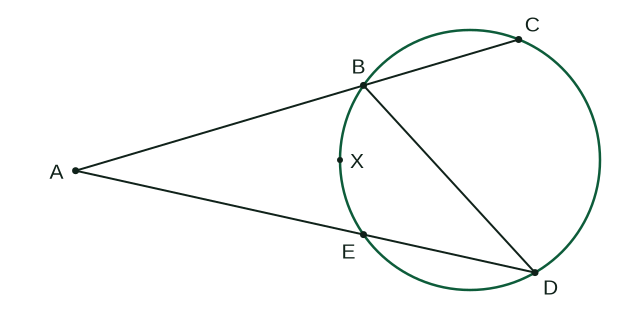
Consider the figure shown below. If m(∠BAE)=50∘m(\angle BAE) = 50^\circ and m(∠CBD)=80∘m(\angle CBD) = 80^\circ, then m(BXE^)m(\widehat{BXE}) is equal to:
Figure for question 1 from the exam paper
  1. A. 65∘65^\circ
  2. B. 20∘20^\circ
  3. C. 60∘60^\circ
  4. D. 30∘30^\circ
Worked solutionUnofficial

Answer: C

∠CBD\angle CBD is an inscribed angle standing on arc CDCD, so arc CD=2(80∘)=160∘CD = 2(80^\circ) = 160^\circ. The angle between two secants from an outside point is half the difference of the intercepted arcs: m(∠BAE)=12(mCD^−mBXE^)m(\angle BAE) = \tfrac{1}{2}\left(m\widehat{CD} - m\widehat{BXE}\right) 50∘=12(160∘−mBXE^)⇒mBXE^=60∘50^\circ = \tfrac{1}{2}(160^\circ - m\widehat{BXE}) \Rightarrow m\widehat{BXE} = 60^\circ (Check: in triangle ABDABD, exterior angle ∠CBD=∠A+∠ADB\angle CBD = \angle A + \angle ADB, so ∠ADB=30∘\angle ADB = 30^\circ, and this inscribed angle stands on arc BXEBXE, giving 60∘60^\circ.)

Answer: C.

Why not A/B/D?

  • A. 65° is half the sum (50° + 80°)/2, which is not a rule for this configuration.
  • B. 20° does not follow from the secant-angle rule; using arc CD = 160° and ∠A = 50° gives arc BXE = 60°.
  • D. 30° is ∠ADB, the inscribed angle on arc BXE; the arc itself is twice that.

Unofficial — solved by Abrari, not an official EAES key.
Practice this subject

Q16 · Congruent triangles

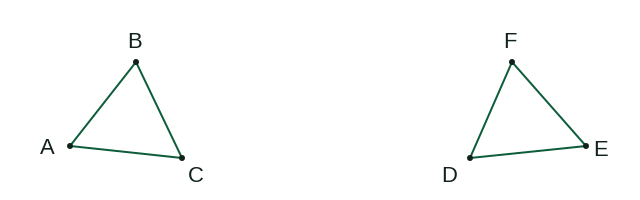
In the figure shown below, AC‾=DE‾\overline{AC} = \overline{DE}, ∠BAC=∠DEF\angle BAC = \angle DEF, ∠ACB=∠FDE\angle ACB = \angle FDE and AC‾≡DE‾\overline{AC}\equiv \overline{DE}. Then which one of the following is true?
Figure for question 16 from the exam paper
  1. A. △ABC≡△FED\triangle ABC \equiv \triangle FED
  2. B. △ABC≡△EFD\triangle ABC \equiv \triangle EFD
  3. C. △ABC≡△DEF\triangle ABC \equiv \triangle DEF
  4. D. △ABC≡△DFE\triangle ABC \equiv \triangle DFE
Worked solutionUnofficial

Answer: B

Match the vertices using the given equal parts.

  • ∠BAC=∠DEF\angle BAC=\angle DEF: the angle at AA equals the angle at EE, so A↔EA\leftrightarrow E.
  • ∠ACB=∠FDE\angle ACB=\angle FDE: the angle at CC equals the angle at DD, so C↔DC\leftrightarrow D.
  • The remaining vertices must match: B↔FB\leftrightarrow F.

Check the side: AC‾\overline{AC} (between AA and CC) matches ED‾\overline{ED} (between EE and DD), and AC=DEAC = DE is given. So the two triangles are congruent by ASA.

Write the congruence in the order A,B,C→E,F,DA,B,C \to E,F,D: △ABC≅△EFD\triangle ABC \cong \triangle EFD

Answer: B.

Why not A/C/D?

  • A. FED matches A with F and C with D, but the angle at A equals the angle at E, not F.
  • C. DEF matches A with D, but the angle at A equals the angle at E.
  • D. DFE matches A with D and C with E, which reverses the given angle pairs.

Unofficial — solved by Abrari, not an official EAES key.
Practice this subject

Q59 · Plane geometry - parallelogram area

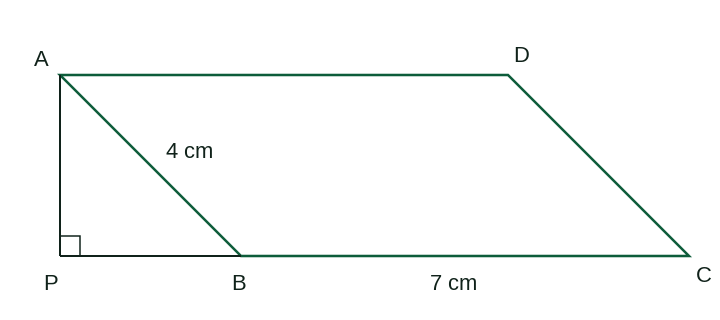
ABCD is a parallelogram with length of base 7 cm and △APB\triangle APB is an isosceles right angled triangle with right angle at P and hypotenuse 4 cm. What is the area of ABCD in cm2^2?
Figure for question 59 from the exam paper
  1. A. 14214\sqrt{2}
  2. B. 8
  3. C. 28
  4. D. 727\sqrt{2}
Worked solutionUnofficial

Answer: A

Triangle APBAPB is an isosceles right triangle with the right angle at PP, so AP=PBAP = PB and AB=4AB = 4 cm is the hypotenuse.

AP2+PB2=42⇒2AP2=16⇒AP=22 cmAP^2 + PB^2 = 4^2 \Rightarrow 2AP^2 = 16 \Rightarrow AP = 2\sqrt{2}\text{ cm}

APAP is perpendicular to the line through BB and CC, so it is the height of the parallelogram on base BCBC.

Area=BC×AP=7×22=142 cm2\text{Area} = BC \times AP = 7 \times 2\sqrt{2} = 14\sqrt{2}\text{ cm}^2

Answer: A.

Why not B/C/D?

  • B. 8 is the area of a square with side 222\sqrt{2} (or 2×42 \times 4), not base × height of the parallelogram.
  • C. 28 uses the slanted side AB=4AB = 4 cm as the height (7×47\times4) instead of the perpendicular height 222\sqrt{2}.
  • D. 727\sqrt{2} uses a height of 2\sqrt{2}, which halves the leg 222\sqrt{2} by mistake, or is half the correct area.

Unofficial — solved by Abrari, not an official EAES key.

Practice this subject

Q2 · Polynomials - Factor Theorem

Let f(x)f(x) be a polynomial of degree at least 1, g(x)g(x) be a non-zero polynomial and c∈Rc \in \mathbb{R}. Which of the following states the Factor Theorem?
  1. A. f(c)=0f(c) = 0 if and only if x−cx - c is a factor of f(x)f(x).
  2. B. For distinct real numbers aa and bb, if f(a)f(b)<0f(a)f(b) < 0, then f(x)f(x) has at least one zero between aa and bb.
  3. C. There exist polynomials q(x)q(x) and r(x)r(x) such that f(x)=g(x)q(x)+r(x)f(x) = g(x)q(x) + r(x).
  4. D. If f(x)f(x) is divided by x−cx - c, then the remainder is f(c)f(c).
Worked solutionUnofficial

Unofficial keyed letter A. A full worked solution is not published for this item yet.

Unofficial — solved by Abrari, not an official EAES key.

Practice this subject

Q3 · Sets - Cartesian product

Let A={1,2}A = \{1,2\} and B={1,3}B = \{1,3\} be sets. Then which one of the following Cartesian products is correct?
  1. A. B×A={(1,1),(3,1),(1,2),(3,2),(2,3)}B\times A = \{(1,1),(3,1),(1,2),(3,2),(2,3)\}.
  2. B. B×B={(1,1),(1,3),(3,3),(2,3)}B\times B = \{(1,1),(1,3),(3,3),(2,3)\}.
  3. C. A×B={(1,1),(1,3),(2,1),(2,3),(3,2)}A\times B = \{(1,1),(1,3),(2,1),(2,3),(3,2)\}.
  4. D. A×A={(1,1),(2,2),(2,1),(1,2)}A\times A = \{(1,1),(2,2),(2,1),(1,2)\}.
Worked solutionUnofficial

Unofficial keyed letter D. A full worked solution is not published for this item yet.

Unofficial — solved by Abrari, not an official EAES key.

Practice this subject

Q4 · Matrices - cofactor

Consider the matrix (2−310−1π314)\begin{pmatrix} 2 & -3 & 1 \\ 0 & -1 & \pi \\ 3 & 1 & 4 \end{pmatrix}. What is the cofactor of entry π\pi?
  1. A. 77
  2. B. −11-11
  3. C. −11π-11\pi
  4. D. −7π-7\pi
Worked solutionUnofficial

Unofficial keyed letter B. A full worked solution is not published for this item yet.

Unofficial — solved by Abrari, not an official EAES key.

Practice this subject

Q5 · Geometric series - recurring decimal

When converting the recurring decimal 0.25‾0.\overline{25} into a fraction using convergent geometric series, then what are the first term and the common ratio respectively?
  1. A. 0.250.25 and 0.010.01
  2. B. 2525 and 0.010.01
  3. C. 0.250.25 and 0.10.1
  4. D. 2.52.5 and 0.10.1
Worked solutionUnofficial

Unofficial keyed letter A. A full worked solution is not published for this item yet.

Unofficial — solved by Abrari, not an official EAES key.

Practice this subject

Q6 · Linear programming

What are the maximum and minimum values respectively of z=3x+yz = 3x + y subject to constraints {3x+2y≤202x−y≥4x≥0,y≥0\begin{cases} 3x + 2y \leq 20 \\ 2x - y \geq 4 \\ x \geq 0, y \geq 0 \end{cases}?
  1. A. 2020 and 66
  2. B. 4040 and 66
  3. C. 1616 and 66
  4. D. 1818 and 88
Worked solutionUnofficial

Unofficial keyed letter A. A full worked solution is not published for this item yet.

Unofficial — solved by Abrari, not an official EAES key.

Practice this subject

Grade 12 national exam · Model exam questions · 2016 E.C. all subjects · 2017 E.C. all subjects · 2018 E.C. all subjects · All past papers · Practice online

Frequently asked questions

Is this an official Grade 12 Mathematics model exam?
No. Abrari model tests are unofficial practice. They are not an official EAES, NEAEA, or Ministry model exam and they are not leaked papers.
Is this a PDF?
No. The questions live as HTML on this site so you can practise online. Abrari does not offer a model-exam PDF download.
How is this different from a past-paper page?
A past-paper page follows one year. This model-exam page is timed practice you sit now, using unofficial bank items for the subject.