Mathematics · Entrance exam Q&A · Unofficial

Grade 12 Mathematics (Social) entrance exam questions and answers

Unofficial Social stream Grade 12 Mathematics entrance exam questions from the Abrari study bank. 142 reviewed items across 2017 E.C., 2016 E.C., 2015 E.C. are in this subject. A sample with unofficial answers and explanations is on this page — practise the rest online. Not a government paper.

142 unofficial Mathematics questions in the public bank

2017 E.C. Mathematics questions

Unofficial stems, answers, and explanations from the Abrari bank. Years use the Ethiopian calendar.

Q1 · Circle geometry - arcs

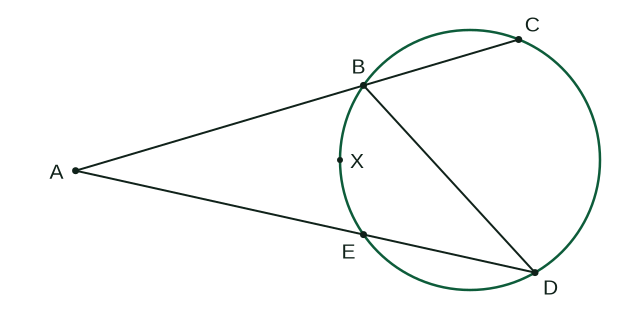
Consider the figure shown below. If m(∠BAE)=50∘m(\angle BAE) = 50^\circ and m(∠CBD)=80∘m(\angle CBD) = 80^\circ, then m(BXE^)m(\widehat{BXE}) is equal to:
Figure for question 1 from the exam paper
  1. A. 65∘65^\circ
  2. B. 20∘20^\circ
  3. C. 60∘60^\circ
  4. D. 30∘30^\circ
Worked solutionUnofficial

Answer: C

∠CBD\angle CBD is an inscribed angle standing on arc CDCD, so arc CD=2(80∘)=160∘CD = 2(80^\circ) = 160^\circ. The angle between two secants from an outside point is half the difference of the intercepted arcs: m(∠BAE)=12(mCD^−mBXE^)m(\angle BAE) = \tfrac{1}{2}\left(m\widehat{CD} - m\widehat{BXE}\right) 50∘=12(160∘−mBXE^)⇒mBXE^=60∘50^\circ = \tfrac{1}{2}(160^\circ - m\widehat{BXE}) \Rightarrow m\widehat{BXE} = 60^\circ (Check: in triangle ABDABD, exterior angle ∠CBD=∠A+∠ADB\angle CBD = \angle A + \angle ADB, so ∠ADB=30∘\angle ADB = 30^\circ, and this inscribed angle stands on arc BXEBXE, giving 60∘60^\circ.)

Answer: C.

Why not A/B/D?

  • A. 65° is half the sum (50° + 80°)/2, which is not a rule for this configuration.
  • B. 20° does not follow from the secant-angle rule; using arc CD = 160° and ∠A = 50° gives arc BXE = 60°.
  • D. 30° is ∠ADB, the inscribed angle on arc BXE; the arc itself is twice that.

Unofficial — solved by Abrari, not an official EAES key.
Practice this subject

Q16 · Congruent triangles

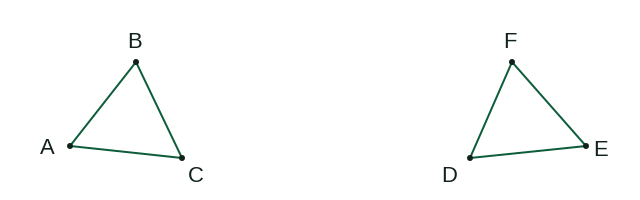
In the figure shown below, AC‾=DE‾\overline{AC} = \overline{DE}, ∠BAC=∠DEF\angle BAC = \angle DEF, ∠ACB=∠FDE\angle ACB = \angle FDE and AC‾≡DE‾\overline{AC}\equiv \overline{DE}. Then which one of the following is true?
Figure for question 16 from the exam paper
  1. A. △ABC≡△FED\triangle ABC \equiv \triangle FED
  2. B. △ABC≡△EFD\triangle ABC \equiv \triangle EFD
  3. C. △ABC≡△DEF\triangle ABC \equiv \triangle DEF
  4. D. △ABC≡△DFE\triangle ABC \equiv \triangle DFE
Worked solutionUnofficial

Answer: B

Match the vertices using the given equal parts.

  • ∠BAC=∠DEF\angle BAC=\angle DEF: the angle at AA equals the angle at EE, so A↔EA\leftrightarrow E.
  • ∠ACB=∠FDE\angle ACB=\angle FDE: the angle at CC equals the angle at DD, so C↔DC\leftrightarrow D.
  • The remaining vertices must match: B↔FB\leftrightarrow F.

Check the side: AC‾\overline{AC} (between AA and CC) matches ED‾\overline{ED} (between EE and DD), and AC=DEAC = DE is given. So the two triangles are congruent by ASA.

Write the congruence in the order A,B,C→E,F,DA,B,C \to E,F,D: △ABC≅△EFD\triangle ABC \cong \triangle EFD

Answer: B.

Why not A/C/D?

  • A. FED matches A with F and C with D, but the angle at A equals the angle at E, not F.
  • C. DEF matches A with D, but the angle at A equals the angle at E.
  • D. DFE matches A with D and C with E, which reverses the given angle pairs.

Unofficial — solved by Abrari, not an official EAES key.
Practice this subject

Q59 · Plane geometry - parallelogram area

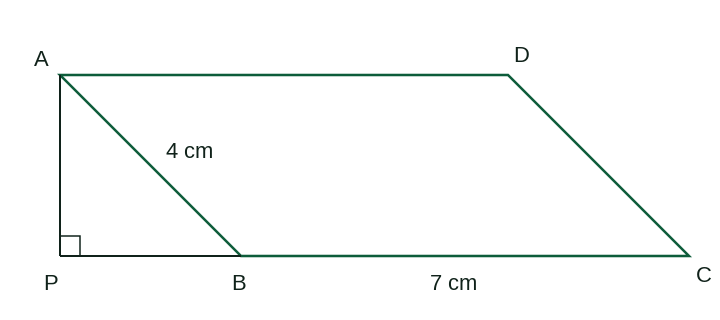
ABCD is a parallelogram with length of base 7 cm and △APB\triangle APB is an isosceles right angled triangle with right angle at P and hypotenuse 4 cm. What is the area of ABCD in cm2^2?
Figure for question 59 from the exam paper
  1. A. 14214\sqrt{2}
  2. B. 8
  3. C. 28
  4. D. 727\sqrt{2}
Worked solutionUnofficial

Answer: A

Triangle APBAPB is an isosceles right triangle with the right angle at PP, so AP=PBAP = PB and AB=4AB = 4 cm is the hypotenuse.

AP2+PB2=42⇒2AP2=16⇒AP=22 cmAP^2 + PB^2 = 4^2 \Rightarrow 2AP^2 = 16 \Rightarrow AP = 2\sqrt{2}\text{ cm}

APAP is perpendicular to the line through BB and CC, so it is the height of the parallelogram on base BCBC.

Area=BC×AP=7×22=142 cm2\text{Area} = BC \times AP = 7 \times 2\sqrt{2} = 14\sqrt{2}\text{ cm}^2

Answer: A.

Why not B/C/D?

  • B. 8 is the area of a square with side 222\sqrt{2} (or 2×42 \times 4), not base × height of the parallelogram.
  • C. 28 uses the slanted side AB=4AB = 4 cm as the height (7×47\times4) instead of the perpendicular height 222\sqrt{2}.
  • D. 727\sqrt{2} uses a height of 2\sqrt{2}, which halves the leg 222\sqrt{2} by mistake, or is half the correct area.

Unofficial — solved by Abrari, not an official EAES key.
Practice this subject

Q2 · Polynomials - Factor Theorem

Let f(x)f(x) be a polynomial of degree at least 1, g(x)g(x) be a non-zero polynomial and c∈Rc \in \mathbb{R}. Which of the following states the Factor Theorem?
  1. A. f(c)=0f(c) = 0 if and only if x−cx - c is a factor of f(x)f(x).
  2. B. For distinct real numbers aa and bb, if f(a)f(b)<0f(a)f(b) < 0, then f(x)f(x) has at least one zero between aa and bb.
  3. C. There exist polynomials q(x)q(x) and r(x)r(x) such that f(x)=g(x)q(x)+r(x)f(x) = g(x)q(x) + r(x).
  4. D. If f(x)f(x) is divided by x−cx - c, then the remainder is f(c)f(c).
Worked solutionUnofficial

Unofficial keyed letter A. A full worked solution is not published for this item yet.

Unofficial — solved by Abrari, not an official EAES key.
Practice this subject

Q3 · Sets - Cartesian product

Let A={1,2}A = \{1,2\} and B={1,3}B = \{1,3\} be sets. Then which one of the following Cartesian products is correct?
  1. A. B×A={(1,1),(3,1),(1,2),(3,2),(2,3)}B\times A = \{(1,1),(3,1),(1,2),(3,2),(2,3)\}.
  2. B. B×B={(1,1),(1,3),(3,3),(2,3)}B\times B = \{(1,1),(1,3),(3,3),(2,3)\}.
  3. C. A×B={(1,1),(1,3),(2,1),(2,3),(3,2)}A\times B = \{(1,1),(1,3),(2,1),(2,3),(3,2)\}.
  4. D. A×A={(1,1),(2,2),(2,1),(1,2)}A\times A = \{(1,1),(2,2),(2,1),(1,2)\}.
Worked solutionUnofficial

Unofficial keyed letter D. A full worked solution is not published for this item yet.

Unofficial — solved by Abrari, not an official EAES key.
Practice this subject

Q4 · Matrices - cofactor

Consider the matrix (2−310−1π314)\begin{pmatrix} 2 & -3 & 1 \\ 0 & -1 & \pi \\ 3 & 1 & 4 \end{pmatrix}. What is the cofactor of entry π\pi?
  1. A. 77
  2. B. −11-11
  3. C. −11π-11\pi
  4. D. −7π-7\pi
Worked solutionUnofficial

Unofficial keyed letter B. A full worked solution is not published for this item yet.

Unofficial — solved by Abrari, not an official EAES key.
Practice this subject

Q5 · Geometric series - recurring decimal

When converting the recurring decimal 0.25‾0.\overline{25} into a fraction using convergent geometric series, then what are the first term and the common ratio respectively?
  1. A. 0.250.25 and 0.010.01
  2. B. 2525 and 0.010.01
  3. C. 0.250.25 and 0.10.1
  4. D. 2.52.5 and 0.10.1
Worked solutionUnofficial

Unofficial keyed letter A. A full worked solution is not published for this item yet.

Unofficial — solved by Abrari, not an official EAES key.
Practice this subject

Q6 · Linear programming

What are the maximum and minimum values respectively of z=3x+yz = 3x + y subject to constraints {3x+2y≤202x−y≥4x≥0,y≥0\begin{cases} 3x + 2y \leq 20 \\ 2x - y \geq 4 \\ x \geq 0, y \geq 0 \end{cases}?
  1. A. 2020 and 66
  2. B. 4040 and 66
  3. C. 1616 and 66
  4. D. 1818 and 88
Worked solutionUnofficial

Unofficial keyed letter A. A full worked solution is not published for this item yet.

Unofficial — solved by Abrari, not an official EAES key.
Practice this subject

Q7 · Functions - domain

What is the domain of the function f(x)=3−x2f(x) = \sqrt{3 - x^2}?
  1. A. [3,∞)[\sqrt{3}, \infty)
  2. B. [−3,3][-\sqrt{3}, \sqrt{3}]
  3. C. [−3,3][-3, 3]
  4. D. (−∞,3]∪[3,∞)(-\infty, \sqrt{3}] \cup [\sqrt{3}, \infty)
Worked solutionUnofficial

Unofficial keyed letter B. A full worked solution is not published for this item yet.

Unofficial — solved by Abrari, not an official EAES key.
Practice this subject

Q8 · Logarithms - mantissa

If x=0.00471x = 0.00471, then which of the following gives the mantissa of log⁡x\log x?
  1. A. −3-3
  2. B. 33
  3. C. log⁡4.71\log 4.71
  4. D. log⁡0.471\log 0.471
Worked solutionUnofficial

Unofficial keyed letter C. A full worked solution is not published for this item yet.

Unofficial — solved by Abrari, not an official EAES key.

Practice this subject

10 of 55 unofficial 2017 E.C. questions on this page.

All 2017 E.C. stems: 2017 E.C. Mathematics Social (55)

2016 E.C. Mathematics questions

Unofficial stems, answers, and explanations from the Abrari bank. Years use the Ethiopian calendar.

Q5 · Quadratic functions - graph

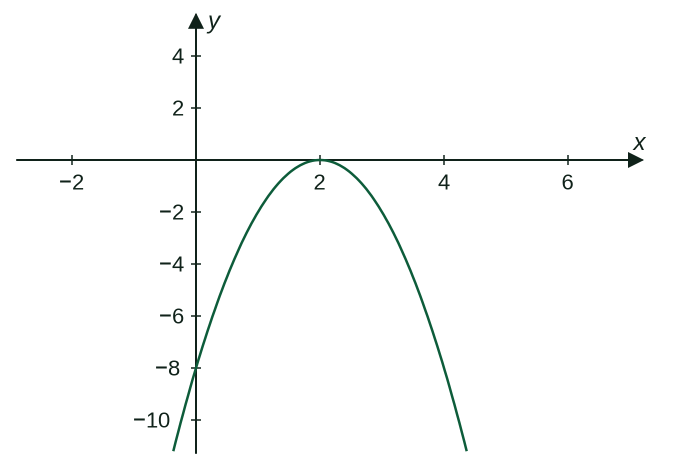
Let f be a function whose graph is given (parabola). Which one of the following is equal to f(x)?
Figure for question 5 from the exam paper
  1. A. −2x2+4x−8-2x^2 + 4x - 8
  2. B. 2x2−8x+82x^2 - 8x + 8
  3. C. 8x−2x2+88x - 2x^2 + 8
  4. D. 8x−2x2−88x - 2x^2 - 8
Worked solutionUnofficial

Answer: D

The vertex is (2,0)(2, 0), so f(x)=a(x−2)2f(x) = a(x-2)^2.

The graph passes through (0,−8)(0, -8): −8=a(0−2)2=4a-8 = a(0-2)^2 = 4a, so a=−2a = -2.

f(x)=−2(x−2)2=−2x2+8x−8f(x) = -2(x-2)^2 = -2x^2 + 8x - 8

This is 8x−2x2−88x - 2x^2 - 8.

Answer: D.

Why not A/B/C?

  • A. −2x2+4x−8-2x^2 + 4x - 8 has vertex at x=1x = 1 and never touches the x-axis.
  • B. 2x2−8x+82x^2 - 8x + 8 is the mirror image: it opens upward and crosses the y-axis at +8.
  • C. 8x−2x2+88x - 2x^2 + 8 crosses the y-axis at +8 and its vertex is above the x-axis.

Unofficial — solved by Abrari, not an official EAES key.

Practice this subject

Q1 · Number theory

In the set of natural numbers, which one of the following defines a composite number?
  1. A. A number that has only two distinct factors.
  2. B. A number that is divisible by numbers from 2 to 9.
  3. C. A number that has two or more different factors.
  4. D. A number that has three or more different divisors.
Worked solutionUnofficial

Unofficial keyed letter D. A full worked solution is not published for this item yet.

Unofficial — solved by Abrari, not an official EAES key.

Practice this subject

Q2 · Radicals

Which of the following is true about rationalizing the denominator?
  1. A. Only denominators can be multiplied by an irrational number.
  2. B. Only numerators can be rationalized when there is a radical.
  3. C. It is a method of changing the denominator into a rational number.
  4. D. It is a technique of multiplying a given number by an irrational expression.
Worked solutionUnofficial

Unofficial keyed letter C. A full worked solution is not published for this item yet.

Unofficial — solved by Abrari, not an official EAES key.

Practice this subject

Q3 · Division algorithm

When dividing 142 by 13 and expressed the result by applying the division algorithm, we get?
  1. A. 142=10(13)+2142 = 10(13) + 2
  2. B. 142=11(13)−1142 = 11(13) - 1
  3. C. 142=11(13)+1142 = 11(13) + 1
  4. D. 142=10(14)+2142 = 10(14) + 2
Worked solutionUnofficial

Unofficial keyed letter B. A full worked solution is not published for this item yet.

Unofficial — solved by Abrari, not an official EAES key.

Practice this subject

Q6 · Similar figures

Which one of the following refers to the definition of similar plane figures?
  1. A. Figures whose corresponding angles have the same ratio.
  2. B. Figures where one is an enlargement of the other.
  3. C. Figures whose ratios of length of corresponding sides are different.
  4. D. Figures that have different shapes but might have same size.
Worked solutionUnofficial

Unofficial keyed letter B. A full worked solution is not published for this item yet.

Unofficial — solved by Abrari, not an official EAES key.

Practice this subject

Q7 · Right triangle trig

In △ABC\triangle ABC, m(<B) = 90°, m(<A) = 30° and BC = 11cm, then what is the length of AC‾\overline{AC}?
  1. A. 22 cm
  2. B. 2233\frac{22\sqrt{3}}{3} cm
  3. C. 11311\sqrt{3} cm
  4. D. 1133\frac{11\sqrt{3}}{3} cm
Worked solutionUnofficial

Unofficial keyed letter A. A full worked solution is not published for this item yet.

Unofficial — solved by Abrari, not an official EAES key.

Practice this subject

Q8 · Circle chord

Given a circle of diameter 16 cm, a chord of the circle is 6 cm far from the center. Which of the following is the length of the chord?
  1. A. 272\sqrt{7} cm
  2. B. 8 cm
  3. C. 474\sqrt{7} cm
  4. D. 16 cm
Worked solutionUnofficial

Unofficial keyed letter C. A full worked solution is not published for this item yet.

Unofficial — solved by Abrari, not an official EAES key.

Practice this subject

Q10 · Statistics - mean

Let x‾\overline{x} denote the arithmetic mean. If each observation is multiplied by 0.5, which is the new mean?
  1. A. x‾\overline{x}
  2. B. 12x‾\frac{1}{2}\overline{x}
  3. C. 2x‾2\overline{x}
  4. D. x‾−0.5\overline{x}- 0.5
Worked solutionUnofficial

Unofficial keyed letter B. A full worked solution is not published for this item yet.

Unofficial — solved by Abrari, not an official EAES key.

Practice this subject

Q11 · Probability

A regular triangular pyramid labeled 1, 2 and 3 is thrown twice. What is the probability that the sum of the numbers faced down is less than 5?
  1. A. 13\frac{1}{3}
  2. B. 23\frac{2}{3}
  3. C. 49\frac{4}{9}
  4. D. 59\frac{5}{9}
Worked solutionUnofficial

Unofficial keyed letter B. A full worked solution is not published for this item yet.

Unofficial — solved by Abrari, not an official EAES key.

Practice this subject

Q13 · Polynomial function

Which one of the following is the definition of a polynomial function?
  1. A. f(x)=anxn+an−1xn−1+...+a1x+a0f(x) = a_n x^n + a_{n-1} x^{n-1} + ... + a_1 x + a_0 where n is a non-negative integer, an≠0a_n \ne 0 and coefficients in R\mathbb{R}.
  2. B. f(x)=anxn+...+a1xn+1+a0f(x) = a_n x^n + ... + a_1 x^{n+1} + a_0 where n is a positive integer.
  3. C. f(x)=anxn+...+a1xn−1+a0f(x) = a_n x^n + ... + a_1 x^{n-1} + a_0 where n is an integer.
  4. D. f(x)=anxn−an−1xn−1+...+a1x+a0f(x) = a_n x^n - a_{n-1} x^{n-1} + ... + a_1 x + a_0 where n is a rational number.
Worked solutionUnofficial

Unofficial keyed letter A. A full worked solution is not published for this item yet.

Unofficial — solved by Abrari, not an official EAES key.

Practice this subject

10 of 31 unofficial 2016 E.C. questions on this page.

All 2016 E.C. stems: 2016 E.C. Mathematics Social (31)

2015 E.C. Mathematics questions

Unofficial stems, answers, and explanations from the Abrari bank. Years use the Ethiopian calendar.

Q16 · Logarithmic functions - graph

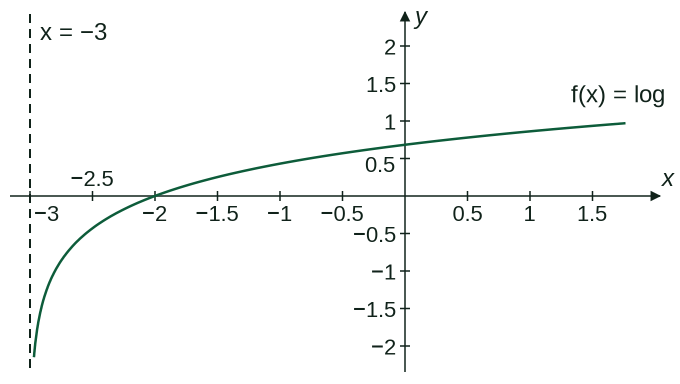
Consider the graph of f(x)=log⁡5(x+3)f(x) = \log_5(x + 3) which is shown below. Which one of the following is NOT true about the function ff?
Figure for question 16 from the exam paper
  1. A. The domain of ff is the set of all real numbers greater than −3-3.
  2. B. The x-intercept of the graph of ff is −2-2.
  3. C. The y-axis is a vertical asymptote of the graph of ff.
  4. D. The function increases as the value of xx increases.
Worked solutionUnofficial

Answer: C

A log is defined only for positive inputs, so we need x+3>0x + 3 > 0, which means x>−3x > -3. So A is true.

Set f(x)=0f(x) = 0: log⁡5(x+3)=0\log_5(x+3) = 0 gives x+3=1x + 3 = 1, so x=−2x = -2. So B is true.

The base 5 is greater than 1, so ff increases. D is true.

The vertical asymptote is where x+3=0x + 3 = 0, which is the line x=−3x = -3, the dashed line in the graph. It is not the y-axis (x=0x = 0). The graph actually crosses the y-axis at log⁡53≈0.68\log_5 3 \approx 0.68.

Answer: C.

Why not A/B/D?

  • A. True: x+3>0x + 3 > 0 gives the domain x>−3x > -3.
  • B. True: log⁡5(x+3)=0\log_5(x+3) = 0 when x+3=1x + 3 = 1, which gives x=−2x = -2.
  • D. True: a logarithm with base greater than 1 is an increasing function.

Unofficial — solved by Abrari, not an official EAES key.

Practice this subject

Q17 · Geometry - medians and centroid

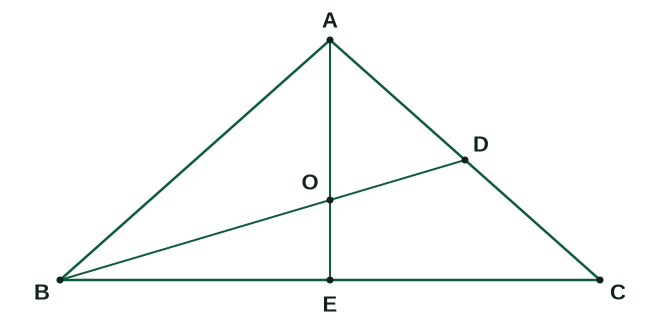
In △ABC\triangle ABC shown below, the medians BD‾\overline{BD} and AE‾\overline{AE} of △ABC\triangle ABC are concurrent at point OO. If BD=15BD = 15 cm, OD=5OD = 5 cm and AO=BOAO = BO, then which one of the following is NOT true?
Figure for question 17 from the exam paper
  1. A. BO = 10 cm
  2. B. OE = 5 cm
  3. C. AO = 5 cm
  4. D. AE = 15 cm
Worked solutionUnofficial

Answer: C

The medians meet at the centroid, which divides each median in the ratio 2:12:1 from the vertex.

BD=15BD = 15 and OD=5OD = 5, so BO=15−5=10BO = 15 - 5 = 10 cm.

Given AO=BOAO = BO, so AO=10AO = 10 cm.

Then OE=12AO=5OE = \tfrac{1}{2}AO = 5 cm and AE=10+5=15AE = 10 + 5 = 15 cm.

So A, B and D are true, but AO=5AO = 5 cm is false.

Answer: C.

Why not A/B/D?

  • A. BO = BD − OD = 15 − 5 = 10 cm, so this statement is true.
  • B. OE is half of AO = 10 cm, so OE = 5 cm is true.
  • D. AE = AO + OE = 10 + 5 = 15 cm, so this statement is true.

Unofficial — solved by Abrari, not an official EAES key.

Practice this subject

Q28 · Matrices - augmented matrix

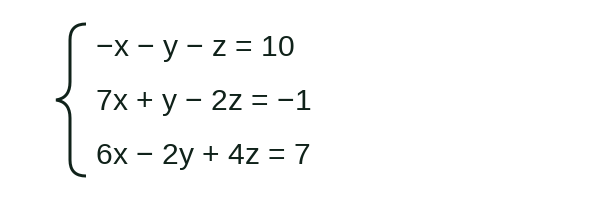
Consider the system of equations (shown in image). Which one of the following is the correct augmented matrix of the given system?
Figure for question 28 from the exam paper
  1. A. (−176−11−2−1−2410−17)\begin{pmatrix} -1 & 7 & 6 \\ -1 & 1 & -2 \\ -1 & -2 & 4 \\ 10 & -1 & 7 \end{pmatrix}
  2. B. (10−1−1−1−1−21774−26)\begin{pmatrix} 10 & -1 & -1 & -1 \\ -1 & -2 & 1 & 7 \\ 7 & 4 & -2 & 6 \end{pmatrix}
  3. C. (−1−1−11071−2−16−247)\begin{pmatrix} -1 & -1 & -1 & 10 \\ 7 & 1 & -2 & -1 \\ 6 & -2 & 4 & 7 \end{pmatrix}
  4. D. (−1−1−171−26−2410−17)\begin{pmatrix} -1 & -1 & -1 \\ 7 & 1 & -2 \\ 6 & -2 & 4 \\ 10 & -1 & 7 \end{pmatrix}
Worked solutionUnofficial

Answer: C

An augmented matrix has one row per equation. The first three columns hold the coefficients of xx, yy, zz and the last column holds the constant.

Row 1, from −x−y−z=10-x-y-z=10: (−1, −1, −1∣10)(-1,\ -1,\ -1 \mid 10).

Row 2, from 7x+y−2z=−17x+y-2z=-1: (7, 1, −2∣−1)(7,\ 1,\ -2 \mid -1).

Row 3, from 6x−2y+4z=76x-2y+4z=7: (6, −2, 4∣7)(6,\ -2,\ 4 \mid 7).

(−1−1−11071−2−16−247)\begin{pmatrix} -1 & -1 & -1 & 10 \\ 7 & 1 & -2 & -1 \\ 6 & -2 & 4 & 7 \end{pmatrix}

Answer: C.

Why not A/B/D?

  • A. This is the transpose of the correct matrix (4 × 3), so its rows are variables instead of equations.
  • B. This puts the constants in the first column and scrambles the entries, so the rows no longer match the equations.
  • D. This is a 4 × 3 matrix with the constants written as a bottom row, which is not the augmented matrix of a 3-equation system.

Unofficial — solved by Abrari, not an official EAES key.

Practice this subject

Q33 · Statistics - deciles

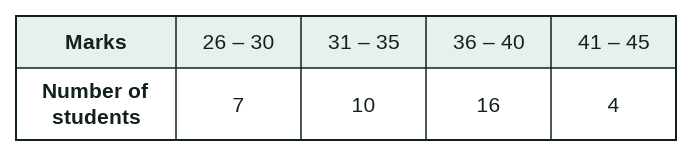
The following table shows the frequency distribution of scores of students in Mathematics Mid-Exam which was marked out of 50. Which one of the following is TRUE about distribution score?
Figure for question 33 from the exam paper
  1. A. The third decile of the distribution lies in the first class.
  2. B. The fourth decile of the distribution is in the third class.
  3. C. The fifth decile of the distribution lies in the third class.
  4. D. The eighth decile of the distribution lies in the fourth class.
Worked solutionUnofficial

Answer: C

Total N=7+10+16+4=37N = 7 + 10 + 16 + 4 = 37. Cumulative frequencies: 7, 17, 33, 377,\ 17,\ 33,\ 37. The kk-th decile is at position kN10\dfrac{kN}{10}.

  • D3D_3: 3(37)10=11.1\dfrac{3(37)}{10} = 11.1 → falls in class 2 (cf 8–17).
  • D4D_4: 14.814.8 → class 2.
  • D5D_5: 18.518.5 → class 3 (cf 18–33).
  • D8D_8: 29.629.6 → class 3. Only the statement about D5D_5 in the third class is true.

Answer: C.

Why not A/B/D?

  • A. D₃ is at position 11.1, which is past the first class's 7 students, so it is in the second class.
  • B. D₄ is at position 14.8, which is within the cumulative 17 of the second class, not the third.
  • D. D₈ is at position 29.6, which is within the cumulative 33 of the third class, not the fourth.

Unofficial — solved by Abrari, not an official EAES key.

Practice this subject

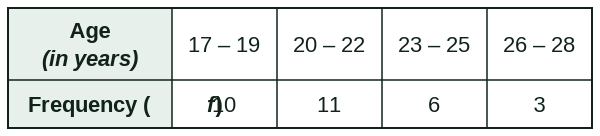
Q34 · Statistics - mean

The following table shows the age distribution of Grade 12 students in one section of a certain school. Which one of the following is the mean age in years?
Figure for question 34 from the exam paper
  1. A. 20.2
  2. B. 22.2
  3. C. 23.2
  4. D. 21.2
Worked solutionUnofficial

Answer: D

For grouped data, use the class midpoint xx for each class.

| Class | xx | ff | fxfx | |---|---|---|---| | 17–19 | 18 | 10 | 180 | | 20–22 | 21 | 11 | 231 | | 23–25 | 24 | 6 | 144 | | 26–28 | 27 | 3 | 81 |

∑f=30\sum f = 30 and ∑fx=636\sum fx = 636.

xˉ=∑fx∑f=63630=21.2 years\bar{x} = \frac{\sum fx}{\sum f} = \frac{636}{30} = 21.2\ \text{years}

Answer: D.

Why not A/B/C?

  • A. 20.2 is one year too low; it comes from an arithmetic slip, such as using lower class limits shifted by one.
  • B. 22.2 is one year too high; it comes from using upper-boundary-type values (for example 19, 22, 25, 28) instead of midpoints.
  • C. 23.2 is far too high; with 21 of the 30 students aged 17–22, the mean cannot be above 23.

Unofficial — solved by Abrari, not an official EAES key.

Practice this subject

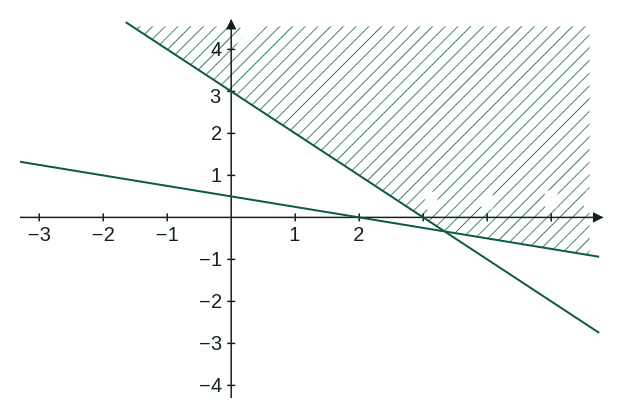
Q41 · Linear inequalities - graph

On the coordinate plane a graph is given as shown below. Which one of the following system of linear inequalities has the above shaded region as its solution?
Figure for question 41 from the exam paper
  1. A. {−x−y≤−3x+4y≥2\begin{cases}-x-y\leq-3\\x+4y\geq2\end{cases}
  2. B. {x+y≤3x+4y≥2\begin{cases}x+y\leq3\\x+4y\geq2\end{cases}
  3. C. {−x−y≥−3x+4y≤2\begin{cases}-x-y\geq-3\\x+4y\leq2\end{cases}
  4. D. {x+y≥−3x+4y≤2\begin{cases}x+y\geq-3\\x+4y\leq2\end{cases}
Worked solutionUnofficial

Answer: A

The steep line through (0,3)(0,3) and (3,0)(3,0) is x+y=3x+y=3. The shallow line through (0,12)(0,\tfrac12) and (2,0)(2,0) is y=−14x+12y=-\tfrac14x+\tfrac12, that is x+4y=2x+4y=2. The hatched region lies above both lines, so a point inside it, such as (4,1)(4,1), works as a test point. At (4,1)(4,1): x+y=5≥3x+y=5\ge 3 and x+4y=8≥2x+4y=8\ge 2. The region is x+y≥3x+y\ge 3 and x+4y≥2x+4y\ge 2. Multiplying x+y≥3x+y\ge 3 by −1-1 flips the sign: −x−y≤−3-x-y\le -3. This matches option A. Answer: A.

Why not B/C/D?

  • B. x+y≤3x+y\le 3 is the side containing the origin, below the steep line, which is not hatched.
  • C. −x−y≥−3-x-y\ge -3 means x+y≤3x+y\le 3, and x+4y≤2x+4y\le 2; both describe the unhatched side containing the origin.
  • D. x+y≥−3x+y\ge -3 uses the wrong boundary line, and x+4y≤2x+4y\le 2 is the side below the shallow line.

Unofficial — solved by Abrari, not an official EAES key.

Practice this subject

Q51 · Average rate of change

The following table is the distance traveled by a car in the given times. Which of the following time intervals has the maximum average rate of change of the distance with respect to time?
Figure for question 51 from the exam paper
  1. A. t = 1 hour and t = 2 hours
  2. B. t = 2 hours and t = 3 hours
  3. C. t = 3 hours and t = 4 hours
  4. D. t = 4 hours and t = 5 hours
Worked solutionUnofficial

Answer: D

Each interval is 1 hour long, so the average rate of change is just the change in distance.

t=1→2t = 1 \to 2: 50−301=20\frac{50-30}{1} = 20 km/h

t=2→3t = 2 \to 3: 60−501=10\frac{60-50}{1} = 10 km/h

t=3→4t = 3 \to 4: 80−601=20\frac{80-60}{1} = 20 km/h

t=4→5t = 4 \to 5: 120−801=40\frac{120-80}{1} = 40 km/h, which is the largest.

Answer: D.

Why not A/B/C?

  • A. The rate here is only 20 km/h, half of the 40 km/h in the last hour.
  • B. This is the smallest rate, 10 km/h.
  • C. This is 20 km/h, which ties with A but is less than 40 km/h.

Unofficial — solved by Abrari, not an official EAES key.

Practice this subject

Q1 · Statistics - mean

A student took 5 Model Exams and scored 85, 88, 90 and 92 in four subjects namely English, Geography, Economics and History exams respectively. She did not know her score in Mathematics exam but she knew that her mean score in all five exams is 90. What is her score in Mathematics?
  1. A. 95
  2. B. 89
  3. C. 90
  4. D. 93
Worked solutionUnofficial

Unofficial keyed letter A. A full worked solution is not published for this item yet.

Unofficial — solved by Abrari, not an official EAES key.

Practice this subject

Q2 · Geometry - parallelogram area

For a parallelogram ABCD the length of side AB‾\overline{AB} is equal to the length of the side of a square with area 64 cm². If the length of side BC‾\overline{BC} of parallelogram ABCD is 3 cm and m(∠ABC) = 120°, what is the area of ABCD?
  1. A. 24324\sqrt{3} cm²
  2. B. 64 cm²
  3. C. 434\sqrt{3} cm²
  4. D. 12312\sqrt{3} cm²
Worked solutionUnofficial

Unofficial keyed letter D. A full worked solution is not published for this item yet.

Unofficial — solved by Abrari, not an official EAES key.

Practice this subject

Q3 · Geometry - symmetry

If a regular polygon circumscribes a circle and the sides of the polygon touches the circle at exactly seven points, what is the maximum number of lines of symmetry of the polygon?
  1. A. Eight
  2. B. Seven
  3. C. Six
  4. D. Five
Worked solutionUnofficial

Unofficial keyed letter B. A full worked solution is not published for this item yet.

Unofficial — solved by Abrari, not an official EAES key.

Practice this subject

10 of 56 unofficial 2015 E.C. questions on this page.

All 2015 E.C. stems: 2015 E.C. Mathematics Social (56)

Practise the rest of Mathematics online · Mathematics (Social) model exam · All Mathematics papers

Grade 12 national exam · Model exam questions · 2016 E.C. all subjects · 2017 E.C. all subjects · 2018 E.C. all subjects · All past papers · Practice online

Frequently asked questions

Are these official Grade 12 Mathematics exam questions?
No. They are unofficial practice reconstructed from the Abrari study bank. Abrari is not affiliated with MoE, EAES, or NEAEA and does not publish official keys.
Are the answers official?
No. Letters and worked solutions are unofficial Abrari keys. Do not treat them as an official marking scheme.
Why is only a sample on this page?
This page shows a sample grouped by year. Open a year paper or start Mathematics practice to work the rest of the bank, timed, with the same unofficial explanations.
Do you sell leaked or paid exam papers?
No. Abrari does not host leaked exams, paid bank copies, or official answer keys.