Stems are visible for study. Worked solutions stay inside each item and are unofficial.
Q1 · Biotechnology
A transgenic organism is an organism that:
A. can undergo chromosomal non-disjunctionB. replicates its DNA without controlC. has received genetic material of another organismD. is artificially cultured and harvestedWorked solutionUnofficial Unofficial keyed letter C. A full worked solution is not published for this item yet.
Unofficial — solved by Abrari, not an official EAES key.
Practice this subject
Q2 · Biosensor technology
Which of the following explains how biology takes part in biosensor technology? Using microorganism to
A. develop vaccinesB. monitor pollutantsC. extract metals from oresD. produce antibioticsWorked solutionUnofficial Unofficial keyed letter B. A full worked solution is not published for this item yet.
Unofficial — solved by Abrari, not an official EAES key.
Practice this subject
Q3 · Industrial microbiology
In a textile industry, microorganism's commercial products play a significant role in removing stains like grease by changing:
A. the temperature of insoluble large stain moleculesB. the acidic or basic nature of the stain moleculesC. the color of stain molecules to another colorD. large insoluble stain molecules into small and soluble onesWorked solutionUnofficial Unofficial keyed letter D. A full worked solution is not published for this item yet.
Unofficial — solved by Abrari, not an official EAES key.
Practice this subject
Q4 · Bio-pesticides
Which one of the following statements is correct about application of bio-pesticide in agriculture? It
A. breakdowns glyphosate by an enzyme introduced into plant cell culture.B. uses bacteria and fungi or their metabolites to kill insects.C. produces insect resistant crops through modification of the plant genes using bacterial plasmids.D. produces toxic chemicals by crops through modification of their genes.Worked solutionUnofficial Unofficial keyed letter B. A full worked solution is not published for this item yet.
Unofficial — solved by Abrari, not an official EAES key.
Practice this subject
Q5 · Bacteria
Which one of the following statements correctly describes bacteria?
A. They are single celled prokaryotic organisms.B. They are multicellular eukaryotic organisms.C. They are single celled eukaryotic organisms.D. They are multicellular prokaryotic organisms.Worked solutionUnofficial Unofficial keyed letter A. A full worked solution is not published for this item yet.
Unofficial — solved by Abrari, not an official EAES key.
Practice this subject
Q6 · Evolution/Gene flow
Gene flow is the movement of genetic material
A. that drives a population towards perfection.B. without altering the allele frequencies.C. without affecting the balance of gene pool of a population.D. where organisms either join or leave a population.Worked solutionUnofficial Unofficial keyed letter D. A full worked solution is not published for this item yet.
Unofficial — solved by Abrari, not an official EAES key.
Practice this subject
Q7 · Nervous system
Which one of the following options is a constituent of peripheral nervous system?
A. Somatic sensory nerves, spinal cord and efferent nervesB. Afferent nerves, brain and automatic motor nervesC. Afferent nerves, efferent nerves and somatic motor nervesD. Spinal cord, efferent nerves and somatic sensory nervesWorked solutionUnofficial Unofficial keyed letter C. A full worked solution is not published for this item yet.
Unofficial — solved by Abrari, not an official EAES key.
Practice this subject
Q8 · Neuron structure
Which one of the following structures of neurons is correctly paired with its function?
A. Cell body - maintains structure and supply energyB. Axon - receives signal from muscleC. Dendrites - protects the neuron and insulate itD. Myelin sheath - reduces nerve impulse transmissionWorked solutionUnofficial Unofficial keyed letter A. A full worked solution is not published for this item yet.
Unofficial — solved by Abrari, not an official EAES key.
Practice this subject
Q9 · Nerve impulse
Which one of the following statements explains how nerve impulse is occurred?
A. the movement of neurotransmitter molecules into myelin sheath.B. charge difference across the membrane of axon.C. balanced course across the membrane of dendrites.D. the movement of neurotransmitter molecules out of cell body.Worked solutionUnofficial Unofficial keyed letter B. A full worked solution is not published for this item yet.
Unofficial — solved by Abrari, not an official EAES key.
Practice this subject
Q10 · Synapse
Which one of the following statements is an acceptable justification of importance of synapse? Synapse is
A. a facilitator of the reverse flow of neurotransmitter chemical in neuronB. the mechanism of protecting the axon from external damageC. a connection between dendrites of consecutive neuronsD. a conductor of action potential towards the end of the dendriteWorked solutionUnofficial Unofficial keyed letter C. A full worked solution is not published for this item yet.
Unofficial — solved by Abrari, not an official EAES key.
Practice this subject
Q11 · Enzyme inhibition
Which one the following statements explains how the allosteric inhibitors act on enzymes activities? By
A. binding to a site other than the active site and altering the shape of the active siteB. substrate and preventing it from binding to the active siteC. active site of an enzyme and blocking the substrateD. active site and altering the shape of the enzymeWorked solutionUnofficial Unofficial keyed letter A. A full worked solution is not published for this item yet.
Unofficial — solved by Abrari, not an official EAES key.
Practice this subject
Q12 · Enzymes/Metabolism
Why are enzymes considered special molecules in metabolism? Because
A. enzymes facilitate metabolic reactions under controlled physiological conditions.B. metabolic processes can produce special products in the presence of enzymes.C. enzymes are protein molecules that act as a source of energy.D. reactions can't totally take place in the absence of enzymes.Worked solutionUnofficial Unofficial keyed letter A. A full worked solution is not published for this item yet.
Unofficial — solved by Abrari, not an official EAES key.
Practice this subject
Q13 · History of cell biology
Which of the following is the most advanced and recent event in the history of cell biology?
A. Enovation of the first scanning electron microscopeB. Discovery of the double-helix structure of DNAC. Description of the Golgi apparatusD. Sequencing of the human genomeWorked solutionUnofficial Unofficial keyed letter D. A full worked solution is not published for this item yet.
Unofficial — solved by Abrari, not an official EAES key.
Practice this subject
Q14 · Water properties
Which one of the following properties permits insects to freely walk on water? Its high
A. adhesive forceB. specific heat capacityC. latent heat of vaporizationD. surface tensionWorked solutionUnofficial Unofficial keyed letter D. A full worked solution is not published for this item yet.
Unofficial — solved by Abrari, not an official EAES key.
Practice this subject
Q15 · Microscopy
A student focused a slide of an onion epidermal cell on pre-estimated width of 2 millimeter field of view under a microscope. What will be the width of each individual cell if you count 8 cells that fit to the field of view during your observation?
A. 16 millimeterB. 0.40 millimeterC. 4 millimeterD. 0.25 millimeterWorked solutionUnofficial Unofficial keyed letter D. A full worked solution is not published for this item yet.
Unofficial — solved by Abrari, not an official EAES key.
Practice this subject
Q16 · Cell types
Which one of the following statements is correct about the differences between eukaryotic and prokaryotic cells? Prokaryotic cells have
A. small ribosomes whereas eukaryotic cells have large ribosomesB. membrane bound organelles whereas eukaryotic cells don't have itC. cell wall whereas eukaryotic cells don't have itD. division of labor whereas eukaryotic cells don't have itWorked solutionUnofficial Unofficial keyed letter A. A full worked solution is not published for this item yet.
Unofficial — solved by Abrari, not an official EAES key.
Practice this subject
Q17 · Biological tools
Which biological tool is correctly matched with its function?
A. Burette - to measure mass of a substanceB. Petri dishes - to culture microorganismsC. Centrifuges - to collect insectsD. Theodolite - to measure the rate of water flowWorked solutionUnofficial Unofficial keyed letter B. A full worked solution is not published for this item yet.
Unofficial — solved by Abrari, not an official EAES key.
Practice this subject
Q18 · Centrifugation
A student centrifuge a solution containing plant material in order to separate them based on their mass. After 10 minutes of centrifugation some of the components move to the bottom (A), others to the middle layer (B) and the remaining once to the top layer (C). Which alternative shows the mass of the components in decreasing order?
A. C>A>BB. A>B>CC. A=B=CD. B>A>CWorked solutionUnofficial Unofficial keyed letter B. A full worked solution is not published for this item yet.
Unofficial — solved by Abrari, not an official EAES key.
Practice this subject
Q19 · Future of biology
Which one of the following statements shows the future promise of biological sciences?
A. Using stem cells to repair damaged organs and grow new organB. Finding alternative living place for human populationC. Finding the adaptation mechanism of plant in new conditionD. Advising the government on how to conserve environmentWorked solutionUnofficial Unofficial keyed letter A. A full worked solution is not published for this item yet.
Unofficial — solved by Abrari, not an official EAES key.
Practice this subject
Q21 · Oxidative phosphorylation
During oxidative phosphorylation, ATP is produced by combining ADP and inorganic phosphate using energy released from
A. dehydrogenation of pyruvate to oxaloacetate.B. transport of electrons from complex IV to complex I.C. decarboxylation of citrate from NADH/FADH₂ to O₂.D. transfer of electrons from NADH/FADH₂ to O₂.Worked solutionUnofficial Unofficial keyed letter D. A full worked solution is not published for this item yet.
Unofficial — solved by Abrari, not an official EAES key.
Practice this subject
Q22 · Phosphorylation comparison
Which one of the following comparisons between substrate-level and oxidative phosphorylation is correct? During substrate-level phosphorylation
A. phosphorylation is made in the cytosol, but in oxidative phosphorylation it is made in the inner membrane of mitochondria.B. 34 ATP molecules are produced per glucose molecule, but in oxidative phosphorylation ATP molecules are produced per glucose molecule.C. protons are pumped into the inter-membrane space, but in oxidative phosphorylation they are pumped into the cytosol.D. oxygen is the final electron acceptor, but in oxidative phosphorylation NAD is the electron acceptor.Worked solutionUnofficial Unofficial keyed letter A. A full worked solution is not published for this item yet.
Unofficial — solved by Abrari, not an official EAES key.
Practice this subject
Q23 · Disease transmission
Which one of the following diseases and their mode of transmission is correctly matched?
A. Candidiasis - droplet infectionB. Salmonellosis - contaminated foodC. Chicken pox - fecal-oral-routeD. Common cold - direct contactWorked solutionUnofficial Unofficial keyed letter B. A full worked solution is not published for this item yet.
Unofficial — solved by Abrari, not an official EAES key.
Practice this subject
Q25 · Origin of life
The view of biochemical origin of life hypothesized that the first life-forms appeared in warm primitive ocean and were heterotrophic. Which one of the following statements can support this idea?
A. The appearance of dust of unknown source with microbial spores that can feed on organic molecules.B. Life is the inherent property of the universe which permits unlimited existence through usage of resource in it.C. The formation of abundant organic molecules due to radiations and the absence of oxygen led to the primitive living organisms.D. Resistant spores from meteorites reached to the earth and used organic molecules to survive in the environment.Worked solutionUnofficial Unofficial keyed letter C. A full worked solution is not published for this item yet.
Unofficial — solved by Abrari, not an official EAES key.
Practice this subject
Q26 · Lamarck vs Darwin
Which statement shows the correct comparison between the Lamarck's and Darwin's theory of evolution?
A. Darwin recognized the origin of species was through mutation while Lamarck believed it was through effect of the environment.B. Lamarck believed in the development of new traits due to variation while Darwin believed in their occurrence due to use and disuse of organs.C. Lamarck believed the gradual occurrence of changes while Darwin believed in the immediate change of species.D. Darwin claimed that variation is heritable while Lamarck considers variation as acquired traits.Worked solutionUnofficial Unofficial keyed letter D. A full worked solution is not published for this item yet.
Unofficial — solved by Abrari, not an official EAES key.
Practice this subject
Q27 · Bacterial conjugation
Identify the correct mechanism of bacterial reproduction by conjugation.
A. Mitotic spindles are produced to separate bacterial DNA into two equal parts.B. The recipient bacteria use their pili to pull the donor bacteria during plasmid transfer.C. Bacteria take up genetic materials of dead organisms and integrate into their DNA.D. A pair of bacteria come together and exchanges their plasmids.Worked solutionUnofficial Unofficial keyed letter D. A full worked solution is not published for this item yet.
Unofficial — solved by Abrari, not an official EAES key.
Practice this subject
Q28 · Fungi characteristics
Which of the following features is NOT the characteristic feature of fungi?
A. they reproduce asexually through spore productionB. have haploid spores and multinucleate hyphaeC. are often autotrophic, parasitic or saprophyticD. exhibit apical growth of networked hyphaeWorked solutionUnofficial Unofficial keyed letter C. A full worked solution is not published for this item yet.
Unofficial — solved by Abrari, not an official EAES key.
Practice this subject
Q29 · Viruses
What is the argument behind the need of appropriate host cell for viruses to replicate themselves? Because
A. viruses have cell surface antigen specific to a given cell typeB. are obligate saprophyte that can only replicate inside a cellC. lack metabolic capacity to produce energy outside cellsD. lack of double strand DNA to duplicate themselvesWorked solutionUnofficial Unofficial keyed letter C. A full worked solution is not published for this item yet.
Unofficial — solved by Abrari, not an official EAES key.
Practice this subject
Q30 · Metabolism
What is the basic difference between anabolism and catabolism?
A. Catabolism is condensation while anabolism is hydrolysis reactionB. Anabolism is related to respiration while catabolism is to photosynthesisC. Anabolism is energy absorbing while catabolism is energy releasing processD. Catabolism is a constructive while anabolism is a destructive reactionWorked solutionUnofficial Unofficial keyed letter C. A full worked solution is not published for this item yet.
Unofficial — solved by Abrari, not an official EAES key.
Practice this subject
Q31 · Skin/Dermis
What is the main function of the dermis of the skin?
A. Prevention of the entry of pathogensB. Production of skin pigmentsC. Synthesis of hair and nail proteinsD. Temperature regulation in homeostasisWorked solutionUnofficial Unofficial keyed letter D. A full worked solution is not published for this item yet.
Unofficial — solved by Abrari, not an official EAES key.
Practice this subject
Q32 · Eye anatomy
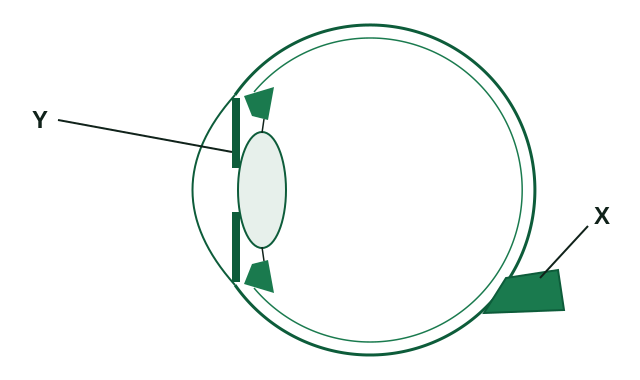
The part of the eye represented by letter 'Y' is
A. irisB. ciliary muscleC. optic nerveD. pupilWorked solutionUnofficial Answer: A
The thick cord leaving the back of the eye, labelled X, is the optic nerve.
The Y pointer goes to the dark, pigmented ring that sits just in front of the lens and behind the cornea.
That ring is the iris. It controls how big the pupil is.
The pupil is only the opening in the middle of the iris, and the ciliary muscle sits further out, where the lens is attached to the wall of the eye.
Answer: A.
Why not B/C/D?
B. The ciliary muscle sits at the edge of the lens, where it joins the eye wall through the suspensory ligaments. Y points to the pigmented band in front of the lens instead.C. The optic nerve is the structure labelled X, at the back of the eye.D. The pupil is the opening in the centre of the iris, not the pigmented tissue the Y line touches.Unofficial — solved by Abrari, not an official EAES key.
Practice this subject
Q33 · Ear/Balance
A man observed elementary school students spinning around, and realized that none of them could properly walk upright after sudden interruption of the spinning. Which one of the following is the correct reason for this condition?
A. The sensory cells were unable to detect stimulus after the spinning was quitted.B. The fluid in the semi secular canal stopped immediately when the body stopped spinning.C. The fluid in the semicircular canal kept moving after the spinning was interrupted.D. The nerve impulse was transmitted after the spinning was stopped.Worked solutionUnofficial Unofficial keyed letter C. A full worked solution is not published for this item yet.
Unofficial — solved by Abrari, not an official EAES key.
Practice this subject
Q34 · Hormones
Which of the following is the correct description of hormones? They are chemical messengers that
A. transmit message faster than the nerve system.B. regulates many physiological process.C. targets only the site of secretion.D. are produced in glands that contain ducts.Worked solutionUnofficial Unofficial keyed letter B. A full worked solution is not published for this item yet.
Unofficial — solved by Abrari, not an official EAES key.
Practice this subject
Q35 · Homeostasis
Homeostasis is a mechanism of
A. adjusting the cell environment relative to body conditionB. keeping the internal body environment constantC. keeping the external environment stableD. protecting the body from pathogensWorked solutionUnofficial Unofficial keyed letter B. A full worked solution is not published for this item yet.
Unofficial — solved by Abrari, not an official EAES key.
Practice this subject
Q36 · Evidences of evolution
Which of the following is true concerning the evidences of evolution?
A. Organisms which live in the same area have similar evolutionary history.B. Organisms which have little genetic relationship show similar behavior.C. Species that are closely related share the most similar DNA sequences.D. Species that live in the same geographic area have the same genetic makeup.Worked solutionUnofficial Unofficial keyed letter C. A full worked solution is not published for this item yet.
Unofficial — solved by Abrari, not an official EAES key.
Practice this subject
Q37 · Natural selection
In a fox population, foxes with thicker fur survived better in cold climate compared to those with thinner fur, however, foxes with thinner fur survived better when the climate was very hot. What type of natural selection is described in this scenario?
A. Stabilizing selectionB. Diversifying selectionC. Disruptive selectionD. Directional selectionWorked solutionUnofficial Unofficial keyed letter C. A full worked solution is not published for this item yet.
Unofficial — solved by Abrari, not an official EAES key.
Practice this subject
Q38 · Gene mutation
The type of gene mutation that results in the change of a triplet (GAG) in a normal hemoglobin to another triplet (GTG) in sickle-cell hemoglobin is
A. insertion mutationB. deletion mutationC. substitutionD. non-disjunctionWorked solutionUnofficial Unofficial keyed letter C. A full worked solution is not published for this item yet.
Unofficial — solved by Abrari, not an official EAES key.
Practice this subject
Q39 · Human evolution
In human evolution, brain size increased over the course of evolution. Which alternative contains the correct series of brain size?
A. Homo erectus → Homo habilis → Homo neanderthalensis → Homo sapiensB. Homo neanderthalensis → Homo erectus → Homo habilis → Homo sapiensC. Homo erectus → Homo neanderthalensis → Homo habilis → Homo sapiensD. Homo habilis → Homo erectus → Homo neanderthalensis → Homo sapiensWorked solutionUnofficial Unofficial keyed letter D. A full worked solution is not published for this item yet.
Unofficial — solved by Abrari, not an official EAES key.
Practice this subject
Q40 · Genetic drift
Which one of the following statements correctly explains the genetic drift? It is a change in allele frequency due to
A. non-random mating of individuals in a population.B. independent assortment of chromosomes.C. chance based sampling error.D. relocation of species into other areas.Worked solutionUnofficial Unofficial keyed letter C. A full worked solution is not published for this item yet.
Unofficial — solved by Abrari, not an official EAES key.
Practice this subject
Q41 · Photosynthesis/Calvin cycle
Which one among the following processes occurs during the light independent phase of photosynthesis?
A. Excitation of electrons from chlorophyll moleculesB. Cyclic photophosphorylation of ADP in the thylakoidC. Splitting of water molecules into its componentsD. Reduction of triose molecules by hydrogen from NADPHWorked solutionUnofficial Unofficial keyed letter D. A full worked solution is not published for this item yet.
Unofficial — solved by Abrari, not an official EAES key.
Practice this subject
Q43 · Photosynthesis equation
Which of the following chemical reactions is the process of photosynthesis?
A. C6H12O6 + 6O2 → 6CO2 + 6H2O + ATPB. C6H12O6 + 6CO2 → C6H12O6 + 6O2 + ATPC. 6CO2 + 6H2O → C6H12O6 + 6O2 + 6H2OD. 6CO2 + 12H2O → C6H12O6 + 6O2 + 6H2OWorked solutionUnofficial Unofficial keyed letter D. A full worked solution is not published for this item yet.
Unofficial — solved by Abrari, not an official EAES key.
Practice this subject
Q44 · ATP structure
Which one of the following statements properly describes the structure of ATP? It is made up of
A. two adenine bases attached to a hexose sugar and three phosphate groups.B. one adenine base attached to a pentose sugar and three phosphate groups.C. two adenine bases attached to a deoxyribose sugar and two phosphate groups.D. one adenine base attached to a ribose sugar and two phosphate groups.Worked solutionUnofficial Unofficial keyed letter B. A full worked solution is not published for this item yet.
Unofficial — solved by Abrari, not an official EAES key.
Practice this subject
Q45 · Glycolysis
Which one of the following descriptions about glycolysis is correct? It is a process
A. that produces a net of 4 ATP through substrate level phosphorylation.B. of producing acetyl CoA from pyruvate by releasing CO2.C. of breaking down of a glucose molecule to two pyruvates.D. that takes place in the cytosol with high demand of oxygen.Worked solutionUnofficial Unofficial keyed letter C. A full worked solution is not published for this item yet.
Unofficial — solved by Abrari, not an official EAES key.
Practice this subject
Q46 · Kidney/Bowman's capsule
Which one of the following is the main function of Bowman's capsule of the human kidneys?
A. Prevent back flow of urineB. Mineral reabsorptionC. Ultrafiltration of bloodD. Water preservationWorked solutionUnofficial Unofficial keyed letter C. A full worked solution is not published for this item yet.
Unofficial — solved by Abrari, not an official EAES key.
Practice this subject
Q47 · Thermoregulation
What is the justification for feeling warm while sweating a lot in a very humid condition?
A. Closure of the glands in the epidermal layer of the skinB. The lower rate of evaporation of water from the skin surfaceC. An increase in metabolic rate as temperature increasesD. Unequal distribution of ions on membrane of cellsWorked solutionUnofficial Unofficial keyed letter B. A full worked solution is not published for this item yet.
Unofficial — solved by Abrari, not an official EAES key.
Practice this subject
Q48 · Climate change
Among the following statements, one briefly describes the concept of climate change. It is the
A. radical change of local weather condition that sustain for less than a year.B. sudden change in an average rainfall of a limited area.C. gradual change of atmospheric temperature over a short period of time.D. global change in the temperature, precipitation and wind conditions.Worked solutionUnofficial Unofficial keyed letter D. A full worked solution is not published for this item yet.
Unofficial — solved by Abrari, not an official EAES key.
Practice this subject
Q49 · Greenhouse effect
As a result of human activities, huge amount of carbon dioxide has been accumulated in the atmosphere. What is the consequence of this phenomenon?
A. Increased rate of uptake of carbon dioxide by green plantsB. Drop in temperature of the earth and death of aquatic organismsC. Preventing certain amount of heat escaping back to the spaceD. Reduction in the sea level and death of aquatic animalsWorked solutionUnofficial Unofficial keyed letter C. A full worked solution is not published for this item yet.
Unofficial — solved by Abrari, not an official EAES key.
Practice this subject
Q50 · UNFCCC
What was the main objective of the United Nations Framework Convention on Climate Change (UNFCCC)?
A. Prevention of dangerous man-made interference with the climate systemB. Reduction of the monopole utilization of border crossing rivers to prevent climate changeC. Donation of high carbon projects related to climate change by the developed countriesD. Prohibition of developing countries from setting up big industries that could affect the climateWorked solutionUnofficial Unofficial keyed letter A. A full worked solution is not published for this item yet.
Unofficial — solved by Abrari, not an official EAES key.
Practice this subject
Q51 · Ecology
The ability of carnivores to survive in an ecosystem is dependent on the
A. catastrophic factor.B. abiotic factor.C. edaphic factor.D. biotic factor.Worked solutionUnofficial Unofficial keyed letter D. A full worked solution is not published for this item yet.
Unofficial — solved by Abrari, not an official EAES key.
Practice this subject
Q52 · Pyramid of biomass
This item is based on the following pyramid of biomass. Which alternative contains organisms that can occupy the above pyramid of biomass from the bottom to the top?
A. Grass, Cricket, Chicken and LizardB. Grass, Cricket, Lizard and ChickenC. Grass, Chicken, Cricket and LizardD. Grass, Lizard, Cricket and ChickenWorked solutionUnofficial Answer: B
A pyramid of biomass is built from a food chain: producer at the bottom, then each consumer that eats the level below.
Grass is the producer, so it is the bottom level.
Crickets eat grass (primary consumer).
Lizards eat insects such as crickets (secondary consumer).
Chickens eat lizards as well as insects, so the chicken is the top (tertiary) consumer.
The chain is Grass → Cricket → Lizard → Chicken.
Answer: B.
Why not A/C/D?
A. It puts the chicken below the lizard, but a lizard does not feed on chickens.C. It puts the chicken as the primary consumer eating grass and below the cricket, but crickets do not eat chickens.D. It puts the lizard directly above grass, but lizards do not eat grass, and crickets do not eat lizards.Unofficial — solved by Abrari, not an official EAES key.
Practice this subject
Q53 · Carbon cycle
The two reverse processes that play a significant role in absorbing and releasing carbon dioxide, respectively are
A. decomposition and respiration.B. combustion and photosynthesis.C. respiration and assimilation.D. photosynthesis and respiration.Worked solutionUnofficial Unofficial keyed letter D. A full worked solution is not published for this item yet.
Unofficial — solved by Abrari, not an official EAES key.
Practice this subject
Q54 · Adaptation
Which one of the following adaptations is important for survival of polar bear in very cold environments? Having
A. smaller sizeB. blubbers under the skinC. thick wrinkled earsD. fine silky furWorked solutionUnofficial Unofficial keyed letter B. A full worked solution is not published for this item yet.
Unofficial — solved by Abrari, not an official EAES key.
Practice this subject
Q55 · Blood groups
Assume your friend has a blood type that has no antigen on his red blood cells but produces antibodies a and b, loses blood due to a car accident. If blood transfusion is necessary to save his life, your friend can receive blood from someone with
A. blood type B.B. blood type AB.C. blood type O.D. blood type A.Worked solutionUnofficial Unofficial keyed letter C. A full worked solution is not published for this item yet.
Unofficial — solved by Abrari, not an official EAES key.
Practice this subject
Q56 · Meiosis
A student concluded that the stage of meiosis on a prepared slide of plant tissue he observed was Anaphase II. What do you think was the reason to come to this conclusion? Observation of
A. divided centromere and separated sister chromatidsB. reformed nuclear envelope and reappearance of nucleolusC. one chromosome from each homologous pairs at the polesD. crossing over between non-sister chromatids of homologous pairsWorked solutionUnofficial Unofficial keyed letter A. A full worked solution is not published for this item yet.
Unofficial — solved by Abrari, not an official EAES key.
Practice this subject
Q57 · Taxonomy/Binomial
The binomial system of naming developed by Linnaeus comprises two names. Which hierarchical groups are used?
A. Kingdome and speciesB. Order and familyC. Genus and speciesD. Kingdome and phylumWorked solutionUnofficial Unofficial keyed letter C. A full worked solution is not published for this item yet.
Unofficial — solved by Abrari, not an official EAES key.
Practice this subject
Q58 · Kingdom Monera
Which one of the following is the feature of kingdom Monera? Its members are
A. multicellular with cell walls.B. unicellular without separated nucleus.C. mainly autotrophic and saprophytic.D. reproduced by hyphia formation.Worked solutionUnofficial Unofficial keyed letter B. A full worked solution is not published for this item yet.
Unofficial — solved by Abrari, not an official EAES key.
Practice this subject
Q59 · Harmful organisms
Which alternative given below is comprised of harmful groups from the kingdom Monera, Protista and Fungi, respectively?
A. Candidaulbicans, Mycobacterium tuberculosis and TrypanosomaB. Trypanosoma, Plasmodium falciparum and TrypanosomaC. Haemophilus ducreyi, Trypanosoma cruzi and Tinea pedisD. Trypanosoma, Plasmodium falciparum and PenicilliumWorked solutionUnofficial Unofficial keyed letter C. A full worked solution is not published for this item yet.
Unofficial — solved by Abrari, not an official EAES key.
Practice this subject
Q60 · Mollusca
Which one of the following is a feature of Octopi and squid in phylum mollusca? They have
A. well-developed brain.B. segmented body with head and thorax.C. lung as a breathing structure.D. hard muscular foot with a hard body.Worked solutionUnofficial Unofficial keyed letter A. A full worked solution is not published for this item yet.
Unofficial — solved by Abrari, not an official EAES key.
Practice this subject
Q61 · Ethiopian research institutes
Which one of the following research activities has been conducted at Armauer Hansen Research Institute?
A. Improving crop production through genetic engineeringB. Conserving the genes of endemic plants and animalsC. Assessing the nutritional status of mothers and babiesD. Developing drugs for leishmaniasis and tuberculosisWorked solutionUnofficial Unofficial keyed letter D. A full worked solution is not published for this item yet.
Unofficial — solved by Abrari, not an official EAES key.
Practice this subject
Q63 · Digestion in stomach
Which one of the following statements is correct about the process of digestion in the stomach?
A. Lipase hydrolyzes fat molecules into fatty acids and glycerol.B. Pepsin hydrolyzes protein molecules into amino acids.C. Amylase hydrolyzes starch molecules into maltose.D. Bile hydrolyzes bigger fat molecules into smaller droplets.Worked solutionUnofficial Unofficial keyed letter B. A full worked solution is not published for this item yet.
Unofficial — solved by Abrari, not an official EAES key.
Practice this subject
Q64 · Trypsin
Which one of the following statements is correct about the role of trypsin in digestion? It acts on
A. maltose in the mouth.B. lipids in the small intestine.C. starch in the stomach.D. protein in the small intestine.Worked solutionUnofficial Unofficial keyed letter D. A full worked solution is not published for this item yet.
Unofficial — solved by Abrari, not an official EAES key.
Practice this subject
Q65 · Nutrient absorption
Which one of the following descriptions about absorption of nutrients in the digestive system is correct?
A. Amino acid molecules are directly absorbed from small intestine into the blood.B. Glycerol molecules are first absorbed into the hepatic portal vein and then to lacteal.C. Glucose molecules are first absorbed into the lacteal and then enter into the blood.D. Fatty acids molecules are absorbed from small intestine directly into the blood.Worked solutionUnofficial Unofficial keyed letter A. A full worked solution is not published for this item yet.
Unofficial — solved by Abrari, not an official EAES key.
Practice this subject
Q66 · FGM/Health
Which one of the following statements is true about female genital mutilation? It
A. helps to deliver baby easily.B. Gives social acceptance for marriage.C. imposes risk of infection.D. keeps girls pure and honest.Worked solutionUnofficial Unofficial keyed letter C. A full worked solution is not published for this item yet.
Unofficial — solved by Abrari, not an official EAES key.
Practice this subject
Q67 · HIV/Health
Assume that you have a friend who is HIV positive and you are familiar about the case. How can you support your friend?
A. Ignore your friend with precautionsB. Help your friend with precautions to protect you from the virusC. Call to other people to protect you from the virusD. Help your friend without any fear of the virusWorked solutionUnofficial Unofficial keyed letter D. A full worked solution is not published for this item yet.
Unofficial — solved by Abrari, not an official EAES key.
Practice this subject
Q68 · Root hairs
Why are root hairs efficient in uptake of water from the soil?
A. show positive hydrotropismB. anchor the plant to the groundC. keep rigidity of the cellD. have high surface area to volume ratioWorked solutionUnofficial Unofficial keyed letter D. A full worked solution is not published for this item yet.
Unofficial — solved by Abrari, not an official EAES key.
Practice this subject
Q69 · Apical dominance
What will happen to a plant if the apical dominance is removed through repeated pruning?
A. plant elongates and bends to one directionB. plant shades its leaves to withstand the conditionC. side shoots grow quickly and the plant becomes bushyD. growth of the lateral shoots will be inhibitedWorked solutionUnofficial Unofficial keyed letter C. A full worked solution is not published for this item yet.
Unofficial — solved by Abrari, not an official EAES key.
Practice this subject
Q70 · Germination
A farmer sowed cotton seeds in a farm land which fulfills the optimum conditions for germination. After a few days, he observed the newly growing seedlings. Which of the following statements is correct about the farmer's observation? The
A. remaining of the cotyledon below the groundB. growth of plumule without forming a hookC. growth of plumule above the soil surfaceD. hypogeal germination of the hypocotylWorked solutionUnofficial Unofficial keyed letter C. A full worked solution is not published for this item yet.
Unofficial — solved by Abrari, not an official EAES key.
Practice this subject
Q71 · Enzymes
Which one of the following properties of enzymes shows their catalytic nature?
A. Reducing the activation energyB. Being non-specific to substratesC. Being altered in a chemical reactionD. Changing the nature of the productWorked solutionUnofficial Unofficial keyed letter A. A full worked solution is not published for this item yet.
Unofficial — solved by Abrari, not an official EAES key.
Practice this subject
Q72 · Enzyme classification
If an enzyme is named as "EC 3.4.11.1." in a systematic naming, what does the number "3" represent?
A. ultra-subclass of an enzyme that is related to the place where they actB. sub-subclass of an enzyme in relation to its protein natureC. sub-class of an enzyme in relation to the source from where it was discoveredD. main class of an enzyme which indicates the type of reaction it catalysesWorked solutionUnofficial Unofficial keyed letter D. A full worked solution is not published for this item yet.
Unofficial — solved by Abrari, not an official EAES key.
Practice this subject
Q73 · Enzyme action
In the lock-and-key model of enzymatic action, the activation energy is lowered through
A. straining of the substrate molecules bound to the active siteB. provision of alternative pathway for the reactionC. conformational change of substrate moleculesD. permanent modification of the active site of the enzymeWorked solutionUnofficial Unofficial keyed letter A. A full worked solution is not published for this item yet.
Unofficial — solved by Abrari, not an official EAES key.
Practice this subject
Q74 · Enzyme cofactors
Which one of the following minerals are used as cofactor for the enzyme alcohol dehydrogenase?
A. Magnesium ionsB. Cobalt ionsC. Ferrous ionsD. Zinc ionsWorked solutionUnofficial Unofficial keyed letter D. A full worked solution is not published for this item yet.
Unofficial — solved by Abrari, not an official EAES key.
Practice this subject
Q76 · Enzyme experiment
A student made an experiment to observe the effect of temperature on catalase of mashed potato. After three parallel trials, results showed reaction rate peaking at 30°C. At which temperature was the reaction fastest?
A. 30°CB. 10°CC. 50°CD. 55°CWorked solutionUnofficial Unofficial keyed letter A. A full worked solution is not published for this item yet.
Unofficial — solved by Abrari, not an official EAES key.
Practice this subject
Q77 · Mendelian genetics
Gregor Mendel crossed two pure-breeding traits of pea plants in his experiment and found only one of the traits expressed in the first generation. This shows that the
A. two traits in the F1 generation were equally expressedB. expressed trait must be determined by the recessive alleleC. alleles masked in the F1 generation were lost due to mutationD. expressed trait must be determined by the dominant alleleWorked solutionUnofficial Unofficial keyed letter D. A full worked solution is not published for this item yet.
Unofficial — solved by Abrari, not an official EAES key.
Practice this subject
Q78 · Chromosome structure
Which one of the following statements correctly describes chromosome structure?
A. Chromosomes are similar to a gene in structureB. The pair of chromosomes is heterozygous in natureC. The DNA is wrapped with ribose sugar to form a chromosomeD. Chromosomes are made up of histone bounded DNAWorked solutionUnofficial Unofficial keyed letter D. A full worked solution is not published for this item yet.
Unofficial — solved by Abrari, not an official EAES key.
Practice this subject
Q79 · Selective breeding
The breeding mechanism that improves the performance of animals or plants using particular traits is
A. selective breedingB. self-breedingC. test crossD. combination of traitsWorked solutionUnofficial Unofficial keyed letter A. A full worked solution is not published for this item yet.
Unofficial — solved by Abrari, not an official EAES key.
Practice this subject
Q81 · Biomolecules/Lipids
Which one of the following organic molecules has ester bonds in its molecular structure?
A. GlycogenB. TriglycerideC. Amino acidD. CelluloseWorked solutionUnofficial Unofficial keyed letter B. A full worked solution is not published for this item yet.
Unofficial — solved by Abrari, not an official EAES key.
Practice this subject
Q82 · Protein structure
Which one of the following statement is correct about the structural organization of hemoglobin? It is formed
A. through the association of two or more polypeptide chainsB. when a polypeptide chain folds itself during protein synthesisC. through folding of secondary structure of a polypeptide chainD. by hydrogen bonding between quaternary and tertiary structuresWorked solutionUnofficial Unofficial keyed letter A. A full worked solution is not published for this item yet.
Unofficial — solved by Abrari, not an official EAES key.
Practice this subject
Q83 · Lipids/Buoyancy
The presence of large amount of lipid reduces the density of an animal. Which function of triglycerides is related to this fact?
A. BuoyancyB. Thermal insulationC. WaterproofingD. Respiratory substrateWorked solutionUnofficial Unofficial keyed letter A. A full worked solution is not published for this item yet.
Unofficial — solved by Abrari, not an official EAES key.
Practice this subject
Q85 · Food tests
A student conducted a food test on three unknown food samples. Benedict's: sample1 Blue, sample2 Red, sample3 Yellow; ethanol emulsion all colourless; Biuret all Mauve; Iodine all Brown. What do you conclude from the result?
A. Proteins and reducing sugars are found in all the food samples at equal concentrationsB. Lipids and reducing sugars are absent from all the three food samples testedC. Non-reducing sugars are present in all the food samples at different concentrationsD. Reducing sugars are found in two of the samples, but not found in allWorked solutionUnofficial Unofficial keyed letter D. A full worked solution is not published for this item yet.
Unofficial — solved by Abrari, not an official EAES key.
Practice this subject
Q86 · Respiratory structures
According to biological scenario, structure is related to function, which one of the following is correctly described?
A. Alveoli- supported by cartilage for swallowing foodB. Trachea - millions of air sacs for diffusion of O2 and CO2C. Nasal passage - large surface area with hairs for filtration of airD. Larynx - hair like strictures for mucus productionWorked solutionUnofficial Unofficial keyed letter C. A full worked solution is not published for this item yet.
Unofficial — solved by Abrari, not an official EAES key.
Practice this subject
Q87 · Gas exchange
As compared to the exhaled air, the inhaled air contains
A. 16% oxygen, 4% carbon dioxide and 80% nitrogenB. 70% oxygen, 20% carbon dioxide and 80% nitrogenC. 80% oxygen, 20% carbon dioxide and 80% nitrogenD. 21% oxygen, 0.04% carbon dioxide and 80% nitrogenWorked solutionUnofficial Unofficial keyed letter D. A full worked solution is not published for this item yet.
Unofficial — solved by Abrari, not an official EAES key.
Practice this subject
Q89 · Oxygen transport
How does oxygen is transported in the human body? It is transported
A. from the red blood cells to actively respiring tissues by facilitated diffusionB. by simple diffusion along concentration gradient from the lungs to the heartC. from the lungs to actively respiring tissue by hemoglobin of RBCD. by the blood plasma from lower concentration to higher concentrationWorked solutionUnofficial Unofficial keyed letter C. A full worked solution is not published for this item yet.
Unofficial — solved by Abrari, not an official EAES key.
Practice this subject
Q90 · Heart/Circulation
Which one of the following statements is well justified, why the left ventricle is tough in nature? Because it
A. returns deoxygenated blood to the heartB. forces oxygenated blood out of the heartC. returns oxygenated blood to the heartD. forces deoxygenated blood out of the heartWorked solutionUnofficial Unofficial keyed letter B. A full worked solution is not published for this item yet.
Unofficial — solved by Abrari, not an official EAES key.
Practice this subject
Q91 · Ethiopian national parks
Which one of the following national parks of Ethiopia is declared as the world's heritage site and comprises endemic animals like Walia ibex?
A. Simien Mountain National ParkB. Yangudi Rassa National ParkC. Rift Valley National ParkD. Bale Mountain National ParkWorked solutionUnofficial Unofficial keyed letter A. A full worked solution is not published for this item yet.
Unofficial — solved by Abrari, not an official EAES key.
Practice this subject
Q92 · Endemic species
Which one of the following plant species is endemic to Ethiopia?
A. Acacia baramuletaB. Persea papayaC. Eucalyptus globuloseD. Guizotia abyssinicaWorked solutionUnofficial Unofficial keyed letter D. A full worked solution is not published for this item yet.
Unofficial — solved by Abrari, not an official EAES key.
Practice this subject
Q93 · Scientific method
A mother milks her cow every morning and the milk usually forms curd after three days. What is the first step to investigate why this change happens?
A. Read scientific articles about the reason for curdling of milkB. Take action to prevent the milk from curdlingC. Formulate hypothesis about the reason for milk curdlingD. Ask a question why the milk forms curdWorked solutionUnofficial Unofficial keyed letter D. A full worked solution is not published for this item yet.
Unofficial — solved by Abrari, not an official EAES key.
Practice this subject
Q94 · Experimental design
A drug efficacy test was conducted under similar set up on two groups of infected mice (A and B), groups A were the control whereas group B were experimental group. A student gave a placebo to the control group and the drug to the experimental group. At the end, the experimental group got better. Which one of the following is true about the result?
A. The drug has an effectB. Conclusion cannot be reachedC. The experiment was wrongD. Placebo has better effectWorked solutionUnofficial Unofficial keyed letter A. A full worked solution is not published for this item yet.
Unofficial — solved by Abrari, not an official EAES key.
Practice this subject
Q95 · Lab reporting
Suppose you did an experiment in a biology laboratory and need to report your work to your biology teacher. Which one of the following steps is correct to report the finding?
A. Title→Hypothesis→Procedure→Prediction→Conclusion→Result→Evaluation→AcknowledgmentB. Title→Procedure→Result→Hypothesis→Prediction→Conclusion→Acknowledgment→EvaluationC. Title→Hypothesis→Prediction→Procedure→Result→Conclusion→Evaluation→AcknowledgmentD. Title→Prediction→Procedure→Hypothesis→Evaluation→Acknowledgment→Result→ConclusionWorked solutionUnofficial Unofficial keyed letter C. A full worked solution is not published for this item yet.
Unofficial — solved by Abrari, not an official EAES key.
Practice this subject
Q96 · Cell membrane
Which one of the following arrangement of molecules in the fluid mosaic model of the cell membrane is correct?
A. Phospholipid molecules are peripherally attached to proteinsB. Phospholipids fill the protein like a sandwich to retain its rigidityC. Phospholipids are inserted into the bilayer of protein moleculesD. Protein molecules are studded between the phospholipid bilayersWorked solutionUnofficial Unofficial keyed letter D. A full worked solution is not published for this item yet.
Unofficial — solved by Abrari, not an official EAES key.
Practice this subject
Q97 · Cholesterol/Membrane
What is the role of cholesterol in the cell membrane? It
A. reduces the fluidity of the cell membraneB. anchors integral proteins to the cytoskeletonC. acts as receptor site for hormones and other signaling moleculesD. transports hydrophilic molecules into the cellWorked solutionUnofficial Unofficial keyed letter A. A full worked solution is not published for this item yet.
Unofficial — solved by Abrari, not an official EAES key.
Practice this subject
Q99 · Osmosis
Potato slices of equal weighed were immersed in four different concentrations of salt solutions. The solutions were 1.5, 1.0, 0.5, and 0.1 molars. After a day, the potato slices were reweighed. Which potato slice weights the least?
A. 1.5 molarsB. 0.1 molarsC. 0.5 molarsD. 1.0 molarsWorked solutionUnofficial Unofficial keyed letter A. A full worked solution is not published for this item yet.
Unofficial — solved by Abrari, not an official EAES key.
Practice this subject
Q100 · Osmosis
Suppose you took a container and divided it into two halves by a membrane which is permeable to water and divided the two halves as "A" and "B". Finally, you added hypertonic solution in "A" and hypotonic solution in "B". What will be the expected result of this experiment? The water level of
A. "B" decreaseB. "A" remains constantC. both "A" and "B" rise upD. "B" rise upWorked solutionUnofficial Unofficial keyed letter A. A full worked solution is not published for this item yet.
Unofficial — solved by Abrari, not an official EAES key.
Practice this subject