Unofficial practice · EUEE

2018 E.C. Geography entrance exam questions and answers

7 questions · 2018 E.C. / 2026 G.C. · Social stream · unofficial

Unofficial practice for the 2018 E.C. / 2026 G.C. Geography Ethiopian University Entrance Exam (EUEE / matric). 7 question stems from the Abrari bank are listed below. Not an official Ministry, EAES, MoLS, or OCACC paper.

ይሞክሩ · Try 5

Try 5 Geography questions

1 / 5geographyEarthquakes

What is an earthquake?

5 የጂኦግራፊ ጥያቄዎች

መግቢያ አያስፈልግም · No sign-in needed

Unofficial EUEE past-paper items. Not an official key.

Unofficial practice. Abrari is an independent study aid and is not affiliated with, endorsed by, or an official product of the Ethiopian Ministry of Education (MoE), EAES, MoLS, or OCACC. Answers are Abrari keys, not an official marking scheme.

Grade 12 Geography textbookGeography exam topicsFull Geography practice

Other Geography papers

What this paper tests

Which Geography units come up most, 2015–2018 E.C.

Questions on this paper

Stems are visible for study. Worked solutions stay inside each item and are unofficial.

Q1 · Earthquakes

What is an earthquake?
  1. A. It is the swift vibration of the ground.
  2. B. It is the slow rising and sinking of the crust.
  3. C. It is the emission of gases and other materials.
  4. D. It is the outpouring of molten rocks.
Worked solutionUnofficial

Unofficial keyed letter A. A full worked solution is not published for this item yet.

Unofficial — solved by Abrari, not an official EAES key.
Practice this subject

Q2 · Weathering

Which of the following is correct about chemical weathering?
  1. A. It is the process of wearing out of rock layers by temperature change.
  2. B. It occurs when weathered and original rocks have similar character.
  3. C. It involves a complete change in the internal structure of rocks.
  4. D. It is the process by which rocks disintegrate by animals and plants.
Worked solutionUnofficial

Unofficial keyed letter C. A full worked solution is not published for this item yet.

Unofficial — solved by Abrari, not an official EAES key.

Practice this subject

Q3 · Folding and orogeny

Which mountain was formed by folding during Alpine orogeny period?
  1. A. Urals
  2. B. Caledonides
  3. C. Himalayas
  4. D. Appalachian
Worked solutionUnofficial

Unofficial keyed letter C. A full worked solution is not published for this item yet.

Unofficial — solved by Abrari, not an official EAES key.

Practice this subject

Q4 · Climate change

What is climate change?
  1. A. It is a change in the atmospheric condition over a long period of time.
  2. B. It is any change in the daily weather conditions of a given place.
  3. C. It is the change in global weather recorded on a daily basis.
  4. D. It is an instant variability of temperature and rainfall patterns.
Worked solutionUnofficial

Unofficial keyed letter A. A full worked solution is not published for this item yet.

Unofficial — solved by Abrari, not an official EAES key.

Practice this subject

Q8 · Migration

Which region is the largest net recipient of international migrants?
  1. A. Asia
  2. B. Africa
  3. C. North America
  4. D. Latin America
Worked solutionUnofficial

Unofficial keyed letter C. A full worked solution is not published for this item yet.

Unofficial — solved by Abrari, not an official EAES key.

Practice this subject

Q93 · Geography

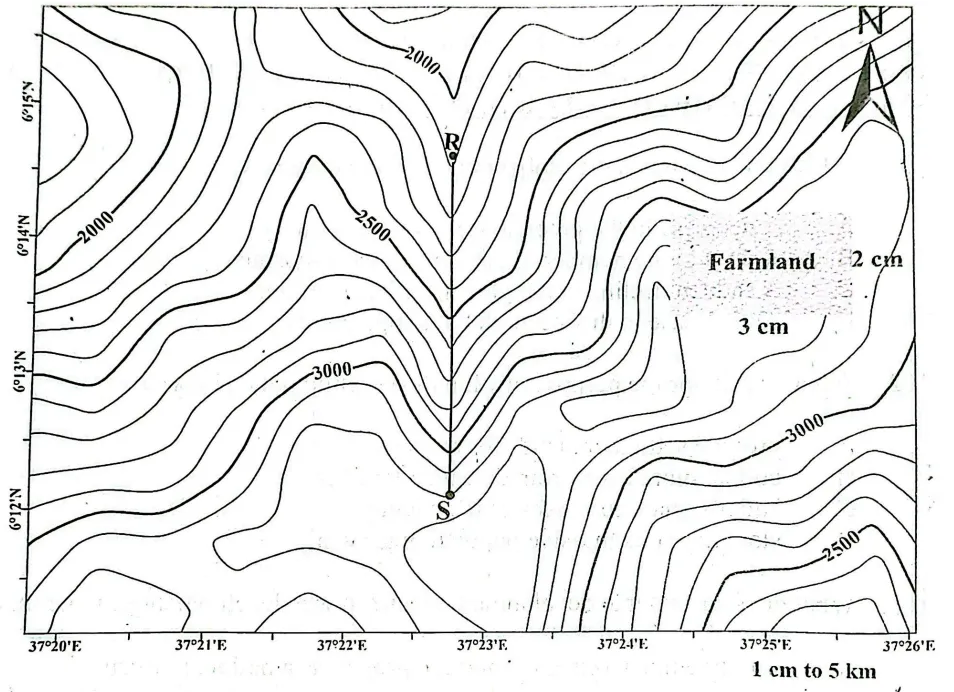
QUESTIONS 93 AND 94 ARE BASED ON THE ATTACHED MAP.

(image)

QUESTIONS 89-95 SHOULD BE DONE ONLY BY NON-BLIND CANDIDATES

What type of land feature does line 'SR' on the map represent?
Figure for question 93 from the exam paper
  1. A. Saddle
  2. B. Ridge
  3. C. Plateau
  4. D. Valley
Worked solutionUnofficial

Answer: D

Read the contour values: about 2000 m near R, 2500 m in the middle, 3000 m near S. So the land rises from R to S.

The contours crossing SR bend into a V whose point is toward S, the higher end.

When contour V's point uphill, they show a valley (a river would flow down it from S toward R).

If the V's pointed downhill, it would be a ridge (spur).

Answer: D.

Why not A/B/C?

  • A. A saddle is a low point between two hills, shown by two sets of closed contours facing each other, not a line of V's.
  • B. A ridge has contour V's pointing downhill; here they point uphill toward S.
  • C. A plateau is a high flat area with widely spaced contours, not a line of nested V's.

Unofficial — solved by Abrari, not an official EAES key.

Practice this subject

Q94 · Geography

QUESTIONS 93 AND 94 ARE BASED ON THE ATTACHED MAP.

(image)

QUESTIONS 89-95 SHOULD BE DONE ONLY BY NON-BLIND CANDIDATES

What is the ground area of the farmland indicated on the map?
Figure for question 94 from the exam paper
  1. A. 150 km²
  2. B. 100 km²
  3. C. 25 km²
  4. D. 6 km²
Worked solutionUnofficial

Answer: A

Convert each map length to ground length with the scale 1 cm : 5 km.

Length: 3 cm×5=15 km3\text{ cm} \times 5 = 15\text{ km}. Width: 2 cm×5=10 km2\text{ cm} \times 5 = 10\text{ km}.

Area=15 km×10 km=150 km2\text{Area} = 15\text{ km} \times 10\text{ km} = 150\text{ km}^2

Answer: A.

Why not B/C/D?

  • B. 100 km² uses 10 km × 10 km, converting only one side correctly.
  • C. 25 km² squares the scale (5 × 5) instead of converting the map sides.
  • D. 6 km² is the map area in cm² (3 × 2) without applying the scale.

Unofficial — solved by Abrari, not an official EAES key.

Practice this subject

Frequently asked questions

Are these official EUEE past papers?
No. Abrari publishes unofficial practice reconstructed from the study bank for this 2018 E.C. Geography paper. It is not an official EAES or Ministry paper and does not use government logos.
Are the answers official?
No. Letters and worked solutions are unofficial Abrari keys. Verified write-ups are labelled Unofficial. Do not treat them as an official marking scheme.
Is Abrari part of MoE, EAES, MoLS, or OCACC?
No. Abrari is an independent study aid. It is not affiliated with, endorsed by, or an official product of those agencies.
Do I need to pay to practice?
No. The questions on this page are free to read and try. There is no payment step.

Try 5 from this paper