Biology · Entrance exam Q&A · Unofficial

Grade 12 Biology entrance exam questions and answers

Unofficial Grade 12 Biology entrance exam questions from the Abrari study bank. 340 reviewed items across 2018 E.C., 2017 E.C., 2016 E.C., 2015 E.C. are in this subject. A sample with unofficial answers and explanations is on this page — practise the rest online. Not a government paper.

340 unofficial Biology questions in the public bank

2018 E.C. Biology questions

Unofficial stems, answers, and explanations from the Abrari bank. Years use the Ethiopian calendar.

Q1 · Carbohydrates

Which of the following is a major carbohydrate found in plants that humans cannot digest?
  1. A. Glycogen
  2. B. Fructose
  3. C. Cellulose
  4. D. Maltose
Worked solutionUnofficial

Unofficial keyed letter C. A full worked solution is not published for this item yet.

Unofficial — solved by Abrari, not an official EAES key.
Practice this subject

Q2 · Lipids

Which of the following best describes the difference between saturated and unsaturated fatty acids?
  1. A. Saturated fatty acids have one or more double bonds between carbon atoms, while unsaturated fatty acids have only single bonds.
  2. B. Saturated fatty acids are typically found in plants, while unsaturated fatty acids are found in animals.
  3. C. Saturated fatty acids have no double bonds between carbon atoms, while unsaturated fatty acids have one or more double bonds.
  4. D. Saturated fatty acids are liquid at room temperature, while unsaturated fatty acids are solid.
Worked solutionUnofficial

Unofficial keyed letter C. A full worked solution is not published for this item yet.

Unofficial — solved by Abrari, not an official EAES key.

Practice this subject

Q3 · Digestive system

What is the role of bile in digestion?
  1. A. It breaks down proteins in the stomach.
  2. B. It emulsifies fats, breaking them down into smaller droplets.
  3. C. It helps to digest carbohydrates in the small intestine.
  4. D. It neutralizes the acid from the stomach to make the food alkaline.
Worked solutionUnofficial

Unofficial keyed letter B. A full worked solution is not published for this item yet.

Unofficial — solved by Abrari, not an official EAES key.
Practice this subject

Q4 · Digestive system

Which part of the digestive system is responsible for producing enzymes that digest carbohydrates, proteins, and fats?
  1. A. Stomach
  2. B. Small intestine
  3. C. Pancreas
  4. D. Liver
Worked solutionUnofficial

Unofficial keyed letter C. A full worked solution is not published for this item yet.

Unofficial — solved by Abrari, not an official EAES key.
Practice this subject

Q5 · Respiratory system

Which structure separates the thoracic cavity from the abdominal cavity and plays a key role in breathing?
  1. A. Larynx
  2. B. Diaphragm
  3. C. Trachea
  4. D. Bronchi
Worked solutionUnofficial

Unofficial keyed letter B. A full worked solution is not published for this item yet.

Unofficial — solved by Abrari, not an official EAES key.
Practice this subject

Q6 · Anaerobic respiration

What is the main product of anaerobic respiration in muscle cells during vigorous exercise?
  1. A. Lactic acid
  2. B. Ethanol
  3. C. Oxygen
  4. D. Carbon dioxide
Worked solutionUnofficial

Unofficial keyed letter A. A full worked solution is not published for this item yet.

Unofficial — solved by Abrari, not an official EAES key.
Practice this subject

Q7 · Anaerobic respiration

Which of the following best describes the process of fermentation in yeast cells?
  1. A. Yeast cells use oxygen to break down glucose and produce ATP, water, and carbon dioxide.
  2. B. Yeast cells break down glucose without oxygen, producing ethanol and carbon dioxide.
  3. C. Yeast cells produce ATP by converting lactic acid into energy.
  4. D. Yeast cells use lactic acid as the main energy source in the absence of oxygen.
Worked solutionUnofficial

Unofficial keyed letter B. A full worked solution is not published for this item yet.

Unofficial — solved by Abrari, not an official EAES key.
Practice this subject

Q8 · Blood and circulation

Which of the following statements about red blood cells is true?
  1. A. Red blood cells have a nucleus and live for about 10-20 days.
  2. B. Red blood cells are shaped as biconcave discs, which gives them a large surface area for oxygen exchange.
  3. C. Red blood cells are responsible for fighting infections in the body.
  4. D. Red blood cells are made in the liver and transport carbon dioxide around the body.
Worked solutionUnofficial

Unofficial keyed letter B. A full worked solution is not published for this item yet.

Unofficial — solved by Abrari, not an official EAES key.
Practice this subject

Q9 · Blood and circulation

In the ABO blood group system, which blood type can receive blood from any of the four ABO blood types?
  1. A. Type A
  2. B. Type B
  3. C. Type AB
  4. D. Type O
Worked solutionUnofficial

Unofficial keyed letter C. A full worked solution is not published for this item yet.

Unofficial — solved by Abrari, not an official EAES key.

Practice this subject

Q10 · Bacteria

Which of the following is NOT a characteristic of bacteria?
  1. A. Bacteria are single-celled organisms.
  2. B. Bacterial cells contain a nucleus to store genetic material.
  3. C. Bacteria can have structures like flagella to help them move.
  4. D. Some bacteria are useful for processes like fermentation and decay.
Worked solutionUnofficial

Unofficial keyed letter B. A full worked solution is not published for this item yet.

Unofficial — solved by Abrari, not an official EAES key.

Practice this subject

10 of 98 unofficial 2018 E.C. questions on this page.

All 2018 E.C. stems: 2018 E.C. Biology (98)

2017 E.C. Biology questions

Unofficial stems, answers, and explanations from the Abrari bank. Years use the Ethiopian calendar.

Q1 · Ethiopian biology institutes

Which one of the following Ethiopian biological research institutes is known for housing a major gene bank in Africa?
  1. A. Addis Ababa University Biology Department
  2. B. Institute of Biodiversity Conservation
  3. C. Aklilu Lemma Institute of Pathobiology
  4. D. Armauer Hansen Research Institute
Worked solutionUnofficial

Unofficial keyed letter B. A full worked solution is not published for this item yet.

Unofficial — solved by Abrari, not an official EAES key.

Practice this subject

Q2 · Microscopy

A grade 12 student marked two dots close to each other using a pen on a piece of paper and observed them under a microscope. The two dots appeared well separated under the microscope. This was due to
  1. A. resolution
  2. B. magnification
  3. C. staining
  4. D. mounting
Worked solutionUnofficial

Unofficial keyed letter A. A full worked solution is not published for this item yet.

Unofficial — solved by Abrari, not an official EAES key.

Practice this subject

Q3 · Cell biology

From the following alternatives select the common features that are found both in animal and plant cells.
  1. A. Cell membrane, nucleus, cytoplasm, lysosome and Golgi apparatus
  2. B. Cell membrane, nucleus, cytoplasm, mitochondria and endoplasmic reticulum
  3. C. Cell membrane, nucleus, cytoplasm, chloroplast and Golgi apparatus
  4. D. Cell membrane, nucleus, cytoplasm, large vacuole and Golgi apparatus
Worked solutionUnofficial

Unofficial keyed letter B. A full worked solution is not published for this item yet.

Unofficial — solved by Abrari, not an official EAES key.

Practice this subject

Q4 · Osmosis / tonicity

A biology teacher grouped his students into two groups and ordered group I to place a slice of potato in hypertonic solution and group II in hypotonic solution. What will happen to the potato slice in group I and group II?
  1. A. turgid while for group II it will be flaccid.
  2. B. haemolyzed while for group II it will be flaccid.
  3. C. flaccid while for group II it will be turgid.
  4. D. turgid while for group II there will be no change.
Worked solutionUnofficial

Unofficial keyed letter C. A full worked solution is not published for this item yet.

Unofficial — solved by Abrari, not an official EAES key.

Practice this subject

Q5 · Nutrition / balanced diet

A man eats only vegetables, beans, banana and orange for one week continuously in his lunch and dinner. For this man, what nutrients are most likely missed in his meal to be a balanced diet?
  1. A. Carbohydrates
  2. B. Lipids
  3. C. Proteins
  4. D. Minerals
Worked solutionUnofficial

Unofficial keyed letter B. A full worked solution is not published for this item yet.

Unofficial — solved by Abrari, not an official EAES key.

Practice this subject

Q6 · Digestion / absorption

Which of the following is correct about the process of digestion or absorption of food in the small intestine?
  1. A. Proteins are converted into amino acids by the action of hydrochloric acid and amylase.
  2. B. Bile emulsifies fats to increase the surface area to make it easier for lipase.
  3. C. Water is reabsorbed into the small intestine and metabolic wastes are excreted.
  4. D. Glucose and non-hydrolyzed starch molecules are absorbed through the lacteal.
Worked solutionUnofficial

Unofficial keyed letter B. A full worked solution is not published for this item yet.

Unofficial — solved by Abrari, not an official EAES key.

Practice this subject

Q7 · Enzymatic digestion / food tests

In an experiment, students wanted to prove that enzymatic digestion begins in the mouth using certain chewed food coated with their own saliva. In order to get a positive result for their experiment, what type of food sample and testing solution should the students use?
  1. A. Potato and iodine solution
  2. B. Meat and Benedict's solution
  3. C. Fish and sodium hydroxide solution
  4. D. Bread and copper sulphate solution
Worked solutionUnofficial

Unofficial keyed letter A. A full worked solution is not published for this item yet.

Unofficial — solved by Abrari, not an official EAES key.

Practice this subject

Q8 · Respiratory gas exchange

Compared to the inhaled air, what are the percentage of nitrogen, oxygen and carbon dioxide gases in exhaled air, respectively?
  1. A. 80%, 16% and 4%
  2. B. 80%, 4% and 16%
  3. C. 16%, 4% and 80%
  4. D. 4%, 16% and 80%
Worked solutionUnofficial

Unofficial keyed letter A. A full worked solution is not published for this item yet.

Unofficial — solved by Abrari, not an official EAES key.

Practice this subject

Q9 · Respiration experiments

Three students carried out different experiments in exhaled air as indicated below. Student I – uses cold glass and blue cobalt chloride paper; Student II – uses ice cubes; Student III – uses tube containing lime solution and straw. Based on their setup, which student plans to demonstrate the presence of water vapour and carbon dioxide, respectively?
  1. A. II and III
  2. B. I and II
  3. C. II and I
  4. D. I and III
Worked solutionUnofficial

Unofficial keyed letter D. A full worked solution is not published for this item yet.

Unofficial — solved by Abrari, not an official EAES key.

Practice this subject

Q10 · Minerals / nutrition

If your body cannot make enough red blood cells, which one of the following mineral-rich foods can correct this problem?
  1. A. Iron-rich food
  2. B. Calcium-rich food
  3. C. Iodine-rich food
  4. D. Sodium-rich food
Worked solutionUnofficial

Unofficial keyed letter A. A full worked solution is not published for this item yet.

Unofficial — solved by Abrari, not an official EAES key.

Practice this subject

10 of 65 unofficial 2017 E.C. questions on this page.

All 2017 E.C. stems: 2017 E.C. Biology (65)

2016 E.C. Biology questions

Unofficial stems, answers, and explanations from the Abrari bank. Years use the Ethiopian calendar.

Q32 · Eye anatomy

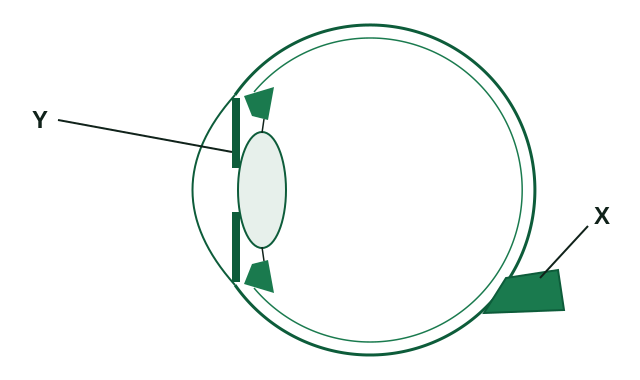
The part of the eye represented by letter 'Y' is
Figure for question 32 from the exam paper
  1. A. iris
  2. B. ciliary muscle
  3. C. optic nerve
  4. D. pupil
Worked solutionUnofficial

Answer: A

The thick cord leaving the back of the eye, labelled X, is the optic nerve.

The Y pointer goes to the dark, pigmented ring that sits just in front of the lens and behind the cornea.

That ring is the iris. It controls how big the pupil is.

The pupil is only the opening in the middle of the iris, and the ciliary muscle sits further out, where the lens is attached to the wall of the eye.

Answer: A.

Why not B/C/D?

  • B. The ciliary muscle sits at the edge of the lens, where it joins the eye wall through the suspensory ligaments. Y points to the pigmented band in front of the lens instead.
  • C. The optic nerve is the structure labelled X, at the back of the eye.
  • D. The pupil is the opening in the centre of the iris, not the pigmented tissue the Y line touches.

Unofficial — solved by Abrari, not an official EAES key.

Practice this subject

Q52 · Pyramid of biomass

This item is based on the following pyramid of biomass. Which alternative contains organisms that can occupy the above pyramid of biomass from the bottom to the top?
Figure for question 52 from the exam paper
  1. A. Grass, Cricket, Chicken and Lizard
  2. B. Grass, Cricket, Lizard and Chicken
  3. C. Grass, Chicken, Cricket and Lizard
  4. D. Grass, Lizard, Cricket and Chicken
Worked solutionUnofficial

Answer: B

A pyramid of biomass is built from a food chain: producer at the bottom, then each consumer that eats the level below.

Grass is the producer, so it is the bottom level.

Crickets eat grass (primary consumer).

Lizards eat insects such as crickets (secondary consumer).

Chickens eat lizards as well as insects, so the chicken is the top (tertiary) consumer.

The chain is Grass → Cricket → Lizard → Chicken.

Answer: B.

Why not A/C/D?

  • A. It puts the chicken below the lizard, but a lizard does not feed on chickens.
  • C. It puts the chicken as the primary consumer eating grass and below the cricket, but crickets do not eat chickens.
  • D. It puts the lizard directly above grass, but lizards do not eat grass, and crickets do not eat lizards.

Unofficial — solved by Abrari, not an official EAES key.

Practice this subject

Q1 · Biotechnology

A transgenic organism is an organism that:
  1. A. can undergo chromosomal non-disjunction
  2. B. replicates its DNA without control
  3. C. has received genetic material of another organism
  4. D. is artificially cultured and harvested
Worked solutionUnofficial

Unofficial keyed letter C. A full worked solution is not published for this item yet.

Unofficial — solved by Abrari, not an official EAES key.

Practice this subject

Q2 · Biosensor technology

Which of the following explains how biology takes part in biosensor technology? Using microorganism to
  1. A. develop vaccines
  2. B. monitor pollutants
  3. C. extract metals from ores
  4. D. produce antibiotics
Worked solutionUnofficial

Unofficial keyed letter B. A full worked solution is not published for this item yet.

Unofficial — solved by Abrari, not an official EAES key.

Practice this subject

Q3 · Industrial microbiology

In a textile industry, microorganism's commercial products play a significant role in removing stains like grease by changing:
  1. A. the temperature of insoluble large stain molecules
  2. B. the acidic or basic nature of the stain molecules
  3. C. the color of stain molecules to another color
  4. D. large insoluble stain molecules into small and soluble ones
Worked solutionUnofficial

Unofficial keyed letter D. A full worked solution is not published for this item yet.

Unofficial — solved by Abrari, not an official EAES key.

Practice this subject

Q4 · Bio-pesticides

Which one of the following statements is correct about application of bio-pesticide in agriculture? It
  1. A. breakdowns glyphosate by an enzyme introduced into plant cell culture.
  2. B. uses bacteria and fungi or their metabolites to kill insects.
  3. C. produces insect resistant crops through modification of the plant genes using bacterial plasmids.
  4. D. produces toxic chemicals by crops through modification of their genes.
Worked solutionUnofficial

Unofficial keyed letter B. A full worked solution is not published for this item yet.

Unofficial — solved by Abrari, not an official EAES key.

Practice this subject

Q5 · Bacteria

Which one of the following statements correctly describes bacteria?
  1. A. They are single celled prokaryotic organisms.
  2. B. They are multicellular eukaryotic organisms.
  3. C. They are single celled eukaryotic organisms.
  4. D. They are multicellular prokaryotic organisms.
Worked solutionUnofficial

Unofficial keyed letter A. A full worked solution is not published for this item yet.

Unofficial — solved by Abrari, not an official EAES key.

Practice this subject

Q6 · Evolution/Gene flow

Gene flow is the movement of genetic material
  1. A. that drives a population towards perfection.
  2. B. without altering the allele frequencies.
  3. C. without affecting the balance of gene pool of a population.
  4. D. where organisms either join or leave a population.
Worked solutionUnofficial

Unofficial keyed letter D. A full worked solution is not published for this item yet.

Unofficial — solved by Abrari, not an official EAES key.

Practice this subject

Q7 · Nervous system

Which one of the following options is a constituent of peripheral nervous system?
  1. A. Somatic sensory nerves, spinal cord and efferent nerves
  2. B. Afferent nerves, brain and automatic motor nerves
  3. C. Afferent nerves, efferent nerves and somatic motor nerves
  4. D. Spinal cord, efferent nerves and somatic sensory nerves
Worked solutionUnofficial

Unofficial keyed letter C. A full worked solution is not published for this item yet.

Unofficial — solved by Abrari, not an official EAES key.

Practice this subject

Q8 · Neuron structure

Which one of the following structures of neurons is correctly paired with its function?
  1. A. Cell body - maintains structure and supply energy
  2. B. Axon - receives signal from muscle
  3. C. Dendrites - protects the neuron and insulate it
  4. D. Myelin sheath - reduces nerve impulse transmission
Worked solutionUnofficial

Unofficial keyed letter A. A full worked solution is not published for this item yet.

Unofficial — solved by Abrari, not an official EAES key.

Practice this subject

10 of 91 unofficial 2016 E.C. questions on this page.

All 2016 E.C. stems: 2016 E.C. Biology (91)

2015 E.C. Biology questions

Unofficial stems, answers, and explanations from the Abrari bank. Years use the Ethiopian calendar.

Q9 · DNA replication

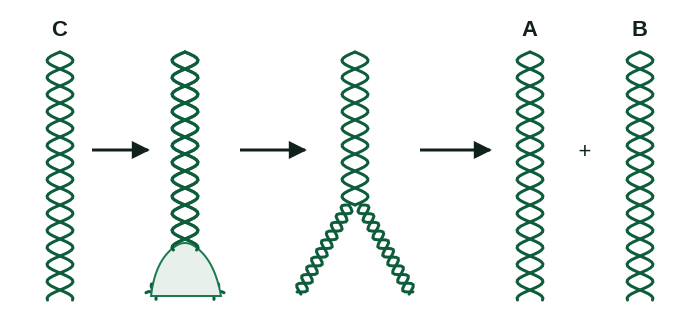
Consider the following model of DNA replication. Which one of the following is true about A, B and C?
Figure for question 9 from the exam paper
  1. A. A and B are identical with each other but not with C.
  2. B. C is not identical with A and B.
  3. C. B and C are not identical with each other.
  4. D. A, B and C are identical with each other.
Worked solutionUnofficial

Answer: D

The figure shows one DNA molecule (C) unwinding and being copied into two molecules (A and B). DNA replication is semiconservative: each parent strand acts as a template, and complementary base pairing (A–T, G–C) builds a new partner strand. So each daughter molecule has one old strand and one new strand, and its base sequence is exactly the same as the parent's. Therefore A, B and C all carry the same base sequence; they are identical to each other. Answer: D.

Why not A/B/C?

  • A. A and B are copies of C made by complementary base pairing, so they are also identical with C.
  • B. C is the template from which A and B were copied, so it has the same sequence as both.
  • C. B and C have the same base sequence because B was copied from C.

Unofficial — solved by Abrari, not an official EAES key.

Practice this subject

Q40 · Biomolecule identification

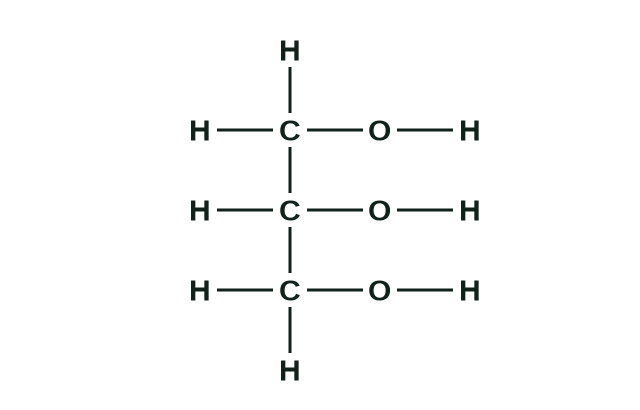
This item is based on the following diagram which depicts structural formula of a biological molecule. [Identify the molecule.]
Figure for question 40 from the exam paper
  1. A. cellulose.
  2. B. amylopectin.
  3. C. fatty acid.
  4. D. glycerol.
Worked solutionUnofficial

Answer: D

Count the parts of the molecule: a chain of 3 carbons, and each carbon has one −OH-OH group.

That gives CH2OH−CHOH−CH2OH\text{CH}_2\text{OH}-\text{CHOH}-\text{CH}_2\text{OH}, which is C3H8O3\text{C}_3\text{H}_8\text{O}_3.

A three-carbon alcohol with three −OH-OH groups is glycerol (propane-1,2,3-triol), the backbone of fats.

It has no −COOH-COOH group, so it is not a fatty acid, and it is not a ring sugar, so it is not a polysaccharide.

Answer: D.

Why not A/B/C?

  • A. Cellulose is a long polymer of ring-shaped glucose units, not a three-carbon chain.
  • B. Amylopectin is a branched polymer of ring-shaped glucose units, not a small three-carbon molecule.
  • C. A fatty acid has a long hydrocarbon chain ending in a -COOH group; this molecule has three -OH groups and no carboxyl group.

Unofficial — solved by Abrari, not an official EAES key.

Practice this subject

Q48 · Respiration / breathing model

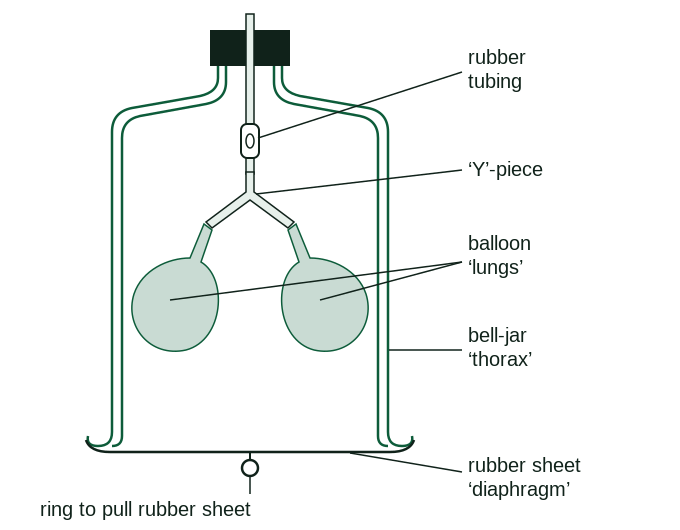
Consider the bell-jar model representing the lung. Which of the following breathing movements happens when air enters into and exits from the balloon lungs?
Figure for question 48 from the exam paper
  1. A. Air enters when the bell-jar thorax contracts.
  2. B. Air enters when the rubber sheet is pushed up.
  3. C. Air exits when Y-piece is rotated both clock wise and counter-clockwise.
  4. D. Air exits when the balloon lungs have higher pressure than the external environment.
Worked solutionUnofficial

Answer: D

Air always moves from higher pressure to lower pressure.

When the rubber sheet is pulled down, the volume inside the jar increases, the pressure around the balloons falls, and air flows in, so the balloons inflate (inhalation).

When the sheet is pushed up (or released), the jar volume decreases, the pressure inside the balloons becomes higher than the outside air, and air flows out (exhalation).

The glass bell jar is rigid, so it cannot contract, and turning the Y-piece does nothing to the pressure.

So air leaves the balloons when the pressure in them is higher than outside.

Answer: D.

Why not A/B/C?

  • A. The bell jar is rigid glass and cannot contract; in this model only the rubber sheet changes the volume.
  • B. Pushing the rubber sheet up makes the volume smaller and raises the pressure, so air leaves the balloons instead of entering them.
  • C. Turning the Y-piece does not change the volume or pressure, so it does not move air in or out.

Unofficial — solved by Abrari, not an official EAES key.

Practice this subject

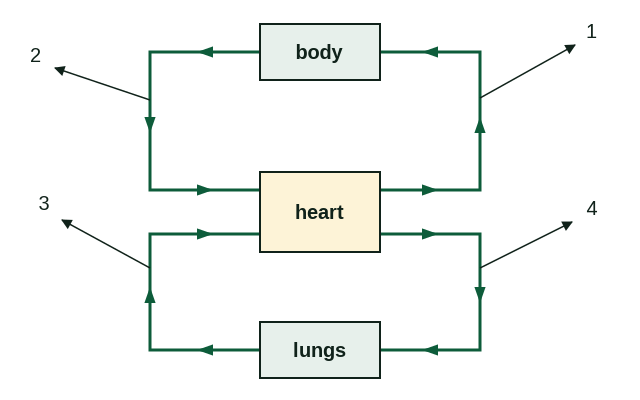
Q51 · Circulatory system / blood vessels

In the diagram showing blood circulation system, the parts indicated by numbers 1, 2, 3 and 4 are respectively
Figure for question 51 from the exam paper
  1. A. aorta, vena cava, pulmonary vein, pulmonary artery.
  2. B. pulmonary artery, pulmonary vein, vena cava, aorta.
  3. C. pulmonary vein, aorta, vena cava, pulmonary artery.
  4. D. vena cava, pulmonary artery, aorta, pulmonary vein.
Worked solutionUnofficial

Answer: A

Follow the arrows in each loop.

  • Vessel 1 takes blood from the heart to the body. The artery leaving the heart for the body is the aorta.
  • Vessel 2 brings blood from the body back to the heart. This is the vena cava.
  • Vessel 3 brings blood from the lungs back to the heart. Oxygen-rich blood returns in the pulmonary vein.
  • Vessel 4 takes blood from the heart to the lungs. This is the pulmonary artery.

So 1, 2, 3, 4 are aorta, vena cava, pulmonary vein, pulmonary artery.

Answer: A.

Why not B/C/D?

  • B. It names vessel 1 the pulmonary artery, but vessel 1 goes to the body, not the lungs.
  • C. It swaps the roles: vessel 1 leaves the heart, so it cannot be a vein, and vessel 2 enters the heart, so it cannot be the aorta.
  • D. It reverses the flow, calling the vessel that leaves the heart for the body the vena cava.

Unofficial — solved by Abrari, not an official EAES key.

Practice this subject

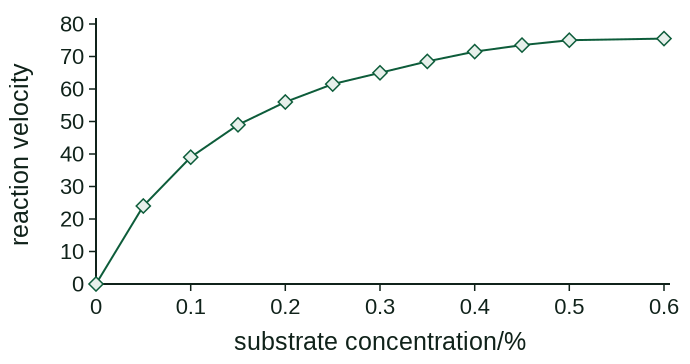
Q72 · Enzymes / graph interpretation

From the graph showing rate of catalase reaction at different substrate concentrations, we can conclude that catalase was functional with its minimum turnover rate from substrate concentration of
Figure for question 72 from the exam paper
  1. A. 0.4 to 0.5.
  2. B. 0.1 to 0.2.
  3. C. 0.5 to 0.6.
  4. D. 0.3 to 0.4.
Worked solutionUnofficial

Answer: C

Read how much the reaction velocity changes over each concentration interval given in the options.

  • 0.1 to 0.2%: velocity rises from about 39 to 56 (a rise of about 17).
  • 0.3 to 0.4%: from about 65 to 71.5 (a rise of about 6.5).
  • 0.4 to 0.5%: from about 71.5 to 75 (a rise of about 3.5).
  • 0.5 to 0.6%: from about 75 to 75.5 (almost no rise).

Between 0.5% and 0.6% the curve is flat. Every active site of catalase is already busy (the enzyme is saturated), so adding more substrate gives the smallest change in turnover rate.

Answer: C.

Why not A/B/D?

  • A. From 0.4 to 0.5% the velocity still rises by about 3.5 units, so the enzyme is not yet at its plateau.
  • B. From 0.1 to 0.2% the curve is steepest; velocity changes the most here, not the least.
  • D. From 0.3 to 0.4% the velocity still rises by about 6.5 units, so the rate is still changing noticeably.

Unofficial — solved by Abrari, not an official EAES key.

Practice this subject

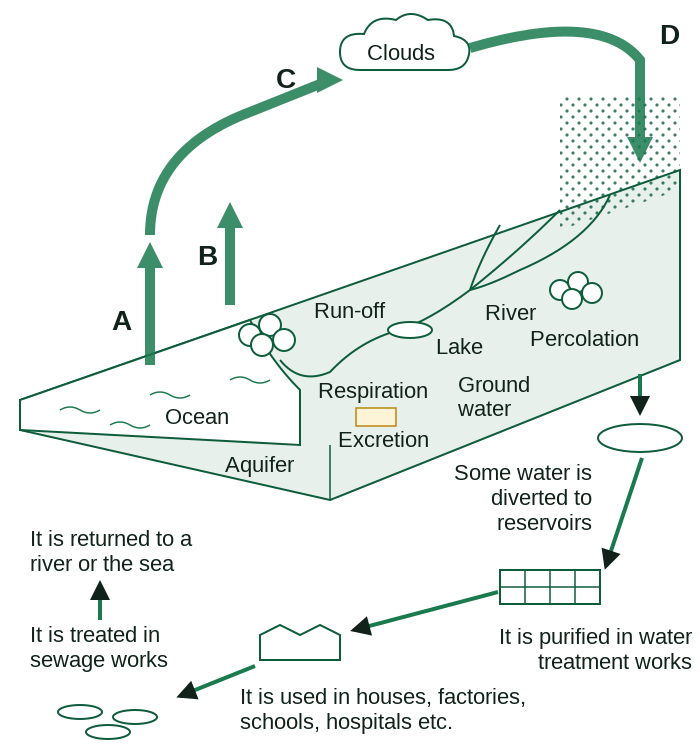
Q79 · Water cycle

In the diagram depicting the water cycle, the letters A, B, C and D respectively represent:
Figure for question 79 from the exam paper
  1. A. evaporation, transpiration, condensation, precipitation.
  2. B. evaporation, precipitation, transpiration, condensation.
  3. C. evaporation, transpiration, precipitation, condensation.
  4. D. evaporation, precipitation, condensation, transpiration.
Worked solutionUnofficial

Answer: A

Arrow A rises from the ocean: water turning to vapour from open water is evaporation. Arrow B rises from the land where the plants are: water vapour lost from plant leaves is transpiration. Arrow C carries the rising vapour up to the clouds: vapour cooling to form cloud droplets is condensation. Arrow D comes down from the clouds over the rain area: water falling as rain is precipitation. So A, B, C, D = evaporation, transpiration, condensation, precipitation. Answer: A.

Why not B/C/D?

  • B. This puts precipitation at B, but B rises up from the land; rain falls down from clouds, which is D.
  • C. This swaps C and D: C leads into the clouds (condensation) and D falls from them (precipitation).
  • D. This puts transpiration at D, but D is the downward arrow from the clouds, which is precipitation.

Unofficial — solved by Abrari, not an official EAES key.

Practice this subject

Q1 · Circulatory system / heart

Which one of the following sentences is correct about the activities of the heart?
  1. A. The noise of heartbeat one hears through a stethoscope is the sound of valves.
  2. B. As the heart beats blood travels through the arteries with a uniform pressure.
  3. C. Diastole is when the heart muscles contract and force the blood out.
  4. D. Systole is when the heart muscles relax and it fills with blood.
Worked solutionUnofficial

Unofficial keyed letter A. A full worked solution is not published for this item yet.

Unofficial — solved by Abrari, not an official EAES key.

Practice this subject

Q2 · Microbiology / culturing

During culturing micro-organisms, all of the following activities are important EXCEPT
  1. A. tilting the lid of the Petri dish during inoculation.
  2. B. adding distilled water to a sterilized agar
  3. C. sterilizing the inoculating loops.
  4. D. transferring target micro-organisms into an agar medium.
Worked solutionUnofficial

Unofficial keyed letter B. A full worked solution is not published for this item yet.

Unofficial — solved by Abrari, not an official EAES key.

Practice this subject

Q3 · Microbial diseases

Which one of the following diseases can be caused by more than one type of microorganisms?
  1. A. Cholera
  2. B. Gastroenteritis
  3. C. Typhoid
  4. D. Tuberculosis
Worked solutionUnofficial

Unofficial keyed letter B. A full worked solution is not published for this item yet.

Unofficial — solved by Abrari, not an official EAES key.

Practice this subject

Q4 · STIs / disease causes

Which one of the following diseases is correctly explained with its causes or symptoms?
  1. A. Syphilis is caused by Neisseria gonorrhoeae.
  2. B. Gonorrhoea has a burning sensation symptom while urinating.
  3. C. Gonorrhoea is caused by Treponema pallidum.
  4. D. Syphilis has sore ulceration on the genitals as a symptom.
Worked solutionUnofficial

Unofficial keyed letter B. A full worked solution is not published for this item yet.

Unofficial — solved by Abrari, not an official EAES key.

Practice this subject

10 of 86 unofficial 2015 E.C. questions on this page.

All 2015 E.C. stems: 2015 E.C. Biology (86)

Practise the rest of Biology online · Biology model exam · All Biology papers

Grade 12 national exam · Model exam questions · 2016 E.C. all subjects · 2017 E.C. all subjects · 2018 E.C. all subjects · All past papers · Practice online

Frequently asked questions

Are these official Grade 12 Biology exam questions?
No. They are unofficial practice reconstructed from the Abrari study bank. Abrari is not affiliated with MoE, EAES, or NEAEA and does not publish official keys.
Are the answers official?
No. Letters and worked solutions are unofficial Abrari keys. Do not treat them as an official marking scheme.
Why is only a sample on this page?
This page shows a sample grouped by year. Open a year paper or start Biology practice to work the rest of the bank, timed, with the same unofficial explanations.
Do you sell leaked or paid exam papers?
No. Abrari does not host leaked exams, paid bank copies, or official answer keys.